

High-Field Superconducting Magnets
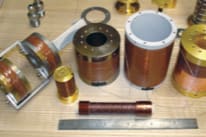 This technology represents a significant improvement over commercial state-of-the-art magnets. These superconducting magnets are very versatile and can be used in a number of applications requiring magnetic fields at low temperature, such as in MRI machines, mass spectrometers, and particle accelerators.
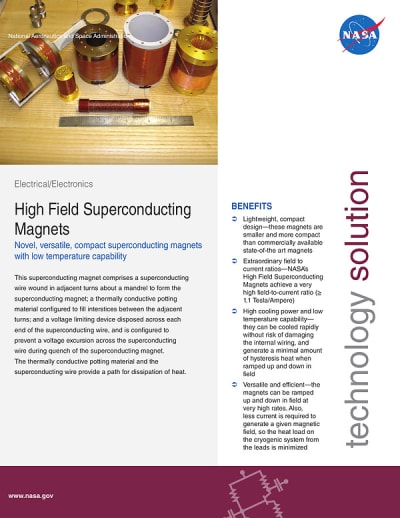
Vision Data Architecture Using Field Programmable Gate Arrays (FPGAs)
Machine vision systems, when implemented with FPGAs, often require complex image processing modules with unique input/output requirements to work together efficiently. This innovation implements an advanced architecture that allows for efficient, multiplexed interfaces and operations for high-performance vision systems used in industrial or hazardous operations robots.
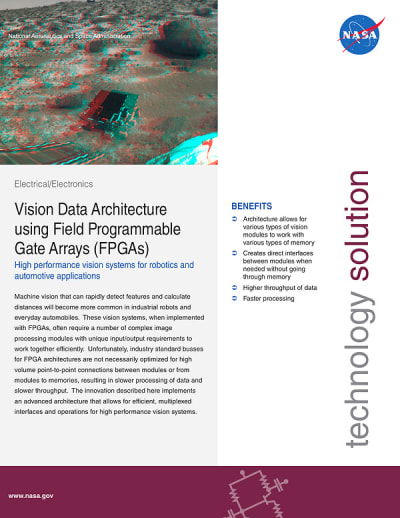
In-Situ Wire Damage Detection and Rerouting System
 This system consists of a miniaturized inline connector containing self-monitoring electronics that use time domain reflectometry to detect wire faults and determine fault type and fault location on powered electrical wiring. When a damaged or defective wire is identified, the system can autonomously transfer electrical power and data connectivity to an alternate wire path.
Overview
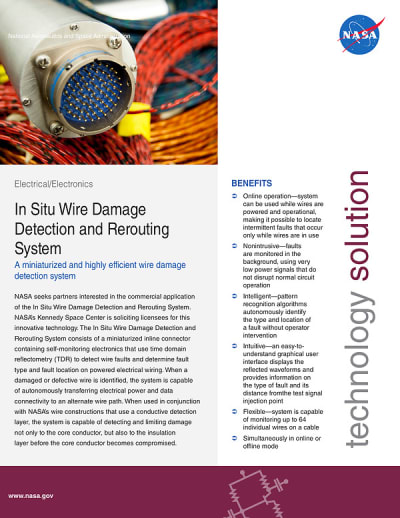
The document outlines NASA's In Situ Wire Damage Detection and Rerouting System, a miniaturized and efficient technology designed to monitor electrical faults in wiring systems across various applications, including aerospace, marine, automotive, industrial, and smart grid wiring. This innovative system operates in both online and offline modes, allowing for real-time monitoring of wires without disrupting their normal operation.
In online mode, the system can detect faults while the wires are powered, identifying intermittent issues that may only occur during operation. In offline mode, it can monitor cables multiple times per second. The system not only detects faults but also classifies them as short, open, or intermittent, and pinpoints their locations. This capability is crucial for addressing intermittent faults before they escalate into more serious problems. A built-in memory device stores relevant fault data, which can be displayed in real-time or retrieved later, facilitating efficient maintenance and repairs.
The technology employs advanced hardware and algorithms to autonomously reroute electrical power and data connectivity from a damaged wire to an alternate path. This process involves a master unit that sends a test pulse down the monitored wire, while a slave unit detects the pulse and communicates back to the master. If the master unit does not receive a response, it identifies the wire as faulty and reroutes the circuit to a spare wire, ensuring continuous operation.
The system's benefits include its nonintrusive nature, as it uses low-power signals that do not disrupt normal circuit operations, and its intelligent design, which utilizes pattern recognition algorithms to identify faults without requiring operator intervention. Additionally, the user interface is intuitive, providing graphical displays of fault waveforms and information about fault types and distances from the test signal injection point.
NASA's Technology Transfer Program is actively seeking partners and licensees for commercial applications of this technology, emphasizing its potential to enhance safety and reliability in various wiring systems while contributing to economic growth and improved quality of life. The document highlights the importance of this technology in modern electrical systems and its role in advancing safety and efficiency in critical applications.







