

Fully Premixed, Low-Emission, High-Pressure, Multi-Fuel Burner
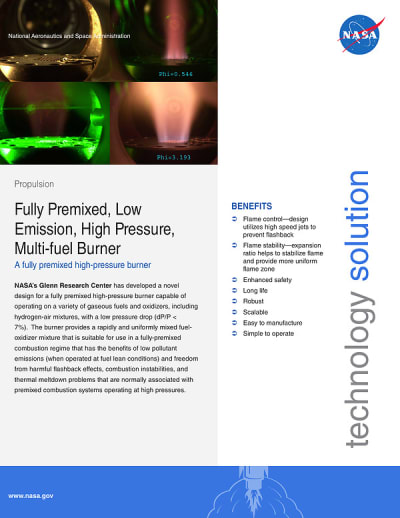
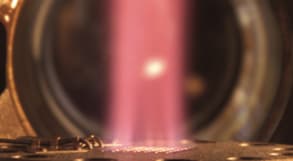 This burner is capable of operating on a variety of gaseous fuels and oxidizers, including hydrogen-air mixtures, with a low pressure drop. The burner provides a rapidly and uniformly mixed fuel-oxidizer mixture that is suitable for use in a fully premixed combustion regime that has the benefits of low pollutant emissions and freedom from harmful flashback effects, combustion instabilities, and thermal meltdown problems.
Non-Pyrotechnic, Zero-Leak, Normally Closed Valves
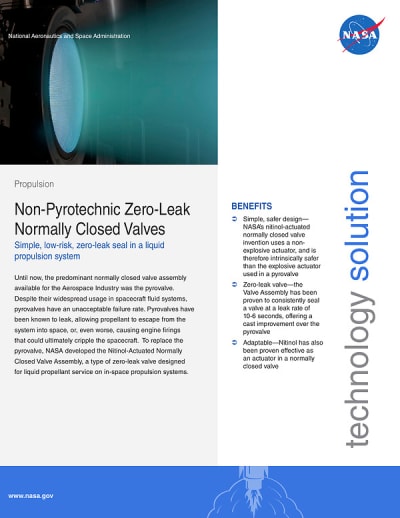
 Until now, the predominant normally closed valve assembly available for the aerospace industry was the pyrovalve, which has an unacceptable failure rate. To replace the pyrovalve, NASA developed the Nitinol-Actuated Normally Closed Valve Assembly, a zero-leak valve designed for liquid propellant service on in-space propulsion systems.
Overview
The document outlines NASA's Technology Transfer Program, which aims to maximize the application of NASA's technological innovations for the benefit of U.S. citizens. Through partnerships and licensing agreements with industry, the program seeks to ensure that NASA's investments in research lead to secondary uses that enhance the economy, create jobs, and improve quality of life.
A key focus of the document is the development of the Nitinol-Actuated Normally Closed Valve Assembly, designed to replace traditional pyrovalves used in liquid propulsion systems. The Nitinol valve is engineered for high-pressure applications (up to 5,000 psi) and low flow, making it suitable for pressurant gas valves in propulsion systems. The valve operates using a Nitinol bar, which is compressed during manufacturing and expands when heated to its transition temperature of 95 °C. This expansion generates a significant recovery force that breaks a titanium seal, allowing flow. Once opened, the valve remains permanently open.
The Nitinol valve offers several advantages over conventional pyrovalves, which have been the standard in aerospace fluid systems. Notably, the Nitinol valve features a non-explosive actuator, making it intrinsically safer than pyrovalves, which can fail and leak propellant into space, potentially crippling spacecraft. The Nitinol valve is also designed to be a zero-leak solution, with a proven leak rate of 10^-6 seconds, significantly improving reliability compared to pyrovalves.
In summary, NASA's Nitinol-Actuated Normally Closed Valve Assembly represents a significant advancement in aerospace technology, providing a safer, more reliable, and adaptable solution for liquid propulsion systems. This innovation not only enhances the performance of spacecraft but also exemplifies NASA's commitment to transferring technology for broader societal benefits. The document emphasizes the importance of such advancements in ensuring the safety and efficiency of space exploration while contributing to economic growth and job creation in the U.S.







