

A report discusses the concept of goal-based fault tolerance as implemented in NASA’s Mission Data System (MDS), which is a developmental architecture for unified flight, test, and ground software that is intended to be adaptable to a variety of next-generation deep-space missions. In goal-based fault tolerance, unlike in prior approaches to fault tolerance, it is not assumed that faults that necessitate deviations from prescribed sequences of commands will occur infrequently; instead, it is assumed that unpredictable conditions, including faults, can arise at any time, and fault tolerance is incorporated as an intrinsic feature of every aspect of system design in a unified approach to ensuring robust system behavior.
This work was done by Daniel Dvorak, Erann Gat, Kim Gostelow, Robert Rasmussen, and Steve Chien of Caltech for NASA’s Jet Propulsion Laboratory. To obtain a copy of the report, “Goal Based Fault Tolerance for Space Systems Using the Mission Data System,” access the Technical Support Package (TSP) free on-line at www.nasatech.com/tsp under the Information Sciences category.
This software is available for commercial licensing. Please contact Don Hart of the California Institute of Technology at (818) 393-3425. Refer to NPO-21176.
This Brief includes a Technical Support Package (TSP).
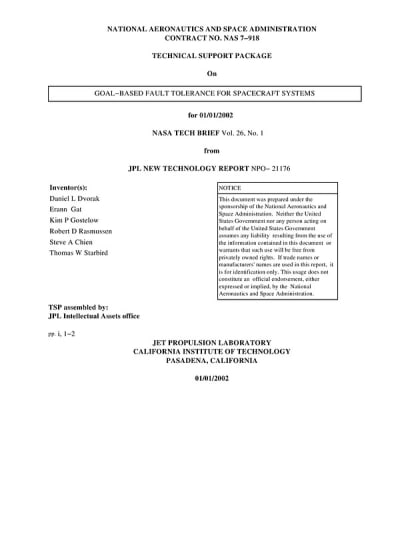
Goal-Based Fault Tolerance for Spacecraft Systems
(reference NPO-21176) is currently available for download from the TSP library.
Don't have an account?
Overview
The document titled "Goal-Based Fault Tolerance for Spacecraft Systems" presents a comprehensive overview of an innovative approach to fault tolerance in NASA's Mission Data System (MDS). Developed by a team from Caltech's Jet Propulsion Laboratory, this system is designed to support next-generation deep-space missions by providing a unified architecture for flight, test, and ground software.
Traditional fault tolerance methods often assume that faults occur infrequently and can be managed through predefined sequences of commands. In contrast, the goal-based fault tolerance approach recognizes that unpredictable conditions, including faults, can arise at any time. This paradigm shift incorporates fault tolerance as an intrinsic feature of the system's design, ensuring robust behavior across all operational scenarios.
The MDS employs a goal-based closed-loop control mechanism, allowing autonomous systems to plan and execute actions based on the current state of the environment and the system itself. This state encompasses all relevant values and uncertainties that characterize both the operational context and the physical condition of the spacecraft. By focusing on achieving specified goals rather than merely following commands, the MDS enhances the adaptability and reliability of spacecraft operations.
The document outlines the novelty of the MDS, highlighting its integration of states and models into key architectural frameworks. This approach not only improves fault tolerance but also simplifies the design and operation of space systems. The system engineering methods supporting this architecture promise to usher in a new era for the design of space systems, particularly in the context of in situ exploration and other scenarios characterized by environmental uncertainty.
The report emphasizes the collaborative effort of the authors, including Daniel Dvorak, Erann Gat, Kim Gostelow, Robert Rasmussen, and Steve Chien, in developing this advanced fault tolerance strategy. The MDS is positioned as a significant advancement in the field, aiming to achieve unprecedented reliability and ease of use in spacecraft operations.
In summary, the document provides a detailed exploration of goal-based fault tolerance in spacecraft systems, showcasing the MDS as a pioneering solution that addresses the complexities of modern space exploration. It underscores the importance of adaptability and robust design in ensuring the success of future deep-space missions.










