Inside this issue
Supplements
Overview
The August 2013 issue of NASA Tech Briefs presents a wealth of information on cutting-edge technologies and innovations across various fields, particularly focusing on advancements in engineering, manufacturing, and automation. This edition highlights several key topics and features that are significant for professionals and enthusiasts in the tech and engineering sectors.
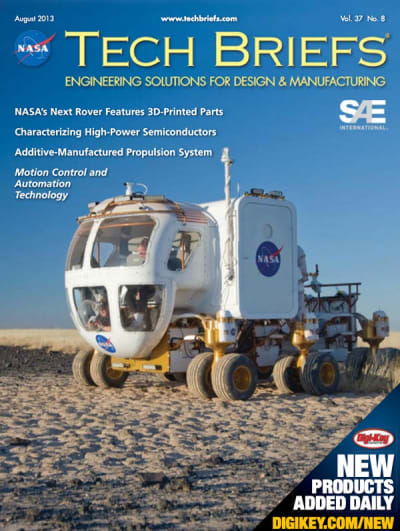
1. NASA Innovations: One of the standout features of this issue is the exploration of NASA's next rover, which is set to utilize 3D-printed parts. This development signifies a major leap in manufacturing techniques, allowing for more efficient and cost-effective production of complex components. The use of additive manufacturing not only reduces waste but also enables rapid prototyping and customization, which are crucial for space exploration missions.
2. High-Power Semiconductors: The issue delves into advancements in high-power semiconductors, which are essential for various applications, including renewable energy systems and electric vehicles. These semiconductors are designed to handle higher voltages and currents, improving efficiency and performance in power electronics. The article discusses the latest materials and technologies that are driving this field forward, emphasizing their potential impact on energy consumption and sustainability.
3. Additive-Manufactured Propulsion Systems: Another significant topic covered is the development of additive-manufactured propulsion systems. This technology is revolutionizing the aerospace industry by allowing for the creation of lightweight, complex geometries that traditional manufacturing methods cannot achieve. The article outlines the benefits of using 3D printing in propulsion systems, including reduced weight, improved performance, and the ability to produce parts on-demand, which is particularly advantageous for space missions.
4. New Products and Technologies: The magazine also features a section dedicated to new products and technologies that are shaping the future of industrial automation. This includes innovations in motion control systems, sensors, and robotics. The articles provide insights into how these technologies are being integrated into manufacturing processes to enhance efficiency, precision, and flexibility. Readers can learn about the latest trends in automation and how they can apply these advancements in their own work environments.
5. Industry Insights: In addition to technical articles, the issue includes insights from industry experts who share their perspectives on the future of technology and engineering. These insights cover a range of topics, from the importance of collaboration between academia and industry to the challenges and opportunities presented by emerging technologies. This section serves as a valuable resource for professionals looking to stay ahead in a rapidly evolving landscape.
6. Subscription and Access Information: For those interested in staying updated with the latest innovations, the magazine provides subscription details. It is published monthly by Tech Briefs Media Group, and subscriptions are available for both domestic and international readers. The magazine also offers single copies for purchase, making it accessible to a wider audience.
7. Free Information Resources: The issue includes links to free information resources, allowing readers to access additional content and technical briefs related to the articles featured in the magazine. This is a great way for professionals to deepen their understanding of specific topics and explore further developments in their areas of interest.
In summary, the August 2013 issue of NASA Tech Briefs is a comprehensive resource for anyone interested in the latest advancements in technology and engineering. With a focus on NASA's innovations, high-power semiconductors, additive manufacturing, and new products in industrial automation, this edition provides valuable insights and information that can inspire and inform professionals across various fields. Whether you are an engineer, researcher, or technology enthusiast, this issue offers a wealth of knowledge that highlights the exciting future of technology.
Features
-
Application Briefs
NASA’s Next Rover Features 3D-Printed Parts
Motors Power NASA’s Interactive Humanoid Tour Guide
Data Management to Support Assembly and Integration of Orion
-
Articles
Using Source Measure Units to Characterize High Power Semiconductors (Part 2)
Using Source Measure Units to Characterize High-Power Semiconductors (Part 1)
Tech Briefs
-
Physical Sciences
Atomic Force Microscope Mediated Chromatography
Spectroscopic Determination of Trace Contaminants in High-Purity Oxygen
CRUQS: A Miniature Fine Sun Sensor for Nanosatellites
On-Chip Microfluidic Components for In Situ Analysis, Separation, and Detection of Amino Acids
Method of Separating Oxygen From Spacecraft Cabin Air to Enable Extravehicular Activities
-
Manufacturing & Prototyping
Additive Manufactured Propulsion System (AMPS) for Small to Micro Cubical Satellites
Bismuth Passivation Technique for High-Resolution X-Ray Detectors
-
Materials
Microgravity Storage Vessels and Conveying-Line Feeders for Cohesive Regolith
High-Strength, Superelastic Compounds
Cu-Cr-Nb-Zr Alloy for Rocket Engines and Other High-Heat- Flux Applications
-
Information Sciences
Sample Analysis at Mars Instrument Simulator
Access Control of Web- and Java-Based Applications
Tool for Automated Retrieval of Generic Event Tracks (TARGET)
Bilayer Protograph Codes for Half-Duplex Relay Channels
Influence of Computational Drop Representation in LES of a Droplet-Laden Mixing Layer
-
Mechanics & Machinery
Radial Internal Material Handling System (RIMS) for Circular Habitat Volumes
Impact-Actuated Digging Tool for Lunar Excavation
Flexible Mechanical Conveyors for Regolith Extraction and Transport
-
Electronics & Computers
Remote Memory Access Protocol Target Node Intellectual Property
Minimal Power Latch for Single-Slope ADCs
Distributed Prognostics and Health Management With a Wireless Network Architecture
Products
-
Applications