

Inside this issue
Supplements
Overview
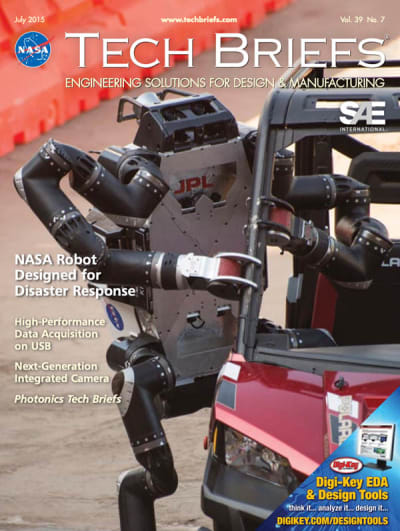
The July 2015 issue of NASA Tech Briefs and Photonics Tech Briefs presents a wealth of information on cutting-edge technologies and innovations in various fields, particularly focusing on advancements in data acquisition, integrated camera systems, and robotics designed for disaster response.
Key Highlights:
-
High-Performance Data Acquisition on USB: This section discusses the latest developments in data acquisition systems that utilize USB technology. These systems are crucial for collecting and analyzing data in real-time, which is essential for various applications, including scientific research, industrial automation, and environmental monitoring. The article emphasizes the importance of high-speed data transfer and the integration of advanced sensors to enhance the performance of these systems.
-
Next-Generation Integrated Cameras: The issue features insights into the evolution of integrated camera systems that are becoming increasingly sophisticated. These cameras are designed to meet the demands of modern applications, such as machine vision, surveillance, and autonomous vehicles. The article highlights advancements in image processing, sensor technology, and connectivity options that enable these cameras to deliver high-quality images and video in real-time.
-
NASA Robot Designed for Disaster Response: A significant focus of this issue is on robotics, particularly a NASA-developed robot tailored for disaster response scenarios. This robot is engineered to assist in search and rescue operations, providing critical support in environments that are hazardous or inaccessible to humans. The article outlines the robot's capabilities, including mobility, sensor integration, and autonomous navigation, which allow it to operate effectively in challenging conditions.
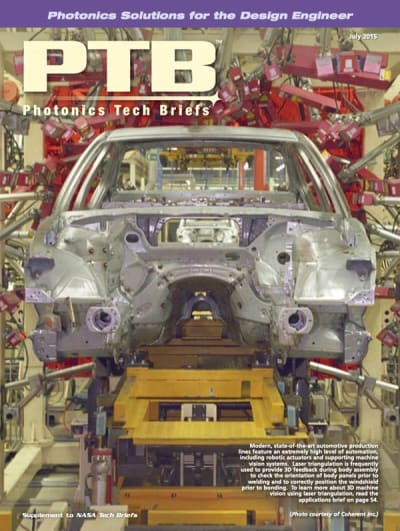
Photonics Solutions for Design Engineers: The magazine also delves into photonics technologies that are essential for design engineers. It discusses the role of laser triangulation in 3D machine vision, particularly in automotive production lines. This technology is used to provide precise feedback during body assembly, ensuring the correct orientation of components before welding and bonding processes. The article emphasizes the significance of photonics in enhancing manufacturing efficiency and product quality.
-
Applications of Laser Triangulation: A detailed applications brief on laser triangulation is included, explaining how this technique is employed in various industries. The article describes the principles of laser triangulation and its advantages in providing accurate 3D measurements. It also highlights case studies where this technology has been successfully implemented, showcasing its impact on improving operational efficiency and reducing errors in manufacturing processes.
-
Editorial and Publisher Information: The issue includes information about the editorial team and the publishing details, ensuring readers are aware of the sources and contributors behind the content. The magazine is published monthly by Tech Briefs Media Group, an SAE International Company, and provides subscription details for interested readers.
-
Advertising and Product Literature: The magazine features an index of advertisers, providing readers with access to additional resources and product literature. This section encourages readers to explore further information on the technologies and solutions presented in the issue.
Conclusion:
The July 2015 issue of NASA Tech Briefs and Photonics Tech Briefs serves as a comprehensive resource for professionals and enthusiasts in the fields of technology, engineering, and robotics. With its focus on high-performance data acquisition, integrated camera systems, and innovative robotic solutions, the issue highlights the ongoing advancements that are shaping the future of these industries. The inclusion of practical applications and case studies further enriches the content, making it a valuable read for anyone interested in the latest technological developments.
Features
-
Application Briefs
System Tests Flight Control of Dream Chaser Spacecraft
Ion Thruster System Powers Spacecraft to Deep-Space Destinations
Tech Briefs
-
Bio-Medical
Intranasal Scopolamine — INSCOP
Microbial Isolates from Research Activities as a Biological Resource
-
Machinery & Automation
Lunar Materials Handling System
Two-Dimensional Dropped Sensor Suite
Controlling Execution Sequence Using Tactile-Classification During Manipulation by a Humanoid Robot
Autonomous Guidance Algorithm to Auto-Pilot Spacecraft in the Vicinity of Primitive Celestial Bodies
-
Manufacturing & Prototyping
All-Organic Electroactive Device Fabricated with Single- Wall Carbon Nanotube Film Electrode
Purifying Hydrogen for a Life Support Process
Low-Pressure Casting of Bulk Metallic Glasses for Gears and Other Applications
-
Information Sciences
Selective Access and Editing in a Database
Integrated Science Instrument Module (ISIM) Reconfigurable Packet Tool
Program Determines When MRO Observations Span More Than One Spacecraft Sequencing Period
Integrated Ground Supported Systems Equation Processor
Build, Assemble, Test (BAT) Planning and Execution Resources Application
-
Electronics & Computers
-
Aerospace
Scientific Balloons as Solar Sails
Non-Thermal, Plasma-Assisted Catalytic Reactor for CO2 Methanation
-
Imaging
Image Processing Software Environment (QuIP)
CubeSat-Compatible, High-Resolution, Thermal Infrared Imager
Fabrication and Imaging Method for Microstructured Photonic Belt Resonator
NASA Vision Workbench (VWB) v3
Flight Proving a Heliophysics Soft X-Ray Imager
Intensity Interferometry Image Recovery
Cameras for All-Sky Meteor Surveillance (CAMS) Version 1.3
Normalized Cross Correlation FPGA Implementation
Advanced Rapid Imaging and Analysis for Monitoring Hazards (ARIA-MH)
Products
-
Briefs
Domain-Engineered Magnesium-Oxide-Doped Lithium Niobate for Lidar-Based Remote Sensing
Fiber-Optic Sensor for Aircraft and Structure Lightning Measurement
-
Applications











