

When NASA and other agencies send landers to Mars and other planets, they rely on existing orbiters to relay the data during the critical entry, descent, and landing (EDL) phase. The current orbiters are aging and there are no current NASA plans to replace them. Future landers have a critical challenge to communicate during a very risky mission phase. The InSight mission will land on Mars in September 2016 with no direct-to-Earth radio link. Instead, Insight expects the Mars Reconnaissance Orbiter (MRO) to be fully functional and placed in an orbit to be in view of the EDL time and place. MRO will take many hours to play back the data to Earth, leaving the project staff without knowledge if their valuable spacecraft has made it safely.
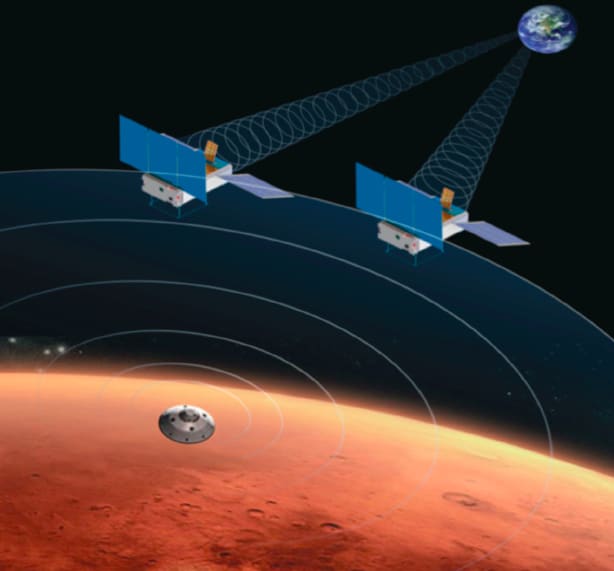
The novelty of this proposed concept is called “carry your own relay.” It solves a very critical communications problem in the robotic solar system exploration for NASA and JPL. New missions, instead of having critical dependencies on other spacecraft to carry out the radio relay process for them, could each carry their own relay, which are low mass, low power, and low cost.
This work directly relates to current and future NASA missions of solar system exploration by solving a communications relay problem. Once demonstrated in space, other future missions requiring relay from any target in the solar system can benefit from this invention, provided the CubeSat can meet the data rate and volume requirements with suitably chosen RF or optical communications technologies. This innovation has applications in future NASA and foreign space agency missions to deep space, especially assets that land (rovers, parachutes, probes) that require a communications relay. With current technology, these CubeSat (or small spacecraft) relay systems are especially applicable to relatively short critical event coverage with relatively low data rate requirements.
This work was done by Sami W. Asmar of Caltech for NASA’s Jet Propulsion Laboratory. NPO-49544
This Brief includes a Technical Support Package (TSP).
Mars Relay CubeSat
(reference NPO-49544) is currently available for download from the TSP library.
Don't have an account?
Overview
The document outlines the Mars Relay CubeSat initiative, specifically focusing on the Mars Cube One (MarCO) mission, which represents the first planetary CubeSat mission developed by NASA's Jet Propulsion Laboratory (JPL) at the California Institute of Technology. The primary goal of the MarCO mission is to provide real-time data relay during the critical entry, descent, and landing (EDL) phase of the InSight mission to Mars, which had a notional arrival date in September 2016.
InSight, unlike previous missions, does not have a direct-to-Earth communication link during its landing, which poses challenges for data transmission. To address this, MarCO was designed to relay EDL data back to Earth, allowing for immediate updates and enhancing the overall mission success. This capability is crucial as it can significantly reduce the time it takes to receive critical information about the landing process, which is typically relayed hours later by the Mars Reconnaissance Orbiter (MRO).
The document emphasizes the strategic advantages of the MarCO mission, highlighting its role in demonstrating the viability of small spacecraft for future missions. By successfully executing this mission, NASA aims to pave the way for more small satellite missions, thereby reducing risks associated with landed missions and fostering innovation in space exploration. The initiative also aims to engage the public and universities, opening new opportunities for scientific research and collaboration.
The document is categorized as pre-decisional information, indicating that it is intended for planning and discussion purposes only. It includes contact information for further inquiries related to research and technology in this area, emphasizing NASA's commitment to technology transfer and the broader implications of aerospace developments.
Overall, the Mars Relay CubeSat initiative exemplifies NASA's leadership in space exploration and its efforts to leverage new technologies to enhance mission capabilities. The MarCO mission not only serves as a technical demonstration but also represents a significant step forward in the use of CubeSats for planetary exploration, potentially transforming how future missions are conducted and how data is communicated from distant worlds.











