An algorithm for analyzing wave reflections and time-of-flight ultrasonic pulse-echo data has been developed for monitoring the health of steam pipes to determine the height of condensed water through the wall in real time, at temperatures up to 250 °C.
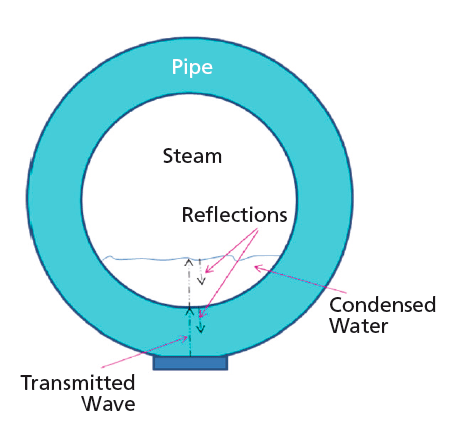
The disclosed algorithm and computer code provide an effective method of analyzing time-of-flight ultrasonic pulse-echo data in nondestructive evaluation (NDE) and health monitoring applications. Such an algorithm is needed to support the determination of the quality and integrity of structures. This includes the ability to detect minute flaws that are critical to secure the operation of NASA structures in service.
There is no existing software that monitors the height of condensed water in steam pipes that are as hot as 250 °C. The data is noisy and complex, and the developed software has been shown to provide accurate determination of the height in real time.
This work was done by Shyh-Shiuh Lih, Yoseph Bar-Cohen, Xiaoqi Bao, and Hyeong Jae Lee of Caltech for NASA’s Jet Propulsion Laboratory.
In accordance with Public Law 96-517, the contractor has elected to retain title to this invention. Inquiries concerning rights for its commercial use should be addressed to:
Innovative Technology Assets Management
JPL
Mail Stop 321-123
4800 Oak Grove Drive
Pasadena, CA 91109-8099
E-mail: This email address is being protected from spambots. You need JavaScript enabled to view it.
Refer to NPO-49048
This Brief includes a Technical Support Package (TSP).
Signal Processing for High-Temperature Health Monitoring of Condensed Water Height in Steam Pipes
(reference NPO49048) is currently available for download from the TSP library.
Don't have an account?
Overview
The document presents a technical disclosure from NASA's Jet Propulsion Laboratory (JPL) regarding a novel signal processing algorithm and computer code developed for monitoring the height of condensed water within steel steam pipes. This technology addresses a critical need for effective health monitoring systems, particularly for aging infrastructure like the steam pipe system in New York City, operated by Consolidated Edison (Con-Edison).
The primary problem tackled by this research is the necessity for a real-time monitoring system that can assess the accumulation of condensed water through the walls of steam pipes without compromising their structural integrity. The system must operate under high temperatures (up to 250°C) and account for factors such as water flow and cavitation. Traditional methods of monitoring often require invasive techniques that can weaken the pipes, making a non-invasive solution essential.
The disclosed algorithm utilizes advanced signal processing techniques, including auto-correlation, Hilbert transform, and Shannon Energy Envelope methods, to analyze time-of-flight ultrasonic pulse-echo data. This approach allows for the detection of small amplitude reflections and complex echo patterns, which are crucial for accurately determining the height of condensed water. The results indicate that the developed method is effective in regular monitoring conditions, and an alternative hybrid method is proposed for scenarios with shallow or no water.
The significance of this work extends beyond immediate applications in steam pipe monitoring; it has implications for NASA's aeronautical and space activities. The ability to assess the integrity of structures is vital for ensuring safety and reliability in aerospace systems. The algorithm can be applied in nondestructive evaluation (NDE) and health monitoring applications, making it a valuable tool for detecting minute flaws that could compromise structural integrity.
Overall, this technical disclosure highlights the innovative contributions of JPL researchers Shyh-Shiuh Lih, Hyeong Jae Lee, Yoseph Bar-Cohen, and Xiaoqi Bao in developing a sophisticated monitoring solution that enhances safety and operational efficiency in both terrestrial and aerospace contexts. The document emphasizes the importance of technology transfer and the potential for broader applications of this research in various industries.