

Inside this issue
Supplements
Overview
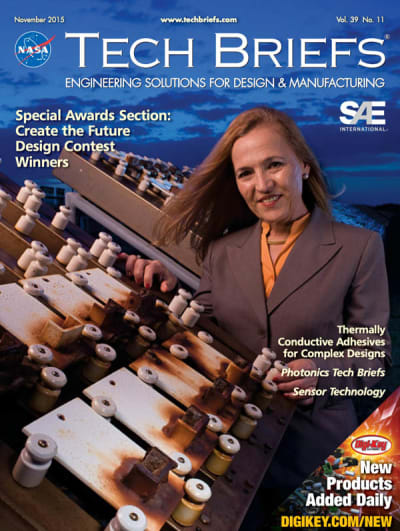
The November 2015 issue of NASA Tech Briefs presents a wealth of information on the latest technological advancements and innovations across various fields, particularly focusing on aerospace and engineering. This edition serves as a platform for showcasing cutting-edge research, practical applications, and emerging technologies that are pivotal for industry professionals, researchers, and enthusiasts alike.
Key Highlights:
-
Innovative Technologies: The issue features articles that delve into new technologies that enhance performance and efficiency in various applications. Notable topics include advancements in thermally conductive adhesives, which are crucial for managing heat in electronic devices and aerospace components. These adhesives are designed to improve thermal management, thereby increasing the reliability and longevity of electronic systems.
-
Sensor Technology: Another significant focus of this issue is on sensor technology. The articles explore the development of advanced sensors that can operate in extreme environments, such as those found in space exploration. These sensors are essential for gathering data and monitoring conditions in real-time, which is vital for the success of missions and the safety of equipment.
-
Robotics and Automation: The magazine also highlights innovations in robotics, particularly the use of robotic systems in manufacturing and assembly processes. The integration of robotics into these processes not only enhances efficiency but also reduces human error, leading to higher quality products. The issue discusses various robotic applications, including automated assembly lines and robotic arms that can perform complex tasks with precision.
-
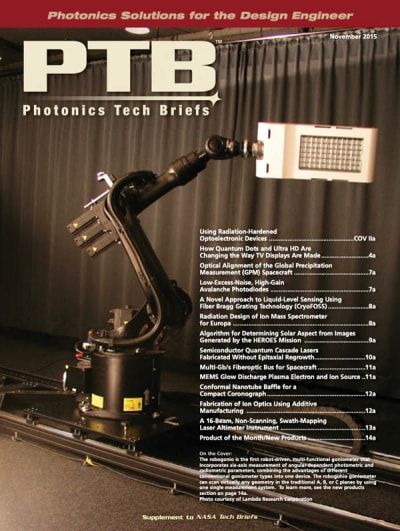
Photonics Innovations: The Photonics Tech Briefs section of the magazine showcases advancements in photonics, including new laser technologies and optical systems. These innovations have applications in telecommunications, medical devices, and manufacturing. The articles emphasize the importance of photonics in driving technological progress and improving existing systems.
Case Studies and Applications: The issue includes several case studies that illustrate the practical applications of the technologies discussed. These real-world examples provide insights into how these innovations are being implemented in various industries, showcasing their impact on efficiency, cost savings, and performance improvements.
-
Expert Insights: The magazine features contributions from industry experts and thought leaders who share their perspectives on the future of technology. These insights provide readers with a deeper understanding of the trends shaping the industry and the challenges that lie ahead.
-
Resources and Tools: In addition to articles, the issue provides readers with access to various resources, including links to free information and tools that can aid in research and development. This includes access to databases, technical papers, and other valuable materials that can support professionals in their work.
-
Publisher and Editorial Team: The issue is published by Joseph T. Pramberger, with contributions from a dedicated editorial team, including Linda L. Bell as the Editorial Director and Bruce A. Bennett as the Editor for Photonics Tech Briefs. Their collective expertise ensures that the content is relevant, accurate, and engaging for the readership.
-
Circulation and Reach: The magazine boasts a significant circulation, with over 116,000 copies distributed, highlighting its reach and influence within the engineering and technology communities. The high percentage of paid subscriptions indicates a strong commitment from readers to stay informed about the latest developments in technology.
-
Conclusion: The November 2015 issue of NASA Tech Briefs is a comprehensive resource for anyone interested in the latest technological advancements in aerospace, engineering, and photonics. With its blend of innovative articles, expert insights, and practical applications, the magazine serves as an essential tool for professionals looking to stay ahead in a rapidly evolving field.
In summary, this issue encapsulates the spirit of innovation and the pursuit of excellence in technology, making it a must-read for those engaged in the fields of engineering, research, and development. Whether you are a seasoned professional or a newcomer to the industry, the insights and information presented in this edition will undoubtedly inspire and inform your work.
Features
-
Application Briefs
Computers Record and Maintain Video and Data on Space Station
Steel Chassis Lets Space Vehicles Traverse Grueling Terrain
Highway Sensor Deployment Gives Valuable Data to ‘Connected’ Drivers
-
Articles
2015 Create the Future Design Contest
2015 Create the Future Design Contest: Grand Prize Winner
2015 Create the Future Design Contest: Aerospace & Defense Category Winner
2015 Create the Future Design Contest: Automotive & Transportation Category Winner
2015 Create the Future Design Contest: Electronics Category Winner
2015 Create the Future Design Contest: Machinery/Automation/Robotics Category Winner
2015 Create the Future Design Contest: Consumer Products Category Winner
2015 Create the Future Design Contest: Medical Category Winner
2015 Create the Future Design Contest: Sustainable Technologies Category Winner
Thermally Conductive Adhesives Bring Specialized Solutions to Complex Design Challenges
LED Lighting Enables Better Sleep and Wake Cycles
Imaging Sensor Eliminates Extraneous Light
Authentication by Heart: Radar's New Role in Biometrics
Finding the Right Custom Magnetic Sensor For Your Application
Tech Briefs
-
Physical Sciences
An Alternative Molecular Sexing Method for the Florida Scrub-jay
Surface Water Ocean Topography (SWOT) Science Simulator
Digital Elevation Model Maker (DEMmaker)
Terrestrial Observation and Prediction System (TOPS)
Characteristics of the Spliced Kennedy Space Center Doppler Radar Wind Profiler Database
-
Machinery & Automation
Autonomous Micro Aerial Vehicle Flight Using Optical Flow and Inertial Cues
Universal Robotically Operated Leave-Behind Gripper
DshellCommon Simulation Framework
Neutrally Buoyant Tank Inspection and Cleaning Robot
Visualization and Introspection for Teleoperation of Robotic Systems
-
Materials
Aerogel-Filled Foam Core Insulation for Cryogenic Propellant Storage
Multifunctional B/C Fiber Composites for Radiation Shielding
Using Black Polyimide/Kevlar as a Metering Structure Multi-Layer Insulation (MLI)
-
Information Sciences
Discovery Through Eigenbasis Modeling of Uninteresting Data
Bar Code Scanner to Supplement Property Inventory Process
Semantic Language and Tools for Reporting Human Factors Incidents
Control Software for Integrated CW Radar Module
Furuno Radar/SureTrak Interface Software
Gravitational Compensation Onboard a Comsat
Open Scheduling and Planning Interface for Exploration (Open SPIFe)
AMMOS-PDS Pipeline Service (APPS) — Label Design Tool (LDT)
Activity Model Problem Translator
Ontological System for Context Artifacts and Resources (OSCAR)
-
Electronics & Computers
Fault Recovery for Multi-Phase Power Converters
Isolated Bidirectional DC Converters for Distributed Battery Energy Applications
Device Accommodating Volume Expansion and Contraction for Water-Ice Phase Change Material Heat Sinks
-
Sensors/Data Acquisition
ATMS Antenna Beam Analysis Software
LabNotes Mobile App for Instrument Control and Data Collection
SMAP SDS Science Processing and Data Management System
Hyperlinked Overview of Piloted Evaluations (HOPE) Web- Based Data Archive
Signal Processing for High-Temperature Health Monitoring of Condensed Water Height in Steam Pipes
Non-Intrusive, On-Line, Simultaneous Multi-Species Impurity Monitor for Hydrogen Gas
X1 Human Interface Detection System (HIDS)
-
Aerospace
Shuttle Orbiter Entry Aero Reconstruction Tool
C++ Aerospace Vehicle Modeling Software
Autonomous Quadrotor Safety System
Spot and Runway Departure Advisor (SARDA)
Two-Phase Airborne Security Search
Blended Cutout Flap for Reduction of Jet-Flap Interaction Noise
Products
-
Briefs
Optical Alignment of the Global Precipitation Measurement (GPM) Spacecraft
Low-Excess-Noise, High-Gain Avalanche Photodiodes
A Novel Approach to Liquid-Level Sensing Using Fiber Bragg Grating Technology (CryoFOSS)
Radiation Design of Ion Mass Spectrometer for Europa
Algorithm for Determining Solar Aspect from Images Generated by the HEROES Mission
Semiconductor Quantum Cascade Lasers Fabricated Without Epitaxial Regrowth
Multi-Gb/s Fiberoptic Bus for Spacecraft
MEMS Glow Discharge Plasma Electron and Ion Source
Conformal Nanotube Baffle for a Compact Coronagraph
Fabrication of Ion Optics Using Additive Manufacturing
A 16-Beam, Non-Scanning, Swath-Mapping Laser Altimeter Instrument











