

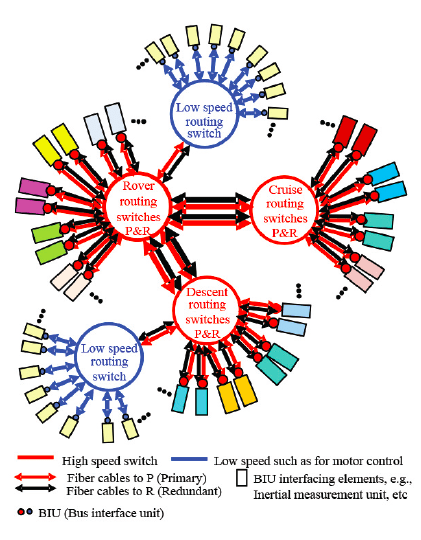
The system enables intra-spacecraft networks with data rate on the order of 10 Gb/s or more, and reduces mass, power, cost, latency, jitter, and integration and test complexity and cost relative to conventional copper buses. This configuration also significantly reduces EMI (electromagnetic interference) and crosstalk, and uniquely supports distributed control, computation, and processing capability.
This work was done by Hamid Hemmati, Yijiang Chen, and Raphael R. Some of Caltech for NASA’s Jet Propulsion Laboratory.
In accordance with Public Law 96-517, the contractor has elected to retain title to this invention. Inquiries concerning rights for its commercial use should be addressed to:
Innovative Technology Assets Management
JPL
Mail Stop 321-123
4800 Oak Grove Drive
Pasadena, CA 91109-8099
E-mail: This email address is being protected from spambots. You need JavaScript enabled to view it.
Refer to NPO-47905.
This Brief includes a Technical Support Package (TSP).
Multi-Gb/s Fiberoptic Bus for Spacecraft
(reference NPO47905) is currently available for download from the TSP library.
Don't have an account?
Overview
The document outlines NASA's Jet Propulsion Laboratory (JPL) project focused on developing a Multi-Gb/s Fiberoptic Bus for spacecraft, aimed at enhancing data transmission capabilities for future missions. The principal investigator, Hamid Hemmati, along with co-investigator Jimmy Chen, leads this initiative, which is documented under NASA Tech Brief NPO-47905.
The project addresses the need for increased onboard data flow, proposing a fiberoptic data transmission layer that can achieve speeds exceeding 2.5 Gb/s, scalable to over 10 Gb/s using the RapidIO protocol. This advancement is crucial for supporting high-bandwidth applications such as synthetic aperture radar (SAR) instruments, multi-spectral imagers, and high-resolution cameras, which are essential for modern space exploration.
Key features of the project include:
-
Increased Throughput: The new system significantly boosts data flow compared to current technologies, which typically operate below 100 Mb/s.
-
Cost Reduction: By simplifying integration and testability, the project aims to lower system integration costs.
-
Reliability Improvements: The design addresses electromagnetic interference (EMI) and crosstalk issues, enhancing overall system reliability.
-
Reduced Complexity: The fiberoptic solution minimizes cabling complexity, mass, and power consumption by at least a factor of three, while also reducing latency to sub-millisecond levels and jitter to sub-nanosecond levels.
-
Environmental Robustness: The technology is designed to withstand harsh environmental conditions, including radiation, thermal extremes, shock, and vibration, making it suitable for missions to Mars and beyond.
The document also highlights the successful demonstration of real-time live camera image transmission through the avionic system, showcasing the integration of both fiberoptic and copper physical layers. A protocol bridge was developed to interface Gigabit Ethernet with the RapidIO protocol, enhancing data transmission capabilities across various system components.
Overall, this project represents a significant advancement in spacecraft communication technology, promising to facilitate more complex and data-intensive missions for NASA and JPL. The fiberoptic-based RapidIO protocol offers mature features such as multi-core computing and topology flexibility, while the 1393 ring bus configuration provides a simple, robust, and reliable interconnect solution, ultimately contributing to reduced complexity, cost, and schedule in spacecraft development.











