

The mercury linear ion trap frequency standard (LITS) at JPL has been demonstrated to have multiple potential applications in NASA deep space missions. An increase of the deep ultraviolet (DUV)/vacuum ultraviolet (VUV) light output from the plasma discharge lamp light source used in trapped ion clock atomic state preparation and detection would improve the clock signal-to-noise ratio (SNR) and decrease optical pumping times. Both lead to an improvement in clock short-term stability and/or enable the use of a local oscillator having lower cost and performance. A solution for higher intensity light generation is needed.
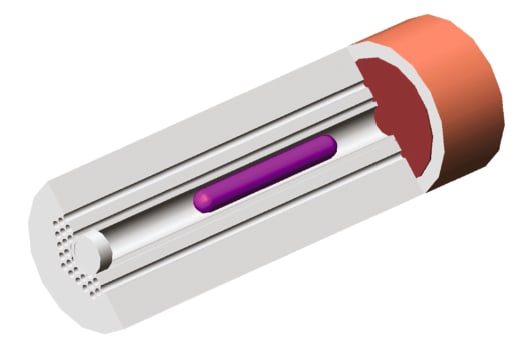
The functionality of mercury micro-plasma generated in a sub-mm scale capillary tube and the associated fiber-based optical interface were previously demonstrated [“Deep UV Discharge Lamps in Capillary Quartz Tubes with Light Output Coupled to an Optical Fiber” (NPO-48845), NASA Tech Briefs, Vol 38, No. 6 (June 2014), p. 55]. This work extends the concept to use hollow-core photonic crystal fiber (HCPCF) in the micro-plasma generation process as a replacement for the capillary tube. An ability to generate, collect, and guide the VUV light with an intensity at least one order of magnitude higher than the capillary lamps has been estimated.
The light of the micro-plasma generated in the capillary lamp is collected via the fiber tip at the end of the capillary. As the length of the capillary increases, less additional light is coupled due to the decrease of collecting (solid) angle.
Using fused quartz with ultra-low loss at 194 nm, HCPCF works at the first order band-gap (low loss) with a plasma diameter of 1 mm. Light generation is simulated at the fiber end for different types of lamp while the length is increased. Due to the fact that HCPCF serves both as a plasma generator and a DUV/VUV waveguide, the light intensity is more than ten times that of the capillary lamp. Furthermore, due to plasma generation within the HCPCF, further improvements can be achieved with longer length.
The HCPCF lamp works at the submillimeter range, where the plasma is categorized as a micro-plasma. The light generated can be applied to trapped mercury ions for optical pumping and detection. Conversely, a trapped ion clock can be used as a spectroscopic probe for the mercury micro-plasma in DUV/VUV wavelengths. The trapped mercury ions provide a well-defined atomic ensemble that is de-coupled from major environmental parameters such as room temperature, magnetic field, etc.
This is the first HCPCF lamp design. It keeps the virtues of the capillary-fiber optical system and provides higher-output light intensity for application to mercury ion clocks. By utilizing this type of HCPCF lamps, the short-term stability of current ground-based trapped ion clocks is expected to improve.
The Hg+ ion trap and the related spectroscopic experimental apparatus may serve as a high-resolution probe to study the micro-plasma physics in HCPCF lamps. This may broaden microplasma applications into fields such as lithography, biotech sensors, medical treatment, environmental monitoring, etc.
This work was done by Lin Yi, Robert L. Tjoelker, Eric A. Burt, and Shouhua Huang of Caltech for NASA’s Jet Propulsion Laboratory.
This invention is owned by NASA, and a patent application has been filed. Inquiries concerning nonexclusive or exclusive license for its commercial development should be addressed to
the Patent Counsel, NASA Management Office–JPL.
Refer to NPO-49310.
This Brief includes a Technical Support Package (TSP).
Hollow-Core Fiber Lamp for Mercury Ion Clocks and Micro-Plasma Studies
(reference NPO-49310) is currently available for download from the TSP library.
Don't have an account?
Overview
The document is a Technical Support Package from NASA's Jet Propulsion Laboratory (JPL) detailing the development of a Hollow-Core Fiber Lamp designed for use in mercury ion clocks and micro-plasma studies. The research aims to create a lamp that operates effectively at vacuum ultraviolet (VUV) and deep ultraviolet (DUV) wavelengths, which are critical for various scientific and technological applications.
The hollow-core photonic crystal fiber (HCPCF) is central to this technology. The document discusses the fusion splicing of HCPCF to a solid-core DUV fiber, which allows for efficient light transmission. The HCPCF is designed to minimize attenuation, with a specific focus on maintaining low loss at VUV/DUV wavelengths. The current commercial HCPCF operates at visible wavelengths, and the document outlines the steps needed to adapt this technology for shorter wavelengths.
To achieve the desired performance, the HCPCF is integrated into a vacuum system using low-emission vacuum glue, ensuring a secure and effective seal. The system is capable of generating micro-plasma by heating a mercury oxide (HgO) reservoir, which produces metallic mercury as needed. An inductive coil RF resonator is employed to excite and sustain the micro-plasma, with the RF generating system capable of delivering up to 180W of RF signal across a frequency range of 20MHz to 500MHz.
The document emphasizes the importance of designing a large hollow-core fiber, with a diameter of at least 500 microns, to enhance light generation. This design consideration is particularly relevant for applications where a single-mode Gaussian beam is not required, allowing for a broader light output.
Overall, the research aims to pave the way for the development of a commercial HCPCF lamp that can operate efficiently at VUV/DUV wavelengths, which could have significant implications for precision timekeeping and other advanced scientific applications. The document serves as a comprehensive overview of the current state of research, the technical challenges involved, and the potential future directions for this innovative technology.











