Inside this issue
Supplements
Overview
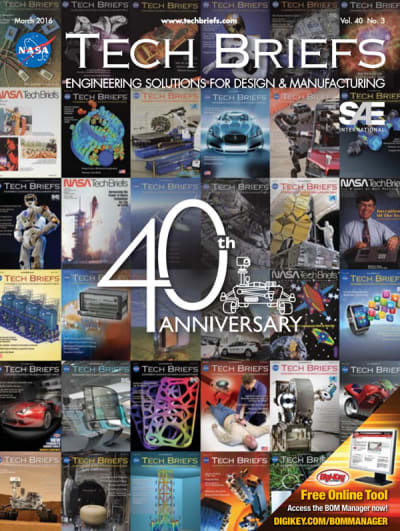
The March 2016 issue of NASA Tech Briefs marks a significant milestone, celebrating 40 years of the magazine's role in disseminating NASA's research and development innovations to the American industry. Since its inception in 1976, NASA Tech Briefs has served as a vital platform for sharing commercially significant technologies developed by NASA, impacting various sectors and enhancing technological advancements.
This special anniversary issue reflects on the past four decades, highlighting key technologies that have emerged from NASA's research efforts. It emphasizes the agency's commitment to innovation and its influence on everyday life, showcasing how NASA inventions have transcended their original purposes to benefit society at large.
The issue features a variety of articles that delve into different technology areas, including advancements in materials science, robotics, and aerospace engineering. Each article provides insights into how these technologies have evolved and their potential future applications. The magazine also includes case studies and success stories that illustrate the practical applications of NASA's innovations in commercial settings.
One of the central themes of this issue is the importance of collaboration between NASA and the private sector. The magazine discusses how partnerships with industry have facilitated the transfer of technology, enabling businesses to leverage NASA's research for commercial gain. This collaboration has not only spurred economic growth but has also led to the development of new products and services that enhance quality of life.
In addition to celebrating past achievements, the issue looks forward to future technological trends and challenges. It addresses the need for continued investment in research and development to maintain the momentum of innovation. The articles encourage readers to consider the implications of emerging technologies, such as artificial intelligence and advanced manufacturing, and how they can be harnessed to solve complex problems.
The magazine also features a special section dedicated to automated testing technologies. This section highlights the shift towards software-oriented solutions that improve testing efficiency and accuracy. It discusses the benefits of automation in reducing human error, speeding up the testing process, and ultimately enhancing product reliability. The articles provide practical insights into implementing automated testing systems in various industries, showcasing real-world examples of successful integration.
Throughout the issue, readers are encouraged to engage with the content through interactive features and links to additional resources. The magazine's user-friendly design allows for easy navigation, making it accessible for both industry professionals and those with a general interest in technology.
In summary, the March 2016 issue of NASA Tech Briefs serves as both a celebration of the magazine's legacy and a forward-looking exploration of the future of technology. It underscores the importance of innovation, collaboration, and the ongoing quest for knowledge that has defined NASA's mission for the past 40 years. As the magazine continues to evolve, it remains a crucial resource for anyone interested in the intersection of space exploration and commercial technology.
Features
-
Application Briefs
Simulation Software is Key to Orion’s Heat-Shield Success
Cryogenic Seal for Space Launch System Handles Extreme Pressure Conditions
-
Articles
NASA-Developed Platform Integrates Sensors with Smartphones
Tech Briefs 40th Anniversary: Executive Perspectives
Executive Perspectives: Data Acquisition & Sensing
Executive Perspectives: Software
Executive Perspectives: Software
Executive Perspectives: Internet of Things
Executive Perspectives: Test & Measurement
Executive Perspectives: Robotics
Executive Perspectives: Software
Tech Briefs
-
Machinery & Automation
Autonomous Flight Termination System Reference Design Hardware
RoboSimian: Software Algorithms for a Mobile Manipulation Quadruped Robot
Robot Task Commander with Extensible Programming Environment
Multi-Spacecraft Autonomous Positioning System/Network-Based Navigation
Heading Versus Tilt Chart for Assessing HGA Occlusion and Flop Risk in MSL Operations
Rapid Forest Triage by Sub-Canopy Micro Air Vehicles
Insertable, Miniature, In-Vivo Surgical Robot with Embedded Control
-
Mechanics & Machinery
Pyrotechnically Actuated Gas Generator Using Aqueous Methanol
Deployable Perimeter Truss with Blade Reel Deployment Mechanism
-
Electronics & Computers
CMOS-Compatible Ohmic Contact RF MEMS Switch
Miller-Jogging for Synthesizer Lock Algorithm Extension
Deployable Antenna Circuit Board Material Design and Fabrication Process
Recurring Anomaly Detection System (ReADS)
Method for Automatic Optimization of Yaw Maneuvers for Orbiting Space Vehicles
Architecture Framework for Fault Management Assessment and Design
Spacecraft Parameter Database Tool
Eliminating the Need for Payload-Specific Coupled Loads Analyses Without Mission Risk
-
Aerospace
Reynolds-Averaged Navier-Stokes Integration for Shock Noise (RISN)
Regeneratively Cooled Porous Media Jacket
Multi-Pulse Motor (MPM) Designed for Use with Electric Solid Propellants
Daily Mesoscale Sea Surface Salinity from Evaporation and Precipitation
Software for Inferring the Aerosol Water and Soot Fractions from Remote Sensing Measurements
Algae Photobioreactor Using Floating Enclosures With Semi-Permeable Membranes
-
Communications
Mini-Stamp as a Micro-Display for At-a-Glance Subsystem Information for DSN Links
Command and Data Handling for the Magnetospheric Multiscale Mission
Products
-
Briefs
Continental-Scale Mapping of Adélie Penguin Colonies from Landsat Imagery
Photogrammetric-Based Pose Initialization and Propagation for Inertial Navigation Systems
Multi-Channel Laser Absorption Spectrometer for Combustion Product Monitoring
Disturbance-Free, High-Resolution Imaging from Space
Hollow-Core Fiber Lamp for Mercury Ion Clocks and Micro-Plasma Studies
3D Imaging Technology and System
Virtual Windows to Supplement Conventional Spacecraft Windows
SCaN Optical Link Assessment Tool Version 2