

Inside this issue
Supplements
Overview
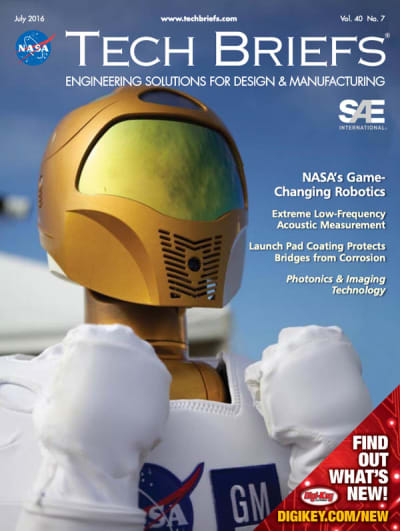
The July 2016 issue of NASA Tech Briefs and Photonics & Imaging Technology presents a wealth of innovative advancements and technologies that are shaping the future of aerospace and imaging. This edition highlights several key topics, including robotics, optical simulation, asteroid detection, and materials science, showcasing the intersection of engineering and technology in addressing complex challenges.
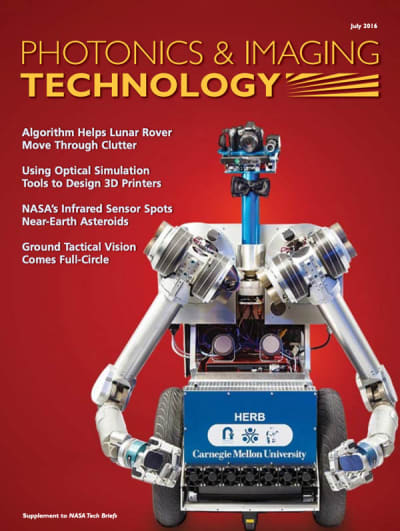
1. Algorithm for Lunar Rover Navigation: One of the standout features of this issue is an article discussing a new algorithm designed to enhance the navigation capabilities of lunar rovers. This algorithm utilizes advanced optical simulation tools to help rovers maneuver through cluttered environments on the lunar surface. By improving the rover's ability to assess its surroundings and make real-time decisions, this technology aims to facilitate more efficient exploration and data collection on the Moon.
2. Optical Simulation Tools for 3D Printers: Another significant topic covered is the use of optical simulation tools in the design and optimization of 3D printers. These tools allow engineers to model and predict the behavior of light within the printing process, leading to improved accuracy and quality of printed objects. The integration of optical simulations can enhance the performance of 3D printers, making them more effective for various applications, from prototyping to manufacturing complex components.
3. NASA’s Infrared Sensor for Asteroid Detection: The issue also features an article on NASA's infrared sensor technology, which is instrumental in spotting near-Earth asteroids. This sensor is designed to detect and track asteroids that could pose a threat to Earth, providing critical data for planetary defense initiatives. The advancements in infrared sensing technology not only enhance our ability to monitor space objects but also contribute to our understanding of the solar system.
4. Ground Tactical Vision Systems: The magazine delves into the development of ground tactical vision systems, which are essential for military and defense applications. These systems utilize advanced imaging technologies to provide real-time situational awareness for ground forces. By integrating various sensors and data processing techniques, these systems enhance the decision-making capabilities of military personnel in complex environments.
5. Protective Coatings for Bridges: In the realm of materials science, the issue discusses innovative launch pad coatings that protect bridges from corrosion. These coatings are designed to withstand harsh environmental conditions, extending the lifespan of infrastructure and reducing maintenance costs. The application of such protective materials is crucial for ensuring the durability and safety of critical structures.
6. Insights from Industry Leaders: The issue features contributions from industry leaders and experts, providing insights into the latest trends and developments in photonics and imaging technology. The editorial team, led by Joseph T. Pramberger and Linda L. Bell, emphasizes the importance of collaboration between academia, industry, and government agencies in driving innovation.
7. Subscription and Access Information: For readers interested in staying updated with the latest advancements, the magazine provides subscription information, including pricing for both domestic and international readers. Digital copies are also available, making it easier for subscribers to access content on various devices.
8. Advertiser Index: The issue includes an advertiser index, allowing readers to easily find product literature and services related to the technologies discussed. This feature enhances the magazine's utility as a resource for professionals seeking to explore new products and solutions in the field.
Conclusion: Overall, the July 2016 issue of NASA Tech Briefs and Photonics & Imaging Technology serves as a comprehensive resource for professionals and enthusiasts in the fields of aerospace, engineering, and imaging technology. By highlighting cutting-edge research and practical applications, the magazine fosters a deeper understanding of the technological advancements that are shaping our world. The combination of innovative algorithms, advanced materials, and sophisticated imaging systems underscores the ongoing commitment to exploration and discovery, paving the way for future breakthroughs in science and technology.
Features
-
Application Briefs
Tech Briefs
-
Test & Measurement
Hermetic Seal Leak Detection Apparatus with Variable Size Test Chamber
Extreme Low Frequency Acoustic Measurement System
Lightweight Internal Device to Measure Tension in Hollow-Braided Cordage
Improved Method to Quantify Leak Rates
Flight Test System for Accurately Predicting Flutter
-
Bio-Medical
Capillary Driven Microorganism Cultivation Platform for Human Life Support
Device and Method for Healing Wounds
Portable Acoustic Holography Systems for Therapeutic Ultrasound Sources
Probiotic Therapy for Astronauts, and During Radiation Therapy
Methods of Manufacturing Bioactive Gels from Extracellular Matrix Material
Multi-Parameter Biodosimetric HemoDose Tools
Soft-Tissue Emulsification Using a Mechanism of Ultrasonic Atomization Inside Gas or Vapor Cavities
-
Physical Sciences
-
Machinery & Automation
-
Software
Method and Apparatus for Generating Flight-Optimizing Trajectories
Team Electronic Gameplay Combining Different Means of Control
Mission Assurance Systems (MAS) Software Used for Engineering Data Sets Across NASA
MATTC Method for Efficient Prediction of Boundary Layer Transition
Google Earth Offline Cache Pre-loader v1 (GEOCP)
Robustness Analysis and Robust Design of Uncertain Systems
XDB3 Extension for Equality and Relational Operators
Simulator for a Self-Stabilizing Synchronization Protocol for Arbitrary Digraphs
Testing Encapsulation of Internet, DTN, and LTP Traffic over AOS Space Data Link Protocol
-
Materials
Method for Exfoliation of Hexagonal Boron Nitride
Sucrose-Treated Carbon Nanotube and Graphene Yarns and Sheets
Method for Manufacturing a Thin Film Structural System
Aromatic Thermosetting coPolyester (ATSP) Composites for High-Temperature and Cryogenic Applications
Ultralow-Temperature-Operable Solid Propellant Binder
Carbon Nanotube-Assisted Microwave Healing of Thermally Re-Mendable Composites
Aluminoborosilicate Supplement for Thermal Protection of a Re-entrant Vehicle
Processing and Manufacture of Inorganic-Organic Hybrid Syntactic Structural Cryogenic Insulator
-
Mechanics & Machinery
Systems, Methods, and Apparatus of a Low-Conductance Silicon Micro-Leak for Mass Spectrometer Inlet
High-Heat-Flux-Capable Boundary Layer Vortex Generator and Boundary Layer Transition Device
GEMINI Stability Control for Reducing Pointing Jitter in CubeSats and Smallsats
-
Electronics & Computers
Polymer Nanofiber-Based Reversible Nano-Switch/Sensor Schottky Diode (nanoSSSD) Device
Method of Fault Detection and Rerouting
Metal Oxide Vertical Graphene Hybrid Supercapacitors
Reconfigurable Drive Current System
System and Method for Transferring Telemetry Data Between a Ground Station and a Control Center
-
Aerospace
System, Apparatus, and Method for Pedal Control
Achieving a Realistic Model of Flight Dynamics and Aeroelasticity of Flexible Aircraft
-
Energy
Method and Circuit for In-Situ Health Monitoring of Solar Cells in Space
Double-acting Extremely Light Thermo-Acoustic (DELTA) Converter
Products
-
Briefs
Smartphone Video Guidance Sensor
A Smooth-Walled Feedhorn with Sub-30-dB Cross-Polarization Over a 30-Percent Bandwidth
Partially Transparent Circular Mask to Suppress Narrowband Laser Light
Large-Area, Polarization-Sensitive Bolometer for Multi-Mode Optics
-
Applications
-
Articles
Using Optical Simulation Tools to Design 3D Printers
Advanced Digital Microscopes Providing Simple Solutions to Common Microscopy Issues











