Inside this issue
Supplements
Overview
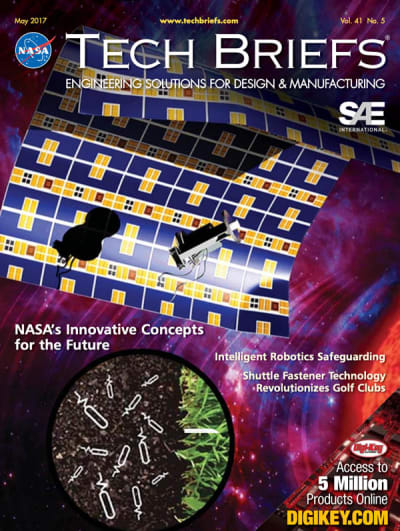
The May 2017 edition of NASA Tech Briefs showcases a variety of innovative concepts and technologies developed by NASA, highlighting advancements that have potential applications in various fields. This issue emphasizes the intersection of space exploration and everyday technology, illustrating how NASA's research can lead to improvements in both specialized and consumer products.
Key Features:
-
Intelligent Robotics: The magazine discusses the advancements in intelligent robotics, focusing on how these technologies can enhance automation and efficiency in various sectors. The article explores the potential for robotics to assist in complex tasks, improve safety, and reduce human error in environments that are hazardous or difficult to navigate.
-
Safeguarding Shuttle Fastener Technology: One of the standout features of this issue is the exploration of shuttle fastener technology. The article details how innovations in fastening systems used in space shuttles can be adapted for use in other industries, such as manufacturing and construction. This technology not only improves the reliability and safety of fasteners but also offers insights into materials and designs that can withstand extreme conditions.
-
Revolutionizing Golf Clubs: The magazine also highlights how NASA's research has influenced the design of golf clubs. By applying aerospace engineering principles, manufacturers have developed golf clubs that enhance performance through improved aerodynamics and materials. This section illustrates the broader impact of NASA's technology transfer initiatives, showing how space research can lead to advancements in sports equipment.
Innovative Partnerships Program: The issue emphasizes NASA's Innovative Partnerships Program, which aims to foster collaboration between NASA and private industry. This program encourages the sharing of technology and expertise, leading to the development of new products and services that benefit both sectors. The magazine provides examples of successful partnerships that have resulted in commercial products derived from NASA's research.
-
Digital Navigation Tools: The digital edition of the magazine includes user-friendly navigation tools, allowing readers to easily access different sections, zoom in on content, and search for specific topics. This enhances the reading experience, making it more interactive and accessible.
-
Editorial Insights: The editorial team, led by Joseph T. Pramberger and Linda L. Bell, provides insights into the importance of innovation in technology and the role of NASA in driving advancements. The editorial emphasizes the need for continued investment in research and development to maintain leadership in technology and exploration.
-
Audience Engagement: The magazine encourages reader engagement through various channels, including subscription options and links to additional resources. This approach fosters a community of readers interested in technology and innovation, allowing them to stay informed about the latest developments in the field.
Conclusion:
The May 2017 issue of NASA Tech Briefs serves as a testament to the ongoing impact of NASA's research on technology and innovation. By showcasing advancements in robotics, fastener technology, and consumer products like golf clubs, the magazine illustrates the far-reaching implications of space exploration on everyday life. The emphasis on partnerships and collaboration highlights the importance of sharing knowledge and resources to drive progress in technology. Overall, this issue not only informs readers about the latest developments but also inspires them to consider the possibilities that arise from the intersection of space research and practical applications.
Features
-
NASA Spinoff
Tech Briefs
-
Software
Open Mission Control Technologies (Open MCT) Web
Human Factors Analysis Support Tool (H-FAST) v 2.0
RAYGUN Fast Generic Geometry Raycasting Tool
LTAS Source Slaving Selector (LS3) Analyzer
Representation and Analysis of System Behavior Using Monotonic Signals
-
Materials
Highly Porous and Mechanically Strong Ceramic Oxide Aerogels
Asymmetric Dielectric Elastomer Composite Material
Method of Creating Micro-Scale Silver Telluride Grains Covered with Bismuth Nanoparticles
Polyimides Derived from Novel Asymmetric Benzophenone Dianhydrides
-
Mechanics & Machinery
Robust, Highly Efficient Oxygen-Carbon Monoxide Cogeneration System
Low Solidity Vaned Diffuser (LSVD) Design for Improvement of Pressure Recovery
-
Electronics & Computers
A Modular Apparatus and Method for Attaching Multiple Devices
-
Sensors/Data Acquisition
Authenticated Sensor Interface Device
Photo-Acoustic Chemical Detector
Ultra-High-Speed Fiber Optic Sensor Detects Structural Damage in Real Time
Piezoelectric Field Disturbance Sensing System and Method
Low-Cost RFID Torque and Tension Sensing Tag System
Low-Power, Special-Purpose Chip for Speech Recognition in Electronics
Method Improves Accuracy of Imaging Data
Automation System Manages Critical Gas Distribution Process
Floating Ultrasonic Transducer Inspection System and Method for Nondestructive Evaluation
-
Communications
Polarization-Dependent Whispering Gallery Modes (WGMs) in Microspheres
Cellular Reflectarray Antenna and Method of Making Same
-
Environment
Methods for Purifying Enzymes for Mycoremediation
-
Propulsion
Green Monopropellant Secondary Payload Propulsion System
Magnetically Conformed, Variable-Area Discharge Chamber for Hall Thruster, and Method
Products
-
Briefs
Development of Sodium Lidar for Spaceborne Missions
Additive-Manufactured, Very Lightweight, Diamond Turned Aspheric Mirror
Partially Transparent Circular Mask to Suppress Narrowband Laser Light
-
Technology Leaders
Using Sensor Fusion to Analyze Laser Processing in Additive Manufacturing
-
Products