Inside this issue
Supplements

Overview
The December 2017 issue of Tech Briefs presents a wealth of information and innovations across various fields of technology and engineering. This edition highlights several key topics, including advancements in product design, autonomous systems, and robotics, as well as trends in hydraulic filtration and the use of origami in engineering applications.
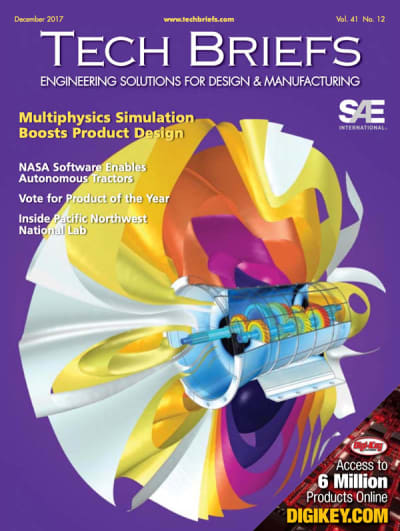
One of the standout features of this issue is the focus on multiphysics simulation, which is increasingly becoming a vital tool in product design. This technology allows engineers to simulate and analyze the interactions between different physical phenomena, such as fluid dynamics, structural mechanics, and thermal effects, all within a single model. By leveraging multiphysics simulation, designers can optimize their products more effectively, leading to improved performance and reduced development time. This approach is particularly beneficial in industries where complex interactions are common, such as aerospace, automotive, and consumer electronics.
Another significant highlight is the introduction of NASA software that enables autonomous tractors. This software is designed to enhance agricultural efficiency by allowing tractors to operate autonomously, reducing the need for human intervention. The technology utilizes advanced algorithms and sensors to navigate fields, optimize planting and harvesting processes, and improve overall crop management. This innovation not only promises to increase productivity but also aims to address labor shortages in the agricultural sector.
The issue also features a section on miniature bearings, which play a crucial role in prolonging the mission of space rovers. These bearings are essential components that allow for smooth movement and operation of various mechanisms within the rover. The article discusses the engineering challenges faced in designing these miniature components to withstand the harsh conditions of space, including extreme temperatures and radiation. The advancements in bearing technology are critical for ensuring the longevity and reliability of rovers as they explore distant planets and moons.
In addition to these highlights, the magazine explores trends in hydraulic filtration. Hydraulic systems are widely used in various applications, from industrial machinery to aerospace systems. The article examines the latest developments in filtration technology, which are essential for maintaining the efficiency and longevity of hydraulic systems. Effective filtration helps prevent contamination, which can lead to system failures and costly repairs. The discussion includes new materials and designs that enhance filtration performance and reduce maintenance requirements.
The issue also delves into the innovative use of origami in creating crawler robots. This fascinating application of origami principles in engineering allows for the design of robots that can change shape and adapt to different environments. The article highlights how these robots can navigate challenging terrains and perform tasks that traditional rigid robots may struggle with. The flexibility and adaptability of origami-inspired designs open up new possibilities for robotics in various fields, including search and rescue operations, environmental monitoring, and exploration.
Additionally, the magazine encourages readers to participate in the Product of the Year voting, showcasing various innovative products that have made significant impacts in their respective fields. This initiative not only recognizes outstanding engineering achievements but also engages the community in celebrating advancements in technology.
Throughout the issue, readers will find a variety of articles, case studies, and insights from industry experts, making it a valuable resource for engineers, designers, and technology enthusiasts. The magazine emphasizes the importance of staying informed about the latest trends and innovations, as these developments can significantly influence future projects and designs.
In summary, the December 2017 issue of Tech Briefs is a comprehensive exploration of cutting-edge technologies and engineering solutions. From multiphysics simulation and autonomous systems to advancements in miniature bearings and hydraulic filtration, this edition provides a rich tapestry of information that highlights the ongoing evolution of technology. The inclusion of innovative applications like origami in robotics further illustrates the creative approaches being taken to solve complex engineering challenges. Overall, this issue serves as an essential resource for professionals looking to stay at the forefront of technological advancements and apply these insights to their work.
Features
-
Application Briefs
Software Helps Optimize World’s Largest All-Composite Aircraft
-
Articles
Vote for Tech Briefs 23rd Annual Readers' Choice Awards
Innovators Recognized for "Creating the Future" 2017
How Multiphysics Simulation and App Deployment Boost Product Design
-
Facility Focus
Tech Briefs
-
Test & Measurement
Handheld Spectral Analyzer for Point-of-Care Diagnostics
On-line Phased Array Ultrasonic Testing (PAUT) System for Friction Stir Welding (FSW)
Apparatus and Method to Test Abrasion Resistance of Material Using Airborne Particulate
Miniature Airborne Particle Mass Monitor
Personal Air Sampler for Collecting Airborne Aerosol Particulates for Molecular Analysis by Size
-
Materials
Rubber Material Enables Scratch-Proof Surfaces
Ultrathin Semiconductor Materials “Rust” to Insulate Circuitry
Sequential/Simultaneous Multi-Metallized Nanocomposites (S2M2N)
Aluminum Alloy for High-Temperature Applications
Multi-Functional Yarns and Fabrics with Anti-Microbial, Anti-Static, and Anti-Odor Characteristics
-
Mechanics & Machinery
Modular Fixturing for Assembly and Welding Applications
Low-Cost, Long-Lasting Valve Seal
Non-Collinear Valve Actuation System
Novel Vent Design Features Variable Flow Control and Rain Protection
Novel Design of an Orifice Control Element
-
Aerospace
Portable Runway Intersection Display and Monitoring System
Networked In-Flight Validation Environment for Air Traffic Management Concepts
Three-Dimensional Radiation Ray-Tracing for Hypersonic Entry Vehicles
Flap Edge Noise Reduction Fins
Separation Assurance Framework for ACES Simulation
-
Imaging
Device-Free Motion Tracing Using WiFi Signals
Detector System for High-Resolution Imaging
Method for Tracking Moving Targets
Method Uses Drones and WiFi to Enable 3D Through-Wall Imaging
-
Communications
System Integrates High-Speed Data and Wireless Power Transfer
Tunable, High-Isolation RF/Microwave Circulator
-
Environment
BOPPERS: Autonomous Underwater Environmental Monitoring System
Electromagnetic Mop (EMop) for Oil Spill Cleanup
Detecting Low-Level Harmful Substances in a Large Volume of Fluid
-
Briefs
Vacuum System Powers Modular Soft Robot
Soft Robotic Gripper Manipulates Objects Without Training
Multi-Legged Robot Reconfigures in Real Time