

A large-area detector without any dead space capable of handling a large dynamic range does not currently exist. Current large-area detectors have dead zones created by abutting several modules together. These detectors are counting detectors, which are good only for low-flux operations. Other integrating detectors currently being developed are also modular assemblies with dead areas, and are expandable in only one direction (as these are only two-side-buttable).
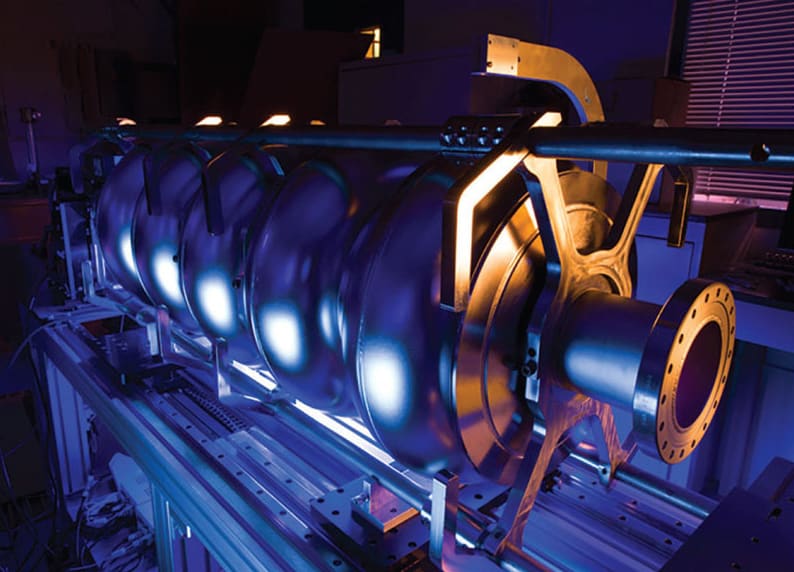
A large-area, high-spatial-resolution camera system was developed for detection of X-rays with pixels capable of handling signals of up to five orders of magnitude dynamic range, and in-situ storage of images acquired at high speed (multi-megahertz frequency).
The High-Resolution X-Ray Camera System is a large-area pixelated detector system up to 20 × 20 cm with small pixel sizes on the order of 100-150 μm (side) without any dead space. Each pixel can integrate a wide dynamic range charge of five orders of magnitude 1 fC to 100 pC from the detector that is equivalent to the range of 1 to 105 photons impinging on a single pixel at a multi-megahertz frequency (6.5 MHz). The system achieves both the required resolution at the low end, and adequate dynamic range with good linearity.
The system consists of three major components: 1) a wafer-scale sensor with approximately one million pixels; 2) a silicon interposer (also called a silicon printed circuit board, or SiPCB) that serves as an interconnection device and pitch adapter between the sensor wafer pixels and a number of smaller readout ASICs; and 3) the custom front-end readout ASIC with a few tens of thousands of pixels that implements a novel design concept to achieve high dynamic range while maintaining both small pixel area and low power dissipation.
The proposed technology is modular; the sensor material can be changed to any material that can be grown in wafer-scale areas, and can collect electrons that can be used for energy ranges beyond that of silicon (few keV up to 8-10 keV).
For more information, contact Aaron G. Sauers at










