

Photovoltaic arrays of the rainbow type, equipped with light-concentrator and spectral-beam-splitter optics, have been investigated in a continuing effort to develop lightweight, high-efficiency solar electric power sources. This investigation has contributed to a revival of the concept of the rainbow photovoltaic array, which originated in the 1950s but proved unrealistic at that time because the selection of solar photovoltaic cells was too limited. Advances in the art of photovoltaic cells since that time have rendered the concept more realistic, thereby prompting the present development effort.
A rainbow photovoltaic array comprises side-by-side strings of series-connected photovoltaic cells. The cells in each string have the same bandgap, which differs from the bandgaps of the other strings. Hence, each string operates most efficiently in a unique wavelength band determined by its bandgap. To obtain maximum energy-conversion efficiency and to minimize the size and weight of the array for a given sunlight-input aperture, the sunlight incident on the aperture is concentrated, then spectrally dispersed onto the photovoltaic-array plane, whereon each string of cells is positioned to intercept the light in its wavelength band of most efficient operation. The number of cells in each string is chosen so that the output potentials of all the strings are the same; this makes it possible to connect the strings together in parallel to maximize the output current of the array.
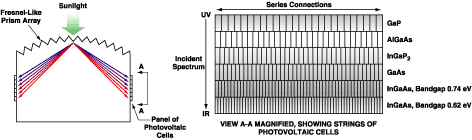
According to the original rainbow photovoltaic concept, the concentrated sunlight was to be split into multiple beams by use of an array of dichroic filters designed so that each beam would contain light in one of the desired wavelength bands. The concept has since been modified to provide for dispersion of the spectrum by use of adjacent prisms. A proposal for an advanced version calls for a unitary concentrator/spectral-beam-splitter optic in the form of a parabolic curved Fresnel-like prism array with panels of photovoltaic cells on two sides (see figure). The surface supporting the solar cells can be adjusted in length or angle to accommodate the incident spectral pattern.
An unoptimized prototype assembly containing ten adjacent prisms and three photovoltaic cells with different bandgaps (InGaP2, GaAs, and InGaAs) was constructed to demonstrate feasibility. The actual array will consist of a lightweight thin-film silicon layer of prisms curved into a parabolic shape. In an initial test under illumination of 1 sun at zero airmass, the energy-conversion efficiency of the assembly was found to be 20 percent. Further analysis of the data from this test led to a projected energy-conversion efficiency as high as 41 percent for an array of 6 cells or strings (GaP, AlGaAs, InGaP2, GaAs, and two different InGaAs cells or strings).
This work was done by Nick Mardesich and Virgil Shields of Caltech for NASA's Jet Propulsion Laboratory.
NPO-21051
This Brief includes a Technical Support Package (TSP).
Advanced Rainbow Solar Photovoltaic Arrays
(reference NPO21051) is currently available for download from the TSP library.
Don't have an account?
Overview
The document discusses the development of Advanced Rainbow Solar Photovoltaic Arrays by NASA's Jet Propulsion Laboratory (JPL). This innovative technology aims to create lightweight, high-efficiency solar electric power sources by utilizing concentrated sunlight and spectral-beam-splitter optics. The concept of rainbow photovoltaic arrays, which dates back to the 1950s, has been revived due to advancements in photovoltaic cell technology that have made it more feasible.
A rainbow photovoltaic array consists of multiple strings of series-connected photovoltaic cells, each with a different bandgap. This design allows each string to operate most efficiently within a specific wavelength band of sunlight. To maximize energy conversion efficiency, sunlight is concentrated and then spectrally dispersed onto the array, ensuring that each string intercepts light in its optimal wavelength range. The output potentials of all strings are matched, enabling them to be connected in parallel to enhance the overall output current of the array.
The document outlines a modified approach to the original concept, which now employs adjacent prisms for spectral dispersion. An advanced version proposes a unitary concentrator/spectral-beam-splitter optic in the form of a parabolic curved Fresnel-like prism array, with photovoltaic cells mounted on both sides. This design allows for adjustments in length or angle to accommodate the incident spectral pattern.
An unoptimized prototype was constructed, featuring ten adjacent prisms and three photovoltaic cells with different bandgaps (InGaP2, GaAs, and InGaAs). Initial tests under standard illumination conditions yielded an energy conversion efficiency of 20 percent, with projections suggesting that an optimized array could achieve efficiencies as high as 41 percent with six different cell types.
The document emphasizes the novelty of this technology, particularly in its ability to control concentrated sunlight through prisms without mixing the spectrum at the solar cell surface. This method enhances efficiency by allowing the use of multiple cells with different bandgaps, which can be connected externally, thus overcoming the area limitations of stacked cells.
Overall, the Advanced Rainbow Solar Photovoltaic Arrays represent a significant step forward in solar technology, promising improved efficiency and reduced weight for solar power systems, making them suitable for various applications, including space exploration.











