Miniature, relatively inexpensive microbioanalytical systems ("laboratory-on-a-chip" devices) have been proposed for the detection of hazardous microbes and toxic chemicals. Each system of this type would include optoelectronic sensors and sensor-output-processing circuitry that would simultaneously look for the optical change, fluorescence, delayed fluorescence, or phosphorescence signatures from multiple redundant sites that have interacted with the test biomolecules in order to detect which one(s) was present in a given situation. These systems could be used in a variety of settings that could include doctors' offices, hospitals, hazardous-material laboratories, biological-research laboratories, military operations, and chemical-processing plants.
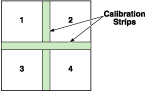
Each system would consist primarily of an integrated circuit or perhaps several integrated circuits packaged together. The system would include (1) a source of optical excitation (e.g., ambient light, superluminescent or laser diode); (2) a photodetector-array circuit of the active-pixel-sensor (APS) type that would be compatible with complementary metal oxide semiconductor (CMOS) circuitry; and (3) on-chip signal- and data-processing circuits for rapid and reliable identification of toxic substances and biomolecules (e.g., antigens) associated with known or general classes of hazardous chemicals, bacteria, and viruses. Each pixel or group of pixels in the APS array would be coated with an antigen-specific optobiochemical reagent or other substance that would change its resultant optical characteristics (i.e., absorption, fluorescence, luminescence, etc.) in response to a biomolecule or hazardous chemical that one seeks to identify. In addition, the array could include strips, bonded directly to the APS surface (see figure), that would produce known temporal and spectral APS outputs for on-chip or off-chip calibration.
In the use of a system of this type, unlike in conventional bioanalytical laboratory practice, the detection of biohazards would not be subject to the limits of visual acuity of human observers and of the resolution of conventional microscopes. Moreover, detection would not be slowed by the need to perform repetitive tedious procedures under sterile laboratory conditions. Instead, it would be possible to simultaneously identify any or all of a large number of different microbial species and/or chemical agents within an analysis time of a few seconds. For example, the number of species and/or chemical agents that could be identified could be as large as a million in the case of a 1,024-by-1,024-pixel APS array.
In a typical analytical procedure, a sample would be dissolved or otherwise suspended in a transport liquid, whereby liquid would be deposited onto the surface of the APS array. After a specified interaction time, the light source (ambient or pulsed) would be sensed and the APS array would be gated so as not to respond to the source light but to respond to the longer-lived fluorescence that would follow the source pulses. The intensity change and/or delayed fluorescence signal from each pixel would be read out and analyzed; the analysis of the signal from each pixel could include correlation with calibration signals and/or with signals from other pixels. In a case in which the response from a pixel could include optical or fluorescence signatures from multiple bioanalytical or fluorescent probes associated with different target molecules of interest, it would be possible to distinguish among them by their position and/or fluorescence lifetimes. For the purpose of measuring fluorescence lifetimes, the light source could be modulated periodically and the reading from each pixel taken at multiple fixed phase delays relative to the optical excitation.
This work was done by Robert Stirbl, Philip Moynihan, Gregory Bearman, and Arthur Lane of Caltech for NASA's Jet Propulsion Laboratory.
NPO-21047
This Brief includes a Technical Support Package (TSP).
Integrated Optoelectronics for Parallel Microbioanalysis
(reference NPO21047) is currently available for download from the TSP library.
Don't have an account?
Overview
The document is a technical support package prepared under the sponsorship of the National Aeronautics and Space Administration (NASA), specifically focusing on Integrated Optoelectronics for Parallel Microbioanalysis. It is part of the NASA Tech Brief, Volume 27, No. 3, and is associated with the Jet Propulsion Laboratory (JPL) at the California Institute of Technology.
The primary aim of the document is to present advancements in optoelectronic technologies that can facilitate parallel analysis in microbiological applications. This research is significant as it addresses the need for efficient and rapid analysis methods in the field of microbiology, which can have implications for various sectors, including healthcare, environmental monitoring, and food safety.
The document outlines the contributions of several inventors: Gregory H. Bearman, Arthur L. Lane, Philip I. Moynihan, and Robert C. Stirbl. Their collaborative efforts have led to the development of innovative techniques and systems that leverage optoelectronic principles to enhance the capabilities of microbioanalysis.
Additionally, the document includes a notice clarifying that references to specific commercial products, processes, or services do not imply endorsement by the U.S. Government or JPL. It emphasizes that the information contained within is provided without any warranty regarding its freedom from privately owned rights, highlighting the importance of intellectual property considerations in research and development.
The work described in the document was conducted under a contract with NASA, indicating a formal relationship between the researchers and the agency, which supports the advancement of technology for space exploration and related fields. The JPL Intellectual Assets office assembled the technical support package, ensuring that the findings and innovations are documented and accessible for further research and application.
In summary, this document serves as a comprehensive overview of the advancements in integrated optoelectronics for microbiological analysis, showcasing the collaborative efforts of key inventors and the support of NASA and JPL in fostering technological innovation. It highlights the potential applications of these advancements in various fields, emphasizing the importance of continued research in optoelectronics and microbiology.