A proposed radiometric instrument denoted the spotlight radiometer (SLR) would operate in a frequency band centered at ≈557 GHz and would scan in a conical or circular pattern. The SLR was conceived for use in obtaining spatially and spectrally resolved indications of CO and H2O molecules in the Martian atmosphere. The basic SLR design is also adaptable to terrestrial use and to operation in different submillimeter-wavelength bands.
Although the SLR would include a Cassegrain telescope, the telescope would not be moved to effect scanning. Instead, the telescope would be fixed and scanning would be effected by simply turning a lightweight, flat mirror in front of the telescope. The entire instrument would fit inside a cylindrical envelope or canister, the diameter of which need not exceed that of the primary reflector of the telescope. The advantages afforded by the foregoing design features include light weight, convenient placement of the electronic and optical components, and simple, compact construction.
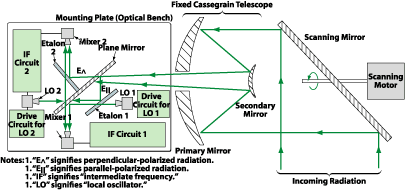
The angle between the flat scanning mirror and the optical axis of the telescope would determine the cone angle of the scan pattern. This angle could be set, for example, to enable scanning of the horizon or of an annular region of the sky. The flat mirror could be constructed easily and, because it could be very lightweight, a low-torque scanning motor would suffice and it would be possible to scan at a high rate. At one or more angular positions of the scan, the viewing of the exterior scene could be blocked out for radiometric calibration.
After reflection from the scanning mirror and passage through the Cassegrain telescope, incoming radiation would pass through a polarizing beam splitter in the form of a wire grid tilted at an angle of 45° to the optical axis. From this beam splitter, each of the two polarization components of the radiation would travel to one of two heterodyne radiometers. Hence, the SLR would provide simultaneous readings of both perpendicular- and parallel-polarized radiation.
In addition to a local oscillator, each heterodyne radiometer would include a silicon etalon beam combiner. The use of a silicon etalon (in contradistinction to the use of a different device) as a diplexer would simplify the design of the input portion of the radiometer and would provide a temperature-insensitive means of coupling the local-oscillator and incoming radiation into the down-converter portion (submillimeter-wave mixer) of the radiometer. The use of a double-sided mirror coplanar with the polarizing grid would facilitate the positioning of the two radiometers within a confined space. Even if polarization measurements were not required in a given application, the use of both polarization channels would make it possible to increase the signal-to-noise ratio slightly.
The mixer and local oscillator of each heterodyne radiometer would be conveniently situated near their respective drive elements and within the shadow of the primary telescope mirror. All of the electronic and optical components could be mounted on a single plate made of a lightweight material (e.g., a carbon-fiber composite). The rear surface of this plate could be used for heat sinking.
This work was done by Peter Siegel of Caltech for NASA's Jet Propulsion Laboratory.
NPO-30183
This Brief includes a Technical Support Package (TSP).
Spotlight Radiometer
(reference NPO30183) is currently available for download from the TSP library.
Don't have an account?
Overview
The document presents a technical support package for the Spotlight Radiometer (SLR), a compact and lightweight submillimeter-wave spectrometer designed for atmospheric remote sensing applications. Developed by Peter H. Siegel at the Jet Propulsion Laboratory (JPL) under a NASA contract, the SLR aims to enhance the capabilities of space-based instruments by providing a novel design that integrates new and existing components in an innovative manner.
Traditionally, submillimeter-wave instruments have been large and complex, limiting their application in space missions. The SLR addresses this challenge by offering a 360-degree spatial scanning capability while maintaining a compact form factor. The design allows for high-resolution measurements, particularly at 557 GHz, which is crucial for detecting carbon monoxide (CO) and water (H₂O) in the Martian atmosphere. The instrument's unique features include fixed optical elements, dual polarization without complicated optical diplexers, and a simple hot/cold load calibration system.
The document outlines the novelty of the SLR, emphasizing that while it does not introduce new component inventions, its overall package design is unique and provides significant advantages over existing systems. The SLR's design allows for a larger primary diameter, which can improve resolution without complicating the scanning mechanism. The use of a lightweight flat mirror for scanning simplifies the optical system and enhances beam quality.
Additionally, the SLR is designed to be temperature insensitive, which is critical for space applications. The document highlights the instrument's potential for both space and ground-based measurements, making it versatile for various scientific missions. The compact design fits within a cylindrical shell, making it suitable for spacecraft envelopes.
In summary, the Spotlight Radiometer represents a significant advancement in submillimeter-wave remote sensing technology, offering a compact, efficient, and high-performance solution for atmospheric measurements. Its innovative design and operational capabilities position it as a valuable tool for future Mars exploration and other atmospheric studies. The document serves as a technical brief detailing the instrument's development, features, and potential applications, emphasizing its importance in advancing scientific understanding of planetary atmospheres.