

The figure schematically depicts a proposed achromatic nulling beam combiner. This instrument is intended for use in astronomy - principally, for attenuating light from stars or other bright sources in order to enable detection of fainter objects that lie near the bright sources. In comparison with a prior nulling beam combiner, the proposed instrument would be simpler, made of fewer parts, easier to use, and less sensitive to the details of optical coatings. The proposed design provides for rigorous symmetry of the optical train. Moreover, the simplified design involves a relatively compact, mostly planar, configuration based entirely on flat optics, with fewer reflections than in previous designs. Because of its high degree of symmetry, the instrument would be inherently achromatic (broad-band) and capable of processing dual polarization light.
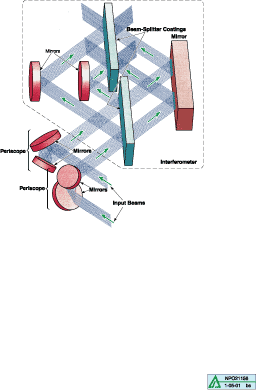
The impetus for the proposed design was the idea that unlike prior approaches, it should be possible to separate the field-flipping and the beam-combining stages. If a relative field inversion were accomplished first, subsequent superposition of the two input beams in a standard interferometer would yield subtraction rather than addition of the electromagnetic fields of the beams at zero optical path difference. In addition, it was realized that if, unlike in prior designs, the optical train could be made completely symmetric, it would theoretically be possible to subtract two identical input beams perfectly (neglecting such practical limitations as variations of optical coatings and errors of alignment and phasing).
It is assumed that the two input beams would be parallel and collimated. The electromagnetic fields of the two beams would be flipped, relative to each other, by reflection in two mirror-symmetric right-angle periscopes. The two mirrors in each periscope would effect one s-plane and one p-plane reflection, respectively, and together they would reverse the roles of the s-plane and p-plane reflections. Hence, the two polarization states would be affected symmetrically by each periscope and hence, as long as the coatings on the mirrors in both periscopes were identical, no s-p phase delay would be incurred. After passage through these periscopes, the propagating two-polarization-component fields should be identical to the input fields, except for the relative field flip.
The beam-combining stage would be based on a Mach-Zehnder interferometer in which each beam would encounter two beam splitters. With respect to the transmission and reflection coefficients for the two polarization states, the encounter with each beam splitter would be reciprocal to the encounter with the other beam splitter, so that complete symmetry would be ensured.
This work was done by Eugene Serabyn and Mark Colavita of Caltech for NASA's Jet Propulsion Laboratory. NPO-21156
This Brief includes a Technical Support Package (TSP).
Simplified Achromatic Nulling Beam Combiner
(reference NPO21156) is currently available for download from the TSP library.
Don't have an account?
Overview
The document presents a technical support package for a Simplified Achromatic Nulling Beam Combiner developed by Eugene Serabyn and Mark Colavita at NASA's Jet Propulsion Laboratory (JPL). This innovative instrument is designed primarily for astronomical applications, specifically to attenuate light from bright stars or other luminous sources, thereby enabling the detection of fainter objects in close proximity.
The proposed beam combiner improves upon previous designs by offering a simpler, more symmetrical configuration that consists entirely of flat optics. This design reduces the number of components and reflections compared to earlier models, making it easier to use and less sensitive to variations in optical coatings. The high degree of symmetry in the optical train ensures that the instrument is inherently achromatic, allowing it to operate effectively across a broad range of wavelengths while processing dual polarization light.
A key feature of the design is the separation of the field-flipping and beam-combining stages. The field-flipping is accomplished using two mirror-symmetric right-angle periscopes, which flip the polarization states of the input beams without introducing phase delays. Following this, a Mach-Zehnder interferometer is employed for the beam-combining stage, where the two input beams are superimposed. This configuration allows for the subtraction of electromagnetic fields at zero optical path difference, enhancing the ability to isolate faint signals from bright backgrounds.
The motivation behind this development stems from the challenges associated with previous nulling beam combiners, particularly the complexity and difficulty in achieving reliable performance, especially in mid-infrared applications. The new design addresses these issues by providing a more user-friendly and efficient solution.
Overall, the Simplified Achromatic Nulling Beam Combiner represents a significant advancement in optical technology for astronomy, promising to enhance observational capabilities by enabling the detection of faint celestial objects that would otherwise be obscured by brighter sources. The work is documented under NASA contract NAS 7−918 and is part of ongoing efforts to improve astronomical instrumentation.











