A control scheme for nulling interferometry has been devised to make it possible to stabilize interferometric optical-path-length differences to within approximately a nanometer. This degree of stabilization is an order of magnitude finer than that achieved previously in typical optical interferometers.
Nulling interferometry is a promising technique for reducing the apparent brightness of a star relative to its surroundings. As such, nulling interferometry has the potential to enable direct detection of extrasolar planets and zodiacal light. Nulling interferometry is based on the precise cancellation, or "nulling," of the starlight received from the same star by two side-by-side telescopes. To cancel on-axis starlight, the electric fields from the two telescopes must be combined in opposite phase at all wavelengths across the waveband of interest. The required degree of cancellation (to the 10-6 level in the infrared) translates to a requirement to stabilize optical-path-length differences at or below the nanometer level.
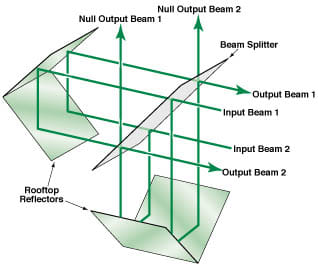
In the present technique, the required achromatic π -radian phase shift between the beams from the two telescopes is introduced by geometrically flipping the electric-field vector of one beam, relative to the other, by use of a rotational shearing interferometer (RSI). The figure schematically depicts aspects of an RSI. The two interferometer arms contain orthogonal rooftop reflectors, and the arms intersect at a beam splitter. Each rooftop flips one of two orthogonal components of the electric-field vector. This RSI generates two null output beams that are balanced in the sense that the intensity of the light in both of them is proportional to rt, wherer and t are the reflection and transmission coefficients, respectively, of the beam splitter. This RSI also generates two bright outputs that are unbalanced in the sense that they are proportional to r2 and t2, respectively.
In order to generate a sufficiently strong feedback signal for controlling the optical-path-length difference between the two arms to maintain the null, one must find a source other than the nominally nulled star itself. The present control scheme exploits a hitherto unrecognized property of interferometric beam combiners in general and of this RSI in particular to generate a sufficiently strong control signal. The scheme involves the insertion of a path offset of λm/8 (where λm is approximately the mean wavelength in the wavelength band of interest) into one of the interferometer arms and the insertion of another path offset of λm/8 into the path (outside the interferometer) of one of the input beams.
Because the path-length offsets add in one nulled output and subtract in the other, these offsets make it possible to preserve the achromatic null in one of the two nominally balanced output beams while converting the other beam into a bright off-null error signal, in which the fractional change in power level is given by
where Δx is the path-length difference that one seeks to minimize. For example, at a wavelength of 628 nm, this scheme yields an error signal with a fractional power change of 1 percent per nanometer of path-length difference; even at a path-length difference of only 1 nm, this fractional power is much greater than the fractional power remaining in the nominally nulled output signal. Although the error-signal beam is chromatic, this is not of concern because achromaticity is needed only in the null output beam.
This work was done by Gene Serabyn of Caltech for NASA's Jet Propulsion Laboratory.
NPO-20758
This Brief includes a Technical Support Package (TSP).
Nanometer-Level Control Scheme for Nulling Interferometry
(reference NPO20758) is currently available for download from the TSP library.
Don't have an account?
Overview
The document is a NASA Technical Support Package detailing a novel nanometer-level control scheme for nulling interferometry, aimed at enhancing astronomical observations, particularly in the detection of extrasolar planets. The work, conducted at the Jet Propulsion Laboratory (JPL), addresses the challenges associated with achieving high-precision measurements in interferometric setups, where the goal is to null out the light from a star to detect the faint light from orbiting planets.
The document outlines the limitations of existing control schemes, particularly the significant reduction in signal photons available for pathlength control when starlight nulling is employed. It highlights that successful nulling can decrease the signal by a factor of 10,000 to 1,000,000, complicating the control of optical paths. The power transmission of an interferometric beam combiner (IBC) is discussed, emphasizing the relationship between input power and output power, particularly in the context of phase errors.
A key focus of the document is the introduction of a new control scheme that leverages unique properties of interferometric beam combiners. This scheme aims to provide a more effective means of stabilizing the output at the null position while managing the challenges posed by low signal levels and phase errors. The document also mentions the potential use of out-of-band radiation as an off-null error signal, although this approach requires further development.
The technical details include equations that describe the power transmission characteristics of the IBC and the implications of phase errors on the system's performance. The document emphasizes the need for innovative solutions to overcome the drawbacks of current methods, such as the zero slope of the transmission versus phase relation at the null position, which complicates error signal detection.
Overall, this technical brief presents a significant advancement in the field of interferometry, proposing a control scheme that could enhance the capability to detect faint astronomical signals amidst overwhelming starlight. The research represents a collaborative effort under NASA's auspices, with implications for future astronomical missions and the search for extraterrestrial life.