

Two polarization-recycling techniques have been proposed to increase the efficiency of illumination of liquid-crystal display (LCD) panels. The motivation for this proposal lies in the inherent inefficiency of an LCD panel: For proper operation, illumination with polarized light is necessary, but a typical lamp generates unpolarized light. If one simply passes the lamp light through a polarizer on the way to the LCD panel, then one wastes the half of the light that is in the undesired polarization. To increase the efficiency of illumination, one would have to recycle the otherwise wasted light, converting the undesired polarization to the desired one; this is what is meant by "polarization recycling."
Unlike a related older polarization-recycling technique, the two proposed polarization-recycling techniques would not enlarge the cross section of the illuminating beam. (Such enlargement is a disadvantage in a typical application in which one seeks to illuminate a small panel.)
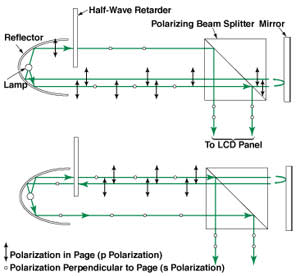
Figure 1 schematically depicts the optical configuration for the first proposed technique. The unpolarized light from a lamp would be concentrated by a reflector and directed to a polarizing beam splitter. The p-polarized light would pass through the beam splitter, while the s-polarized light would be reflected perpendicularly toward an LCD panel. The p-polarized light would strike a flat mirror, then would travel back to the lamp reflector, where it would be reflected twice. After emerging from the lamp reflector, the p-polarized light would pass through a half-wave retarder that would occupy half of the beam cross section. The half-wave retarder would cause the reflected p-polarized light to become s-polarized. In the beam splitter, this newly s-polarized light would be reflected perpendicularly toward the LCD panel, along with the originally s-polarized light.
For the portion of unpolarized lamp light that would hit the half-wave retarder first, the end result would be the same, though the sequence of events would differ: After passing through the half-wave retarder, the initially unpolarized light would remain unpolarized until it reached the polarizing beam splitter. The p-polarized subpart of this part of the light would pass through the beam splitter, while the s-polarized subpart would be reflected perpendicularly toward the LCD panel. The p-polarized light would strike the flat mirror and would go back through the half-wave retarder, which would convert it to s-polarized light. Continuing along its path, this portion of s-polarized light would be reflected twice by the lamp reflector, and would finally be reflected perpendicularly, by the beam splitter, toward the LCD panel.
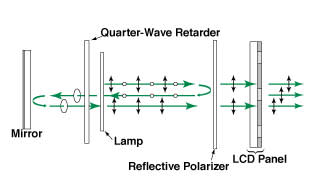
Figure 2 schematically depicts the configuration for the second proposed technique. Light from a lamp would reach a reflective polarizer; the p-polarized light would pass through to the LCD panel, while the s-polarized light would be reflected. The reflected s-polarized light would pass through a quarter-wave retarder, becoming circularly polarized. The circularly polarized light would be reflected by a flat mirror and would go back through the quarter-wave retarder, which would cause this light to become p-polarized, as needed to join the originally p-polarized light in illuminating the LCD panel.
This work was done by Yu Wang of Caltech for NASA's Jet Propulsion Laboratory. For further information, access the Technical Support Package (TSP) free on-line at www.nasatech.com/tsp under the Physical Sciences category .
In accordance with Public Law 96-517, the contractor has elected to retain title to this invention. Inquiries concerning rights for its commercial use should be addressed to:
Technology Reporting Office
JPL
Mail Stop 249-103
4800 Oak Grove Drive
Pasadena, CA 91109
(818) 354-2240
Refer to NPO-20824, volume and number of this NASA Tech Briefs issue, and the page number.
This Brief includes a Technical Support Package (TSP).
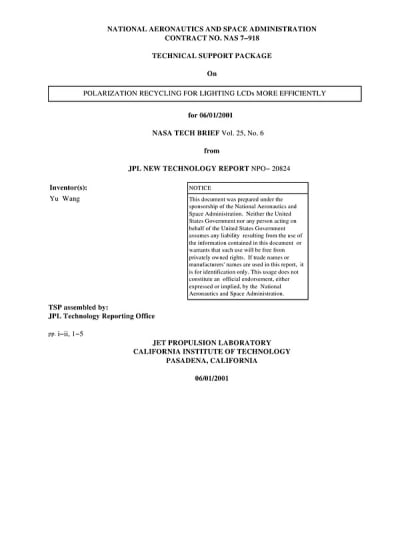
Polarization Recycling for Lighting LCDs More Efficiently
(reference NPO-20824) is currently available for download from the TSP library.
Don't have an account?
Overview
The document is a NASA Technical Support Package detailing advancements in "Polarization Recycling for Lighting LCDs More Efficiently," prepared under the sponsorship of the National Aeronautics and Space Administration (NASA) and authored by Yu Wang. It was published in June 2001 as part of the NASA Tech Brief Vol. 25, No. 6.
The primary focus of the document is on improving the efficiency of liquid-crystal displays (LCDs) through innovative polarization recycling techniques. LCDs are widely used in various applications, including televisions, computer monitors, and mobile devices. However, traditional LCD technology often suffers from inefficiencies related to light usage, particularly in how polarized light is utilized and recycled.
The document outlines methods to enhance the performance of LCDs by effectively recycling polarized light. This involves capturing and reusing light that would otherwise be wasted, thereby increasing the overall brightness and efficiency of the display. The proposed techniques aim to maintain the size of the illuminated area while maximizing the use of unpolarized light emitted from lamps, which is crucial for achieving better display quality and energy efficiency.
The research conducted at the Jet Propulsion Laboratory (JPL) underlines the importance of this technology not only for consumer electronics but also for potential applications in space exploration and other fields where efficient lighting is critical. The document emphasizes that the work was carried out under a contract with NASA, highlighting the collaboration between JPL and the agency in advancing technological innovations.
Additionally, the document includes a disclaimer stating that references to specific commercial products or manufacturers do not imply endorsement by the U.S. Government or JPL. This is a standard practice to ensure that the information presented is objective and not influenced by commercial interests.
In summary, this technical report presents a significant step forward in LCD technology by proposing methods for polarization recycling that enhance efficiency and performance. The findings have the potential to impact various industries, making displays brighter and more energy-efficient, which is increasingly important in today's technology-driven world.











