

A mid-infrared wave-number range has been identified as being useful for laser measurements of CO and CO2 gases that contain various combinations of isotopes of C and O. The isotopic species are 12C16O (common CO), 13C16O, 12C18O, 16O12C18O,12C16O2 (common CO2), and 13C16O2.
More specifically, the wave-number range from about 2,036.2 to 2,038.4 cm-1(wavelength range from about 4.9111 to about 4.9058 µm) contains two absorption spectral lines for 12C16O2, a group of lines for 13C16O2, and one line for each of the other isotopic species (see figure). The range is narrow enough that it can be spanned by a typical tunable laser.
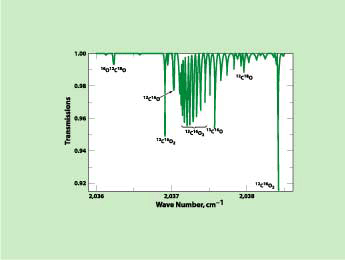
From measurements of the absorption of laser light in this wavelength range, one can determine simultaneously the temperature of a gas mixture and the concentration of each of the six isotopic species. Potential applications for instruments based on this measurement principle include Earth and planetary gas spectrometers; analysis of exhaled, isotope-tagged CO and CO2 for medical diagnosis; analysis of isotope-tagged CO and CO2 for research on the operation of automotive engines and the resulting pollution; and other applications in industries that involve the sensing and/or measurement of gases.
This work was done by Christopher Webster of Caltech forNASA's Jet Propulsion Laboratory.
NPO-21163
This Brief includes a Technical Support Package (TSP).
Spectral Region for Laser Isotope Measurements of Gases
(reference NPO21163) is currently available for download from the TSP library.
Don't have an account?
Overview
The document presents a technical report on a novel method for measuring isotopes of carbon and oxygen in gases, specifically carbon monoxide (CO) and carbon dioxide (CO2), using tunable laser absorption spectroscopy. Conducted by Christopher Webster at the Jet Propulsion Laboratory (JPL) for NASA, the research identifies a mid-infrared spectral region near 2037 wavenumbers (approximately 4.9 microns) that allows for the simultaneous measurement of six isotopic species: CO, CO2, and four isotopes of carbon and oxygen.
Prior methods were limited to measuring only two or three isotopic species, typically focusing on either CO or CO2, but not both together. This new approach overcomes those limitations by utilizing a very narrow wavelength range (2-3 cm⁻¹) where distinct absorption lines for each isotopic species are present. This capability enables the determination of both gas temperature and isotopic concentrations in a single measurement, which is critical for accurate gas analysis.
The document outlines the motivation behind this research, which stems from the need for precise measurements of CO2 and its isotopes for various applications, including environmental monitoring, medical diagnostics (such as analyzing exhaled gases), and automotive research related to engine performance and pollution. The ability to measure isotopic ratios of CO and CO2 can provide valuable insights into processes such as climate change and pollution sources.
The report emphasizes the significance of the findings, noting that the identified spectral region allows for comprehensive analysis without the need for separate instrumentation for temperature measurement, thus streamlining the process. The research is positioned as a significant advancement in the field of gas analysis, with potential applications extending to Earth and planetary gas spectrometers.
In summary, this document highlights a breakthrough in laser isotope measurement technology, showcasing how a specific spectral region can facilitate the simultaneous analysis of multiple isotopic species in gases, enhancing our understanding of various scientific and industrial processes. The work represents a collaborative effort under NASA's auspices, with implications for both research and practical applications in gas sensing and measurement.











