Tunable laser absorption spectrometer (TLAS) sensors enable gas monitoring with high accuracy and gas specificity, and can be optimized for continuous, maintenance-free operation on long-duration manned spacecraft missions. This innovation is a portable, five-channel TLAS instrument designed to continuously monitor ambient concentrations of carbon monoxide, hydrogen chloride, hydrogen cyanide, hydrogen fluoride, and carbon dioxide, with low-level detection limits below the standard spacecraft maximum allowable concentrations. Monitoring of these particular hazardous compounds allows tracking of ambient conditions and enables detection of fires associated with electrical wiring and electronics packaging materials.
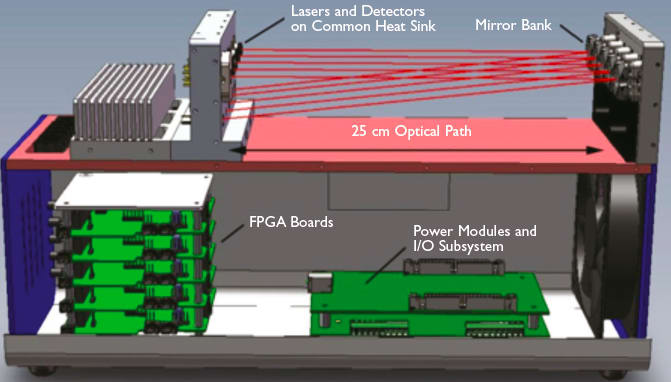
To achieve maximum sensitivity with a small, robust design, the five-channel sensor uses a separate single-mode mid-infrared laser for each gas, with each laser wavelength selected to target strong absorption lines while avoiding interference from other molecules potentially found in manned spacecraft environments. Distributed-feedback laser sources were fabricated for this specific configuration using various semiconductor technologies, including a quantum cascade (QC) intersubband laser based on InP-matched semiconductor quantum well structures, an interband cascade (IC) laser based on type-II band-to-band transitions in GaSb-matched quantum wells, and GaSb-based type-I quantum well diode lasers. A heat-sink assembly accepts the five sets of dedicated lasers and matched detectors, and sits 25 cm from a mirror bank to create the 50-cm two-pass optical path. Dedicated electronics are used to simultaneously control the temperature of each source and detector with integrated thermoelectric coolers, and the ambient temperature and pressure are measured with onboard sensors to correct for absorption line broadening.
The emission wavelength of each laser is swept across target molecular absorption lines of each compound, enabling measurements of both on- and off-resonance absorption and, ultimately, a quantitative measurement of the abundance of the target compounds. By interrogating strong mid-infrared absorption lines, the instrument can detect each gas with part-per-million resolution despite the relatively short absorption path. The open absorption cell design is intended to operate at the same pressure and temperature as the ambient environment, and requires no additional pumps, concentrators, or carrier gases.
This work was done by Ryan M. Briggs, Siamak Forouhar, Clifford F. Frez, Carl E. Borgentun, and Mahmood Bagheri of Caltech; and Randy D. May of Port City Instruments LLC for NASA’s Jet Propulsion Laboratory. NPO-49505
This Brief includes a Technical Support Package (TSP).
Multi-Channel Laser Absorption Spectrometer for Combustion Product Monitoring
(reference NPO-49505) is currently available for download from the TSP library.
Don't have an account?
Overview
The document is a Technical Support Package from NASA's Jet Propulsion Laboratory (JPL) detailing the Multi-Channel Laser Absorption Spectrometer (TLAS) designed for monitoring combustion products. This technology is part of NASA's Commercial Technology Program, aimed at disseminating aerospace-related developments with potential broader applications in scientific and commercial fields.
The TLAS instrument utilizes advanced laser technology to detect various gases produced during combustion processes. It features a five-channel design that includes a laser/detector bank and a two-pass absorption cell, which enhances its sensitivity and accuracy in measuring gas concentrations. The document provides specific performance metrics for several target gases, including carbon monoxide (CO), hydrogen chloride (HCl), hydrogen cyanide (HCN), hydrogen fluoride (HF), and carbon dioxide (CO2).
For each gas, the document outlines the performance range in parts per million by volume (ppmv), the target absorption wavelength in nanometers (nm), and the relative line-center absorption at the lowest detection level. For instance, CO can be detected in a range from 1 to 1000 ppmv at a wavelength of 4735.9 nm using a quantum cascade distributed-feedback (DFB) laser. Similarly, HCl, HCN, HF, and CO2 are monitored using various types of DFB lasers, including interband cascade and laterally coupled diode lasers.
The document emphasizes the importance of compliance with U.S. export regulations, indicating that the information may contain proprietary data. It also provides contact information for further inquiries related to research and technology in this area, specifically through the Innovative Technology Assets Management at JPL.
Overall, the Technical Support Package serves as a comprehensive overview of the TLAS technology, highlighting its capabilities, the specific gases it can monitor, and the underlying laser technologies employed. This innovation represents a significant advancement in combustion monitoring, with implications for environmental monitoring, safety, and efficiency in various industrial applications.