

A simplified microwave radiometric apparatus has been proposed for use in quantifying the potential danger of accretion of ice onto an aircraft flying through a cloud. The quantity of interest, called the "icing hazard potential" (IHP), is the product of (1) the liquid-water content (LWC) of the cloud at a given altitude and (2) some function of the degree of supercooling of the liquid water at that altitude.
In 1983, it was demonstrated that reliable values of IHP could be calculated from readings of a ground-based instrumentation system that comprised (1) a water-vapor radiometer (for measuring LWC), (2) a microwave temperature profiler (MTP) (to measure the vertical temperature profile), (3) a hand-held infrared radiometer (to measure the cloud-base temperature and thus, in conjunction with the MTP, the cloud-base altitude), and (4) a surface meteorological subsystem (to measure surface values of temperature, barometric pressure, and humidity). The proposed system would share some features in common with the 1983 system, but would not include a water-vapor radiometer. Inasmuch as the radiometers embodied most of the cost the 1983 system, eliminating one radiometer would reduce the cost significantly.
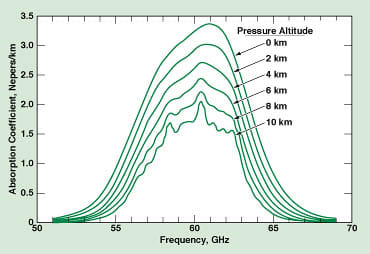
To be able to determine the IHP, one needs to know the temperature and the LWC as a function of altitude. For the purpose of measuring these quantities, the proposed system would exploit the radiometric characteristics of oxygen and liquid water in the frequency range from about 50 to about 70 GHz. The absorption spectrum of oxygen molecules in this frequency range (see figure) depends on temperature, pressure, and water-vapor density. The brightness temperature observed by an MTP is an exponentially weighted average of all oxygen emission along its line of sight and closely approximates the air temperature at an effective distance from the radiometer equal to the reciprocal of the absorption coefficient.
Consider two observation frequencies - one on the high-frequency and one on the low-frequency side of the peak in the oxygen absorption spectrum- for which the absorption coefficient is equal. In the absence of cloud liquid water along the line of sight within the effective distance, the brightness temperatures observed at both frequencies would be the same, but in the presence of cloud liquid water, the brightness temperatures observed at the higher frequency would exceed that observed at the lower frequency, because cloud liquid water contributes to brightness temperature by an amount approximately proportional to the square of frequency. Thus, in principle, one could infer both the air temperature and the LWC from the brightness temperatures at the two frequencies.
The main radiometer in the proposed apparatus would be an extended version of an airborne MTP now in use. As such, it would include a scanning mirror used to scan the line of sight in elevation angle while measurements were taken at several pairs of frequencies (and thus several effective distances), the net effect being to acquire data from different effective altitudes. The apparatus would also include an infrared gun operating in the wavelength range of 8 to 14µm to determine the cloud-base altitude, plus simple sensors to measure the ambient temperature, pressure, and relative humidity.
The proposed apparatus would cost less than airport and aircraft radar systems do. Eventually, taking advantage of monolithic microwave integrated circuitry, it should be possible to mass-produce the apparatus and install it in aircraft at relatively low cost. Because icing is of particular concern during long, slow descents and approaches, prior to miniaturization and mass production, it could be desirable to install copies of the apparatus on the approach paths of major airports to warn approaching aircraft of potential icing hazards.
This work was done by Michael J. Mahoney of Caltech for NASA's Jet Propulsion Laboratory.
NPO-20291
This Brief includes a Technical Support Package (TSP).
Simplified Radiometer for Quantifying Aircraft Icing Hazard
(reference NPO20291) is currently available for download from the TSP library.
Don't have an account?
Overview
The document outlines a technical support package for a simplified microwave radiometric apparatus designed to quantify the icing hazard potential (IHP) for aircraft flying through clouds. The IHP is defined as the product of the liquid-water content (LWC) of a cloud at a specific altitude and a function representing the degree of supercooling of the liquid water at that altitude. This system aims to enhance aviation safety by providing reliable measurements of conditions that can lead to ice accumulation on aircraft.
The proposed instrumentation system consists of several components: a water-vapor radiometer for measuring LWC, a microwave temperature profiler (MTP) to assess the vertical temperature profile, a hand-held infrared radiometer to determine cloud-base temperature and altitude, and a surface meteorological subsystem to gather surface temperature, barometric pressure, and humidity data. This combination allows for a comprehensive understanding of the atmospheric conditions that contribute to icing hazards.
The document highlights the importance of accurate IHP measurements, particularly in inclement weather, where traditional systems may struggle. It notes that existing MTPs consume about 100 watts of power, weigh less than 10 kg, and occupy less than a cubic foot of volume. The use of Monolithic Microwave Integrated Circuit (MMIC) technology for both the receiver and phased-array feed is suggested as a means to significantly reduce these parameters and lower manufacturing costs once initial non-recurring engineering (NRE) costs are absorbed.
The document also addresses weather-related challenges, emphasizing the need for weatherproofing the system to ensure reliable operation in adverse conditions. While liquid water on radomes poses a challenge, ice is particularly problematic as it is transparent to microwaves, complicating detection.
Overall, the document presents a promising advancement in the field of aviation meteorology, aiming to improve the safety of aircraft operations in icing conditions through enhanced measurement techniques. The work is conducted under the auspices of NASA and the Jet Propulsion Laboratory, with references to previous studies that support the efficacy of the proposed system.









