A proposed quantum-well infrared photodetector (QWIP) would exploit resonant-phonon-assisted transitions to reduce dark current significantly below that of a typical previously developed QWIP operating at the same wavelength and temperature. The reduction in dark current would translate to greater sensitivity, a capability to measure the diminished infrared radiation from cooler objects, and/or a less severe requirement for cooling an infrared sensor to obtain a desired signal-to-noise ratio.
The proposed QWIP would likely be fabricated by molecular-beam epitaxy of alternating layers of doped GaAs and AlxGa1 -xAs on a semi-insulating GaAs substrate. The thicknesses and compositions of the GaAs and AlxGa1 -xAs layers would be chosen to form a stack of 25 pairs of coupled quantum wells. The depths and thicknesses of the wells, the thickness of the barrier between the wells in each pair, and the bias electric field to be applied during operation would be chosen to (1) promote excitation of electrons through absorption of photons in the infrared wavelength range of interest and (2) increase (relative to previously developed QWIPs) the heights of the energy barriers to thermionic emission, which is the dominant source of dark current in the temperature range of interest (<55 K).
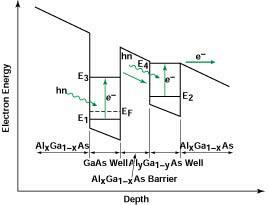
The figure is a conduction-band energy diagram of one pair of quantum wells. The wells would be engineered so that at the threshold applied electric field, E2 – E1 = ΔEhk, where ΔEhk is an optical-phonon energy. Barrier heights and well thicknesses would be chosen such that the photoexcitation energy between ground and first excited states in both wells would be the same; that is, E3 – E1= E4 – E2 = ΔEhv, where ΔEhv is the photoexcitation energy (photon energy) at the desired wavelength of peak detector response. In addition, E4 - the first excited state of the right well - would be placed exactly at the top of the well.
The ground state of the left quantum well would be doped up to Fermi level EF, which would be below E2. Electrons in the E1 level would become excited to the E3 level by absorbing photons. The stated engineered relationships among the energy levels at the threshold electric field would give rise to resonance between (1) the transition from E3 to E2 and (2) the optical phonon without (3) transfer of momentum. Consequently, an electron that had been photoexcited from E1 to E3would make a rapid transition (within a typical quantum-state lifetime of the order of a picosecond) from E3 to E2. Repeated such excitations and transitions would cause the ground (E2) state of the right potential well to become populated.
The lifetime of the E2 level would exceed that of the E3 level because decay back to E1 would involve emission of an optical phonon with a large transfer of momentum. The lifetime of the E2 level would be long enough that an electron in that level would have a high probability of absorbing a second photon, thereby gaining enough energy to escape from the right well to be collected as photocharge. Optimization of design would involve balancing of these various quantum transition processes while providing for coupling of radiation of the wavelength of interest to electrons in the quantum wells.
The quantum efficiency of the proposed QWIP would be about half or even less than half of that of a typical previously developed QWIP, because now two photons would have to be absorbed to get one electron out. However, there would still be a net increase in signal-to-noise ratio because effective height of the barrier against thermionic emission would be increased sufficiently that the dark current would be reduced to much less than half of the previous value. For example, it has been estimated that for a wavelength of 15 µm (equivalent to a photon energy of about 82 meV), an optical-phonon energy of about 36 meV, and a temperature of 55 K, the dark current of the proposed QWIP would be about a thousandth of that a typical previously developed QWIP.
This work was done by Sumith Bandara, Sarath Gunapala, and John K. Liu of Caltech for NASA's Jet Propulsion Laboratory.
In accordance with Public Law 96-517, the contractor has elected to retain title to this invention. Inquiries concerning rights for its commercial use should be addressed to
Technology Reporting Office
JPL
Mail Stop 122-116
4800 Oak Grove Drive
Pasadena, CA 91109
(818) 354-2240
Refer to NPO-20568
This Brief includes a Technical Support Package (TSP).
Phonon-Assisted Quantum-Well Infrared Photodetector
(reference NPO20568) is currently available for download from the TSP library.
Don't have an account?
Overview
The document discusses a proposed advancement in infrared photodetection technology through the development of a quantum-well infrared photodetector (QWIP) that employs resonant-phonon-assisted transitions. This innovative design aims to significantly reduce dark current, which is a common issue in traditional QWIPs, thereby enhancing their performance at specific wavelengths and temperatures.
The proposed QWIP is designed to operate at a wavelength of 15 μm, corresponding to a photon energy of approximately 82 meV, and at a temperature of 55 K. The key feature of this design is its dual-quantum-well structure, which imposes high barriers against thermionic emission and tunneling. This structure allows for a substantial reduction in dark current, estimated to be about one-thousandth of that found in typical QWIPs operating under similar conditions. Although the quantum efficiency of the new QWIP is expected to be lower—about half or even less than half of that of conventional QWIPs—this is offset by a significant increase in the signal-to-noise ratio. The effective height of the barrier against thermionic emission is increased, which compensates for the reduced efficiency by minimizing noise.
The document highlights the importance of this technology for various NASA applications, particularly in earth science, where imaging systems that operate in the very long wavelength infrared (VLWIR) region (12-18 μm) are crucial. These systems can be used for geological and volcanological studies, monitoring atmospheric conditions, and detecting cold objects, such as ballistic missiles, when their engines are not active.
The work was conducted by researchers Sumith Bandara, Sarath Gunapala, and John K. Liu at the California Institute of Technology for NASA’s Jet Propulsion Laboratory. The document also includes a disclaimer stating that references to specific commercial products do not imply endorsement by the U.S. Government or NASA.
In summary, the proposed QWIP represents a significant technological advancement in infrared detection, promising enhanced sensitivity and reduced noise, which are essential for a range of scientific and defense applications. The innovative use of resonant-phonon-assisted transitions marks a notable improvement over previous QWIP designs.