

In-situ resource utilization (ISRU) equipment would be incorporated into remotely controlled exploratory robots, according to a proposal, to generate fuels and oxidizers to extend operational ranges and to provide occasional bursts of power for actions like drilling into the ground, hopping over obstacles, flying, or transmitting data on high-power radio signals. In its original form, the proposal is directed toward the development of a locally refueled planetary explorer (LORPEX) — an exploratory robot that could function on a remote planet, without need for fuel transported from Earth and without need for heavy, bulky power-generating equipment that would be utilized to full capacity only occasionally. The proposal might also be applicable to remotely located scientific instruments (e.g., meteorological instruments) on Earth, or even to automobiles.
The basic idea is that instead of using heavy source that would consume transported fuel to generate high power, one would use a lightweight ISRU unit that would slowly generate a fuel and oxidizer from natural material in its vicinity. The fuel and oxidizer would be stored in lightweight containers (e.g. balloons). The stored fuel could then be consumed rapidly in a lightweight engine or fuel cell to satisfy the occasional demand for high power.
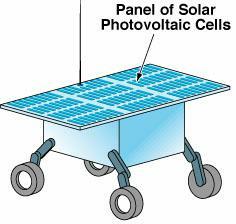
Typically, a LORPEX and its ISRU unit would be powered by solar photovoltaic cells (see figure). The ISRU unit would generate a fuel and oxidizer through electrolysis. On Earth, Venus, or Mars, for example, one could use a solid-oxide electrolyzer with platinum electrodes to split atmospheric carbon dioxide into carbon monoxide (the fuel in this case) and oxygen. Alternative ISRU units might include SABATIER reactors that would produce hydrocarbon fuels from locally available natural materials; such units might prove useful for enhancing the performances of automobiles.
Two proposals that depart somewhat from the basic ISRU/LORPEX concept offer important potential benefits in terrestrial applications. One of these proposals calls for the use of ISRU units to partly detoxify automotive exhaust by converting CO and CO2 to O2 and C. The other proposal calls for sending LORPEX-like robots to hazardous waste sites to detoxify dangerous substances.
This work was done by Kumar Ramohalli of Caltech and Massimiliano Marcozzi of the University of Arizona for NASA's Jet Propulsion Laboratory. For further information, access the Technical Support Package (TSP) free on-line at www.techbriefs.com under the Machinery/Automation category, or circle no. 163 on the TSP Order Card in this issue to receive a copy by mail ($5 charge).
NPO-20269
This Brief includes a Technical Support Package (TSP).
Making fuels onboard for power bursts in exploratory robots
(reference NPO20269) is currently available for download from the TSP library.
Don't have an account?
Overview
The document discusses the development of in-situ resource utilization (ISRU) technology for exploratory robots, specifically focusing on a concept known as the Locally Refueled Planetary Explorer (LORPEX). This innovative approach aims to enable robotic exploration of planets and moons without the need for fuel transported from Earth, significantly reducing spacecraft mass and launch costs.
ISRU technology allows robots to generate fuels and oxidizers from local resources, such as the Martian atmosphere. The document highlights the advancements in ISRU units, particularly a solid oxide electrolyzer (SOXE) that extracts oxygen and carbon monoxide from carbon dioxide using solar energy. This process not only provides the necessary propellants for the robots but also allows for the storage of these gases in lightweight containers, enabling the robots to deliver power bursts for high-demand activities like subsurface drilling, hopping over obstacles, and sample return missions.
The LORPEX design incorporates a lightweight ISRU unit that can produce fuel and oxidizer on-site, thus eliminating the need for heavy power-generating equipment that would only be utilized occasionally. The document emphasizes the importance of this technology for extending the operational range of exploratory robots and enhancing their capabilities. The ISRU unit is designed to be robust and efficient, with significant improvements in production rates and energy use compared to earlier models.
The document also outlines potential applications of ISRU technology beyond planetary exploration, such as detoxifying automotive exhaust and addressing hazardous waste sites on Earth. The research was conducted by a team from NASA's Jet Propulsion Laboratory and the University of Arizona, showcasing the collaborative effort in advancing space exploration technologies.
Overall, the document presents a forward-looking vision for robotic exploration, where ISRU technology plays a crucial role in enabling sustainable and efficient missions to other planets, ultimately paving the way for more extensive scientific investigations and potential human exploration in the future. The integration of ISRU with high-tech robotics represents a significant leap in our ability to explore and utilize resources beyond Earth.









