The National Virtual Observatory (NVO) Extensible Secure Scalable Service Infrastructure (NESSSI) is a Web service architecture and software framework (see figure) that enables Web-based astronomical data publishing and processing on grid computers such as the National Science Foundation's TeraGrid. Characteristics of this architecture include the following:
- Services are created, managed, and upgraded by their developers, who are trusted users of computing platforms on which the services are deployed.
- Service jobs can be initiated by means of Java or Python client programs run on a command line or with Web portals.
- Access is granted within a graduated security scheme in which the size of a job that can be initiated depends on the level of authentication of the user.
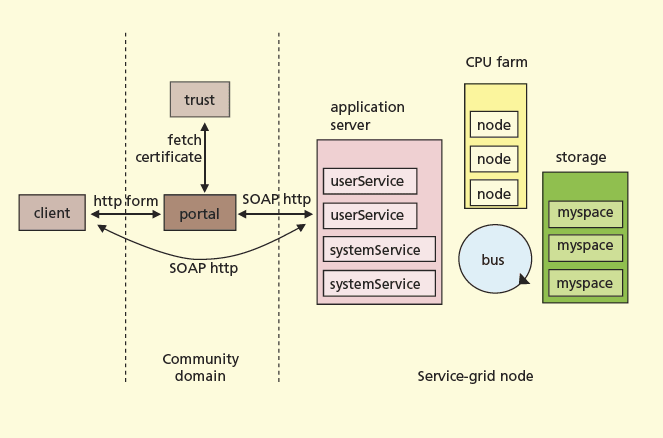
A "small" service request may be submitted anonymously. A "medium" request may be submitted with a "weak" certificate issued by the NVO or another certificate authority not associated with an official grid computing organization like TeraGrid or the Department of Energy (DOE). A "large" request must be accompanied by a "strong" certificate issued by the TeraGrid or DOE certificate authority. User certificates are managed by the Clarens Grid-Enabled Web Services Framework ( clarens.sourceforge.net ).
This work was done by Joseph Jacob, Craig Miller, Roy Williams, Conrad Steenberg, and Matthew Graham of Caltech for NASA's Jet Propulsion Laboratory.
This software is available for commercial licensing. Please contact Karina Edmonds of the California Institute of Technology at (626) 395-2322. Refer to NPO-45067.
This Brief includes a Technical Support Package (TSP).
Service-Oriented Architecture for NVO and Teragrid Computing
(reference NPO-45067) is currently available for download from the TSP library.
Don't have an account?
Overview
The document discusses the architecture and operational frameworks of the TeraGrid and the National Virtual Observatory (NVO), both significant components of the U.S. cyberinfrastructure aimed at enhancing scientific research and education. The TeraGrid is a network of supercomputer centers that facilitates high-performance computing, while the NVO focuses on the publication and accessibility of astronomical data.
The TeraGrid traditionally required extensive proposals for access, but recent initiatives aim to broaden user engagement through science gateways. These gateways allow communities to set up remote web servers that interact with TeraGrid resources, enabling users to start and monitor jobs without needing direct access to TeraGrid systems. This shift emphasizes a service-oriented architecture, where users can deploy services directly on TeraGrid resources, enhancing flexibility and accessibility.
The document outlines the role of Application Servers (AS), such as GT4 and Clarens, which serve as web-service containers that manage user requests and facilitate job distribution across processing nodes. Users can connect to these servers via APIs or community web portals, with options for both authenticated and anonymous access. The architecture supports asynchronous job processing, allowing users to submit jobs that run in the background, with results stored in a temporary area called "myspace."
Security is a critical aspect of this architecture. A graduated security model is being developed to balance ease of access for novice users with the need for robust security for advanced users. This model allows for the deployment of services by non-sysadmins while maintaining security through certificate-based authentication and monitoring.
The document also highlights the collaborative efforts between TeraGrid and NVO to create a middle ground in service deployment, combining the strengths of both systems. This includes the introduction of compute services within the NVO framework, which allows for batch job processing and monitoring, catering to the open-access expectations of the astronomy community.
Overall, the document emphasizes the transition from traditional supercomputing paradigms to a more flexible, service-oriented approach that enhances user engagement, security, and the scientific output of national cyberinfrastructure. It outlines the potential for increased scientific return through this architecture, while also addressing the necessary policy and security considerations for deploying services in such an environment.