A report describes experiments on the concept described in "Real-Time Collision Avoidance for a Robot Arm" (NPO-19861), NASA Tech Briefs, Vol. 20, No. 12 (December 1996), page 98. Under this concept, collision-avoidance software processes data computed by model-based obstacle-detection software to generate perturbations of the trajectory of a robot arm away from the commanded trajectory whenever the commanded trajectory brings the arm within a specified distance from one or more obstacle(s). In computing the perturbation, the software strives to nullify a virtual repulsive force proportional to the incursion of the obstacle plus a virtual damping force proportional to the closing velocity of the arm and the obstacle.
This work was done by Homayoun Seraji, Bruce Bon, and Robert Steele of Caltech for NASA's Jet Propulsion Laboratory. NPO-20336
This Brief includes a Technical Support Package (TSP).
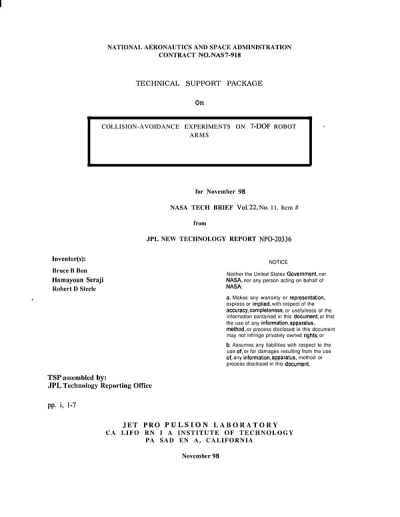
Collision-avoidance experiments on 7-DOF robot arms
(reference NPO20336) is currently available for download from the TSP library.
Don't have an account?
Overview
The document is a technical support package from NASA's Jet Propulsion Laboratory (JPL) detailing collision-avoidance experiments conducted on seven-degree-of-freedom (7-DOF) robotic arms. The primary focus is on developing a robust collision avoidance strategy that allows these robotic arms to operate safely in dynamically varying environments.
The document outlines the fundamental principles of the collision avoidance system, which is designed to perturb the nominal motion trajectory of the robotic arm to nullify any intrusion forces that may arise when the arm approaches obstacles. The intrusion force is calculated based on the extent and rate of intrusion into a predefined safety zone, using a model akin to a spring-damper system. The system employs an external force control loop that adjusts the arm's trajectory in real-time to prevent collisions, ensuring that the arm can navigate safely without abrupt changes in motion.
The experimental setup involved two RRC model K 1207 7-DOF arms, controlled by a real-time VME-based controller interfaced with a SUN workstation. The controller operates at a high frequency, allowing for precise tracking of user-specified Cartesian trajectories. The configuration control scheme ensures that the end-effector's position and orientation are maintained while adapting to avoid obstacles.
The document also discusses the segmentation of the 7-DOF arm into three main links: the tool-link, forearm link, and upper-arm link, which facilitates the implementation of the collision avoidance strategy. The experiments conducted at JPL demonstrated the effectiveness of the proposed methods in real-time scenarios, showcasing the ability of the robotic arms to adjust their paths dynamically in response to potential collisions.
In summary, this document presents a comprehensive overview of the collision-avoidance strategies for robotic arms, emphasizing the importance of real-time adjustments to ensure safety in robotic operations. The findings contribute to the broader field of robotics, particularly in applications where human-robot interaction is critical, such as in space exploration and industrial automation. The research highlights the potential for advanced robotic systems to operate safely alongside humans and in complex environments, paving the way for future innovations in robotic technology.