

RF & Microwave Electronics - April 2019
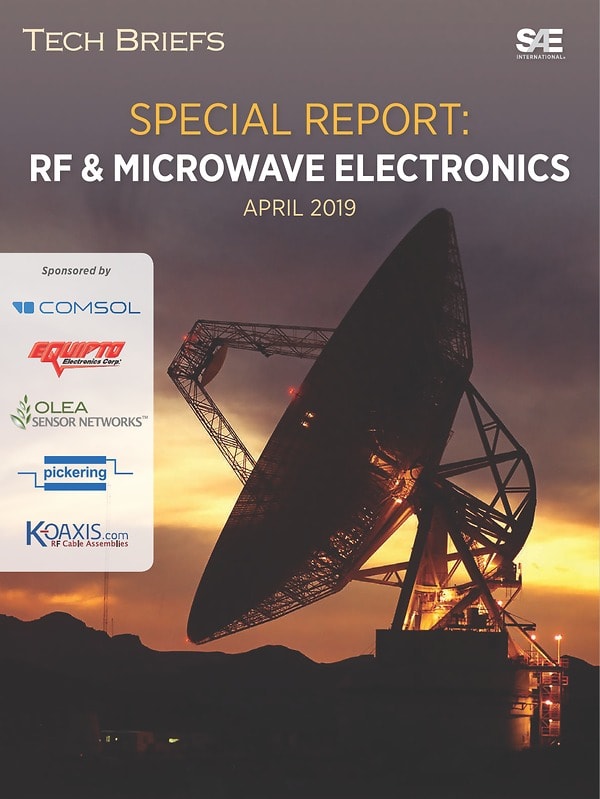
In this compendium of recent articles from the editors of Aerospace & Defense Technology and Tech Briefs, read about how high-frequency electronics advances are enabling new applications in space communications, aviation, the military and more.
Don't have an account?
Overview
The RF & Microwave Electronics Special Report from April 2019 presents a comprehensive overview of advancements and innovations in radio frequency (RF) and microwave technologies, particularly in the context of space communications and other applications. The report is structured into several key sections, including features, application briefs, and tech briefs, each highlighting significant developments in the field.
One of the standout features is the exploration of cognitive radio technology, which represents a new architecture for space communications. This technology is crucial as NASA and other space agencies seek to enhance communication efficiency and manage the increasing volume of data collected from space missions. The report discusses how traditional human-controlled radio systems are being supplemented with advanced technologies to meet growing demands.
Another significant feature focuses on the front end of multiscale modeling for space communications. This section delves into the complexities of modeling communication systems that operate across various scales, emphasizing the importance of accurate modeling in ensuring reliable data transmission from spacecraft to Earth.
The report also covers the hardware design of a high dynamic range RF harmonic measurement system, which is essential for accurately measuring signals in various applications. This technology is vital for ensuring the integrity and quality of RF signals, which are critical in both space and terrestrial communications.
In addition to these features, the report includes application briefs that highlight practical implementations of RF technologies. For instance, it discusses the validation of ubiquitous 2D radar systems and the merging of antenna and electronics to boost energy and spectrum efficiency. These advancements are particularly relevant in the context of the Internet of Things (IoT), where efficient communication is paramount.
The tech briefs section introduces innovative solutions such as the Teletenna, a hybrid telescope antenna system, and a signal combiner designed for wideband communication. These technologies are indicative of the ongoing efforts to enhance communication capabilities across various platforms, including aerospace and terrestrial applications.
The report also touches on the integration of wireless sensors with existing aircraft systems, showcasing how RF technologies are being adapted to improve operational efficiency in aviation. Additionally, it highlights the importance of cybersecurity in wireless communications, with a focus on transmitters that protect data from potential hacking threats.
Overall, the RF & Microwave Electronics Special Report provides valuable insights into the current state and future directions of RF and microwave technologies. It underscores the critical role these technologies play in advancing communication systems, particularly in the context of space exploration and the growing interconnectedness of devices in our daily lives. With over 8 billion devices currently connected globally, the report emphasizes the need for innovative solutions to manage and optimize communication networks effectively.
In summary, this special report serves as a vital resource for professionals and enthusiasts in the field of RF and microwave electronics, offering a glimpse into the transformative technologies that are shaping the future of communication.











