Two hydrogen generators based on reactions involving magnesium and steam have been proposed as means for generating the fuel (hydrogen gas) for such fuel-cell power systems as those to be used in the drive systems of advanced motor vehicles. The hydrogen generators would make it unnecessary to rely on any of the hydrogen-storage systems developed thus far that are, variously, too expensive, too heavy, too bulky, and/or too unsafe to be practical.
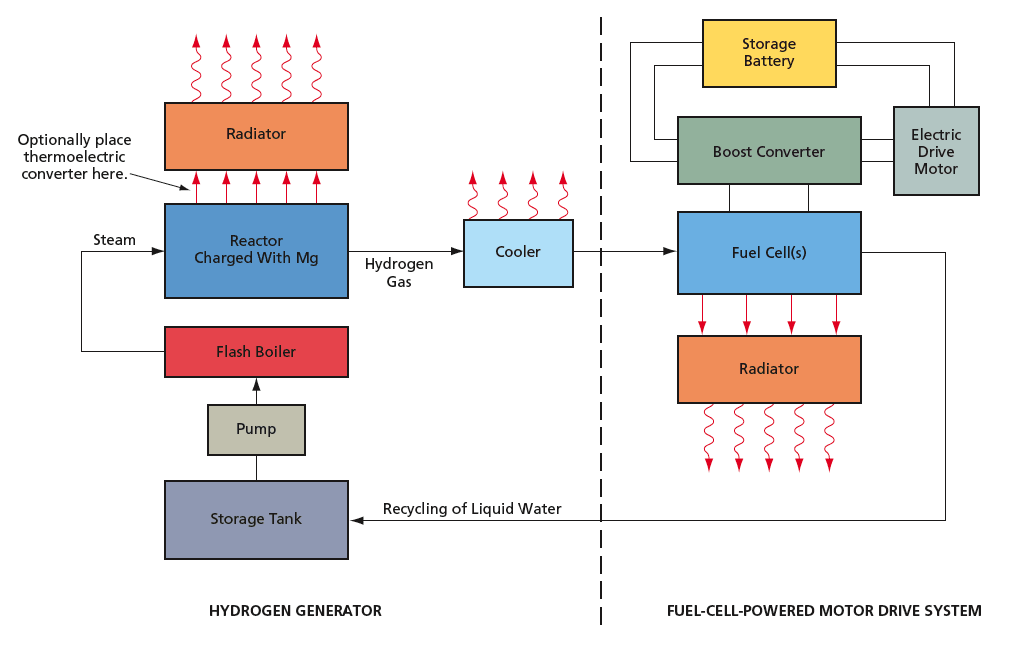
Only a small fraction of the heat generated in the reaction would be needed for boiling: For every kilogram of hydrogen produced, about 44.5 kW⋅h of heat would be generated, while only about 6 kW⋅h would be needed to boil the requisite amount of water. The remaining 38.5 kW⋅h of high-grade heat would have to be dissipated via a radiator. Optionally, the flow of heat from the reactor to the radiator could be intercepted by a thermoelectric converter, thereby increasing the overall electric power generated; the net increase in the overall efficiency of the fuel-cell power system has been estimated to be equivalent to that afforded by an increase of 19 percent in the amount of hydrogen generated.
The generated hydrogen would be sent through a cooler to reduce its temperature to 80 °C as required for the fuel cell(s). During operation of a hydrogen-burning fuel cell, water is generated in liquid and vapor forms. The liquid water could easily be recycled to the storage tank. Depending on detailed calculations yet to be performed, it may be advantageous to also recycle the water vapor by condensing it and pumping the resulting liquid water to the storage tank, provided that the weight of the condenser did not exceed the weight of the water saved. At 80 °C, the waste heat from the fuel cell would be of too low a grade to be useful for most purposes; however, if the fuelcell power system were part of a motor vehicle, the waste heat could be used to heat the passenger compartment in winter.
In the advanced hydrogen generator, the reactor vessel (or one of two or more vessels, depending on the design) would be initially charged with magnesium hydride. The advanced hydrogen generator would exploit two reactions: the aforementioned exothermic reaction at a temperature ≥330 °C plus the endothermic reaction MgH2 → Mg + H2 at a temperature ≥300 °C. Once the initial heating was complete and both reactions under way, the Mg produced in the endothermic reaction would be consumed in the exothermic reaction, which, in turn, would generate sufficient heat to maintain the endothermic reaction. The main advantages of the advanced hydrogen generator over the basic one would be that (1) it would produce twice the amount of hydrogen for a given amount of magnesium, but (2) the cost of operation is likely to be less than that of the basic hydrogen generator because it is likely that MgH2 could be produced at less than twice the cost of the corresponding amount of Mg.
The main waste product of both the basic and advanced systems would be MgO, which has extremely low toxicity. MgO could be safely and easily recycled in a magnesium-refining plant for less than the cost of Mg because MgO is an intermediate product of the refining process.
This work was done by Andrew Kindler and Sri R.. Narayan of Caltech for NASA’s Jet Propulsion Laboratory.
In accordance with Public Law 96-517, the contractor has elected to retain title to this invention. Inquiries concerning rights for its commercial use should be addressed to:
Innovative Technology Assets Management
JPL
Mail Stop 202-233
4800 Oak Grove Drive
Pasadena, CA 91109-8099
(818) 354-2240
E-mail: This email address is being protected from spambots. You need JavaScript enabled to view it.
Refer to NPO-43554, volume and number of this NASA Tech Briefs issue, and the page number.
This Brief includes a Technical Support Package (TSP).
Fuel-Cell Power Systems Incorporating Mg-Based H2 Generators
(reference NPO-43554) is currently available for download from the TSP library.
Don't have an account?
Overview
The document outlines a technical support package from NASA's Jet Propulsion Laboratory (JPL) regarding a novel fuel cell power system that utilizes magnesium-based hydrogen generators. The primary focus is on addressing the need for a reliable hydrogen source for future fuel cell vehicles, which are seen as a promising technology for sustainable transportation. Current hydrogen storage methods are deemed inadequate, prompting the development of this innovative solution.
The hydrogen generation process involves the reaction of magnesium or magnesium hydride with high-temperature steam. The first generation of this technology uses pure magnesium, which produces hydrogen at temperatures above 330 °C. This hydrogen is then cooled and purified for use in fuel cells. The simplicity of the first-generation device is a key advantage, although it produces a lower amount of hydrogen compared to the second generation.
The second-generation system employs magnesium hydride, which can release twice as much hydrogen when reacted with steam. This process occurs in two steps: first, magnesium hydride is dehydrated, consuming energy in the form of heat, and then the resulting magnesium reacts with steam, producing hydrogen and heat. This dual-step reaction is efficient, as the heat generated in the second step can be utilized to support the first step, potentially lowering operational costs.
Both systems ultimately produce magnesium oxide (MgO) as a byproduct, which can be easily recycled at magnesium plants, making the process environmentally friendly. The document emphasizes the "green" nature of both magnesium and magnesium oxide, highlighting their low toxicity and recyclability.
The novelty of this technology lies in its efficient hydrogen generation system, its integration with fuel cells, and the use of waste heat to generate additional electricity. The overall design promises a lightweight, compact, and cost-effective solution for hydrogen production, which is crucial for the advancement of fuel cell vehicles.
For further inquiries or detailed information, the document provides contact details for JPL's Innovative Technology Assets Management. This initiative represents a significant step towards sustainable energy solutions in the automotive sector, aligning with broader goals of reducing carbon emissions and promoting clean energy technologies.