

A proposed metrology system would be incorporated into a proposed telescope that would include focusing optics on a rigid bench connected via a deployable mast to another rigid bench holding a focal-plane array of photon counting photodetectors. Deformations of the deployable mast would give rise to optical misalignments that would alter the directions (and, hence, locations) of incidence of photons on the focal plane. The metrology system would measure the relative displacement of the focusing-optics bench and the focal-plane array bench. The measurement data would be used in post-processing of the digitized photodetector outputs to compensate for the mast-deformation-induced changes in the locations of incidence of photons on the focal plane, thereby making it possible to determine the original directions of incidence of photons with greater accuracy.
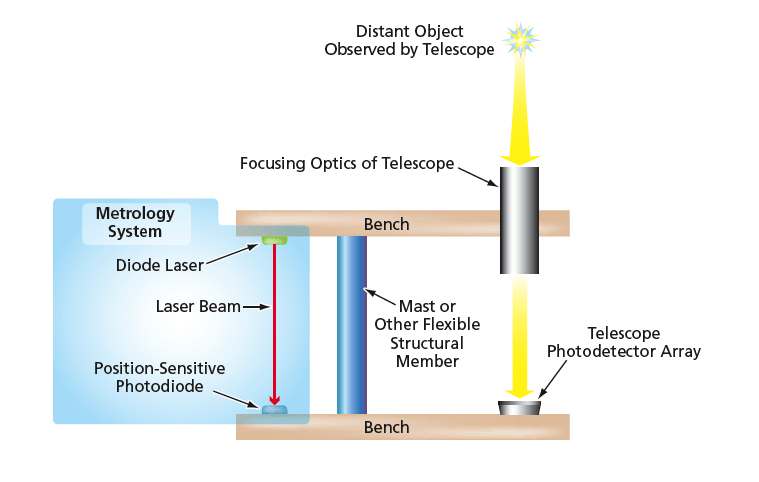
The proposed system would include three diode lasers that would be mounted on the focusing-optics bench. For clarity, only one laser is shown in the figure, which is a greatly simplified schematic diagram of the system. Each laser would be aimed at a position-sensitive photodiode that would be mounted on the detector bench alongside the aforementioned telescope photodetector array. The diode lasers would operate at a wavelength of 830 nm, each at a power of 200 mW. Each laser beam would be focused to a spot of ≈1-mm diameter on the corresponding position-sensitive photodiode. To reduce the effect of sunlight on the measurements, a one-stage light baffle and an 830-nm transmission filter of 10-nm bandwidth would be placed in front of the position- sensitive photodiode. For each metrology reading, the output of the position-sensitive detector would be sampled and digitized twice: once with the lasers turned on, then once with the lasers turned off. The data from these two sets of samples would be subtracted from each other to further reduce the effects of sun glints or other background light sources.
This work was done by Carl Christian Liebe, Randall Bartman, and Walter Cook of Caltech and William Craig of Lawrence Livermore National Laboratory for NASA’s Jet Propulsion Laboratory.NPO-44119
This Brief includes a Technical Support Package (TSP).
Metrology System for a Large, Somewhat Flexible Telescope
(reference NPO-44119) is currently available for download from the TSP library.
Don't have an account?
Overview
The document outlines the Technical Support Package for the Metrology System designed for a Large, Somewhat Flexible Telescope, specifically focusing on the NuSTAR (Nuclear Spectroscopic Telescope Array) mission. NuSTAR is a proposed Small Explorer mission aimed at measuring x-ray emissions from black holes, characterizing supernova remnants, and observing extreme cosmic objects.
The NuSTAR x-ray telescope features an array of three co-aligned hard x-ray mirrors, which are coated with depth-graded multilayers. These mirrors focus x-rays onto three cadmium-zinc-telluride pixel detectors located ten meters away. Each telescope operates independently, and the mission's ultimate sensitivity is achieved by combining exposures from all three systems. The design necessitates a long focal length, which is facilitated by a 10-meter extendable mast.
A significant challenge for NuSTAR is achieving precise positioning of bright x-ray sources to an accuracy of 10 arcseconds (3 sigma). This precision is complicated by the mast's flexures due to external forces and thermal variations in the on-orbit environment. To address this, the metrology system measures the relative displacement between the optics bench and the focal plane detectors, allowing for positional corrections of detected photons during post-processing.
The proposed metrology system employs three 200 mW diode lasers operating at 830 nm. These lasers are mounted on the optical bench and directed at metrology detectors on the detector bench, focusing the laser spots to approximately 1 mm in diameter at the position-sensitive detector. The system includes a 10 nm band pass filter and a baffle to minimize sunlight interference. Measurements are taken twice for each instance—once with the laser off and once with it on—to reduce background noise from sun glints. The digitalization and control of the metrology lasers are managed by the instrument's central electronics box.
The novelty of this invention lies in its ability to determine the exact orientation from which photons arrive, despite the flexible nature of the telescope's structure. This advancement is crucial for enhancing the accuracy and effectiveness of astronomical observations made by the NuSTAR mission.
For further inquiries, the document provides contact information for the Jet Propulsion Laboratory's Innovative Technology Assets Management.











