

Inside this issue
Supplements

Overview
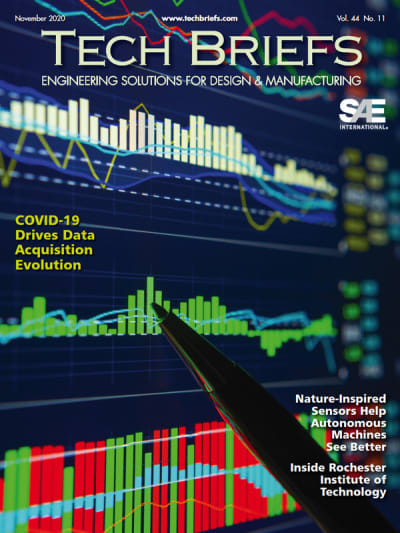
The November 2020 issue of Tech Briefs, Volume 44, No. 11, presents a diverse array of features and innovations across various fields, particularly focusing on advancements in technology and engineering. This edition highlights the impact of COVID-19 on data acquisition and analytics, showcases cutting-edge products, and delves into the latest developments in sensors, robotics, materials, and imaging technologies.
Key Features
-
Products of Tomorrow: This section introduces innovative products that are set to shape the future of technology. It emphasizes the importance of staying ahead in a rapidly evolving market.
-
COVID-19 Drives Data Acquisition and Analytics Evolution: The pandemic has accelerated the need for advanced data acquisition and analytics solutions. This feature discusses how organizations are adapting to new challenges and leveraging technology to enhance data collection and analysis, ultimately improving decision-making processes.
-
NASA Spinoff: Balance Scale Predicts Falls: This article highlights a NASA-developed balance scale that can predict falls, showcasing the practical applications of space technology in everyday life and health monitoring.
Technology Highlights
Sensors
The issue covers several advancements in sensor technology, including:
-
Printable Light Sensors: These sensors can detect colors and have potential applications in various fields, including consumer electronics and environmental monitoring.
-
Long-Range Wireless Sensor Network: This technology enables efficient data transmission over long distances, which is crucial for remote monitoring applications.
-
Psychosensory Electronic Skin Technology: This innovative technology aims to enhance AI and humanoid development by providing machines with a sense of touch.
-
Nature-Inspired Sensors: These sensors are designed to improve the visual capabilities of autonomous machines, drawing inspiration from biological systems.
-
Lab-on-Chip Flow and Temperature Sensor: This compact sensor integrates multiple functions, making it ideal for medical diagnostics and environmental monitoring.
-
Solid-State Sensor for Electric Fields: This sensor is designed for the detection and characterization of electric fields, which can be useful in various scientific and industrial applications.
-
E-Tongue Nanosensor Array: This technology mimics human taste and can be used in food quality assessment and other applications.
-
Finger Location Detection Ring: This innovative device tracks hand movements, which can enhance user interaction in virtual and augmented reality environments.
Robotics & Automation
The magazine also features advancements in robotics, including:
-
Algorithm for Autonomous Driving Robots: An improved navigation algorithm enhances the capabilities of autonomous vehicles, making them safer and more efficient.
3D-Printed Sweating Robot Muscle: This development showcases the potential of 3D printing in creating soft robotics that can mimic biological functions.
-
Octopus-Inspired Soft Robotic Arm: Inspired by the flexibility of octopus limbs, this robotic arm can perform complex tasks in various environments.
-
Self-Assembling Robot Cubes: These cubes can form various structures autonomously, demonstrating the potential for modular robotics in construction and manufacturing.
-
Robotic Assembly of Photovoltaic Arrays: This technology aims to streamline the assembly process of solar panels, contributing to the renewable energy sector.
Materials & Coatings
The issue explores advancements in materials science, including:
-
Aerogel-Reinforced Composites: These materials offer enhanced strength and thermal insulation, making them suitable for various applications, including aerospace.
-
Composite Material for Electrical Current Capacity: This innovation increases the electrical current capacity of copper wires, which is crucial for electrical engineering.
-
Soft Magnetic Nanocomposite: Designed for high-temperature applications, this material can improve the performance of electronic devices.
-
Self-Healing, Recyclable, Shape Memory Polymers: These advanced materials can recover from damage and are environmentally friendly, making them ideal for sustainable design.
-
Janus Particles: These particles improve the performance of paints and coatings, enhancing their durability and functionality.
-
Wool-Like Material: This innovative material can remember and change shape, opening new possibilities in textiles and smart materials.
Imaging Technologies
The magazine also discusses advancements in imaging technologies, including:
-
Lenslet-Based Integral Field Spectrograph: This technology enhances imaging capabilities, particularly in astronomical observations.
-
Radar for Hazard Detection: This radar technology enables vehicles to detect hazards around corners, improving safety in transportation.
-
Imaging Technology for Cancer Surgery: New imaging techniques could significantly improve the outcomes of cancer surgeries by providing better visualization of tumors.
Conclusion
The November 2020 issue of Tech Briefs encapsulates the spirit of innovation and adaptation in technology and engineering. It highlights how various sectors are evolving in response to challenges, particularly those posed by the COVID-19 pandemic. With a focus on sensors, robotics, materials, and imaging technologies, this edition serves as a valuable resource for engineers, researchers, and industry professionals looking to stay informed about the latest advancements and trends shaping the future of technology.
Features
-
Application Briefs
47 Giant Telescope Construction Viewed Through an Industrial Lens
-
5 Ws
-
Facility Focus
-
NASA Spinoff
Tech Briefs
-
Bio-Medical
40 Biosensor Enables Real-Time Oxygen Monitoring for Organs-On-A-Chip
41 Specialized Dye Enables Medical Information to be Stored Below the Skin
-
Machinery & Automation
Octopus-Inspired Soft Robotic Arm
26 Algorithm Improves Navigation of Autonomous Driving Robots
27 3D-Printed Sweating Robot Muscle
-
Materials
Wool-Like Material Remembers and Changes Shape
30 Aerogel-Reinforced Composites
31 Composite Material Increases Electrical Current Capacity of Copper Wires
32 Soft Magnetic Nanocomposite for High-Temperature Applications
-
Sensors/Data Acquisition
Psychosensory Electronic Skin Technology for AI and Humanoid Development
Lab-On-Chip Flow and Temperature Sensor
19 Printable Light Sensors Can See Colors
19 Long-Range Wireless Sensor Network
22 Nature-Inspired Sensors Could Help Autonomous Machines See Better
23 Solid-State Sensor for Detection and Characterization of Electric Fields
-
Imaging
High-Performance, Low-Field MRI for Cardiac and Lung Imaging
Detector Senses X-Rays Over a Broad Energy Range
Lenslet-Based Integral Field Spectrograph
Infrared Detectors Enhance Night-Vision Cameras
35 Radar Enables Cars to Spot Hazards Around Corners
36 Imaging Technology Could Improve Cancer Surgery
38 Virtual and Augmented Reality Device Simulates Vision Loss
-
Environment
Faster-Degrading Plastic for Marine Uses
Sunlight Converts Emissions into Useful Materials
43 Smart Window Improves Energy Efficiency of Buildings
Products
-
Briefs
17 Recovering Data: NIST’s Neural Network Model Finds Small Objects in Dense Images
19 “Alexa, Go to The Kitchen and Fetch Me a Snack”
20 Ambient Light Alters Refraction in 2D Material
21 Continuous and Stable Lasing Achieved From Low-Cost Perovskites at Room Temperature
-
Applications
-
Products
22 New Products











