

Power Electronics - August 2021
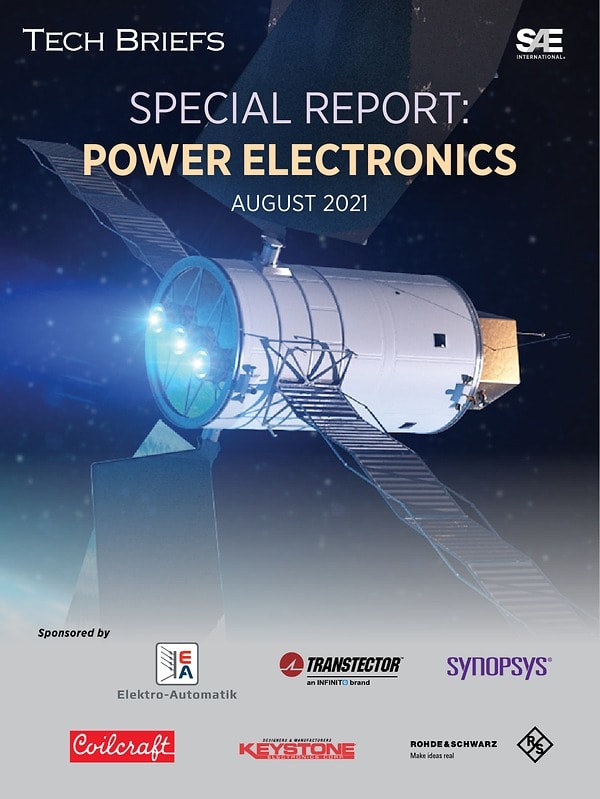
This compendium of recent articles from the editors of Tech Briefs and Aerospace & Defense Technology looks at the latest advances in power electronics and energy storage for a range of applications including wearable devices, electric vehicles, and spacecraft.
Don't have an account?
Overview
The August 2021 Special Report on Power Electronics presents a comprehensive overview of advancements in power processing technologies, particularly in the context of aerospace, defense, and energy storage solutions. The report highlights the critical need for reliable and efficient power systems in mission-critical environments, such as data centers and healthcare facilities, where power interruptions can lead to significant financial losses.
One of the key features discussed is the development of Charge Control Methods for Supercapacitors, which are increasingly being utilized for their rapid charge and discharge capabilities. The report emphasizes the transition towards hybrid supercapacitors that combine the benefits of traditional capacitors and batteries, enhancing performance and efficiency for various applications.
A significant focus is placed on the impact of solid-state technology on aerospace and defense equipment testing. The report outlines the stringent requirements for electronic devices in these sectors, including the need for ruggedness, reliability, and adherence to specific power design requirements. These devices must operate effectively across a wide temperature range and withstand shock and vibration, all while maintaining high mean-time-between-failure (MTBF) rates and minimizing electromagnetic interference (EMI).
The report also features a detailed examination of a Power Processing Unit (PPU) developed by NASA’s Glenn Research Center for small spacecraft electric propulsion. This unit is designed to condition and supply power to spacecraft thrusters and propellant flow control components, making it suitable for small satellites and missions beyond low Earth orbit.
In addition to these advancements, the report discusses the innovative use of nanowires in superconducting transistors. Researchers are developing superconducting nanowires that promise to enhance the efficiency of superconducting electronics, which are crucial for applications in quantum computing and medical imaging. The new design incorporates multiple conductive channels to reduce resistance and overheating, utilizing gallium nitride (GaN) for its favorable properties in high-voltage applications.
The report also addresses the growing importance of environmentally friendly power solutions, such as flywheel energy storage systems. These systems are highlighted as a sustainable choice for protecting critical operations, particularly in light of the increasing frequency of power interruptions due to severe weather and other disturbances. The traditional reliance on valve-regulated lead-acid (VRLA) batteries is being challenged by the high operational costs and environmental concerns associated with their use.
Overall, the Special Report on Power Electronics provides valuable insights into the latest technological advancements and their implications for various industries. It underscores the importance of innovative power solutions in ensuring continuous operations and advancing green initiatives, while also addressing the challenges posed by traditional power systems. The report serves as a vital resource for professionals in the field, offering a glimpse into the future of power electronics and its role in shaping efficient and sustainable energy systems.











