

Medical Manufacturing & Outsourcing - February 2022
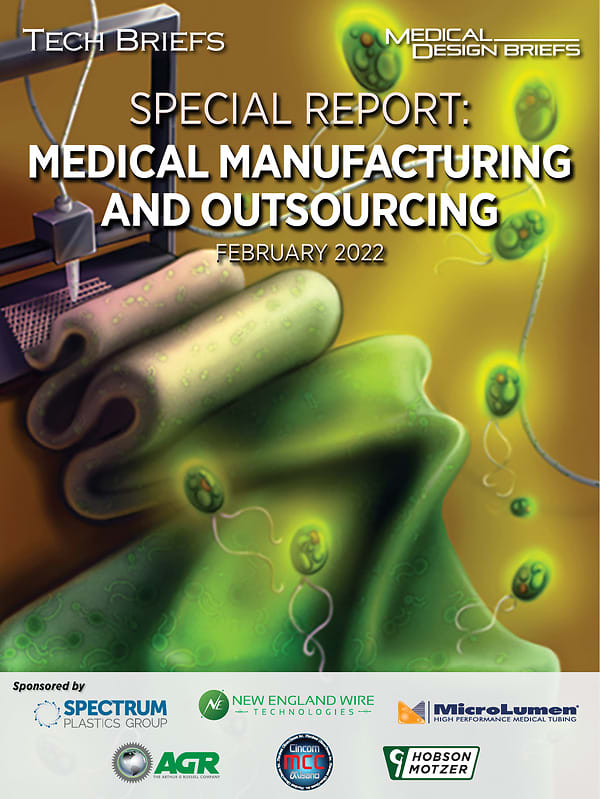
How virtual, cloud-based technologies are powering the next industrial revolution...transforming plastic parts into high-value products...designing optics for medical 3D printing. Read these stories and more in this compendium of recent articles from the editors of Medical Design Briefs magazine.
Don't have an account?
Overview
The Special Report on Medical Manufacturing and Outsourcing from February 2022 provides a comprehensive overview of the current landscape in the medical device industry, highlighting key advancements, challenges, and strategies for success.
The report begins with an exploration of new requirements for medical device cleaning validations, specifically focusing on the ST98 standard. This section emphasizes the importance of rigorous cleaning processes to ensure the safety and efficacy of medical devices, reflecting the industry's commitment to maintaining high-quality standards.
Another significant feature discusses the validation of extruded silicone tubing, which is crucial for various medical applications. The report outlines best practices for ensuring that these materials meet regulatory requirements and perform reliably in clinical settings.
The report also addresses the transformation of plastic parts into high-value products, showcasing innovative manufacturing techniques that enhance the functionality and sustainability of medical devices. This section highlights the growing trend of using advanced materials and processes to create more effective and environmentally friendly products.
A critical analysis of supply chain disruptions caused by the COVID-19 pandemic is presented, detailing the shift from lean production and just-in-time manufacturing strategies to a more resilient approach. The report suggests that manufacturers and consumers must adopt long-term strategic thinking to navigate ongoing uncertainties in the supply chain. It emphasizes the need for stakeholders to focus on their core competencies to enhance supply chain efficiency and reliability.
In the tech briefs section, the report delves into optical design considerations for additive manufacturing, which is becoming increasingly relevant in the production of medical devices. It discusses how optical sensors, such as laser power meters and high-speed cameras, are utilized to monitor and optimize manufacturing processes, ensuring precision and quality in the final products.
The report also highlights a colorful and sustainable solution for 3D printing in healthcare, showcasing how innovative materials can reduce environmental impact while meeting the demands of the medical industry. Additionally, it explores the role of virtual, cloud-based technologies in driving the next industrial revolution, emphasizing the importance of digital transformation in manufacturing processes.
One of the standout features of the report is the discussion on 3D printing of environmentally friendly materials made from algae. This innovative approach not only addresses sustainability concerns but also opens new avenues for creating living materials that mimic natural processes, enhancing the functionality of medical devices.
Overall, the Special Report on Medical Manufacturing and Outsourcing provides valuable insights into the evolving landscape of the medical device industry. It underscores the importance of innovation, sustainability, and strategic thinking in overcoming challenges and meeting the needs of healthcare providers and patients. As the industry continues to adapt to changing circumstances, the report serves as a vital resource for stakeholders looking to stay informed and competitive in this dynamic field.











