

Engine Technology - March 2022
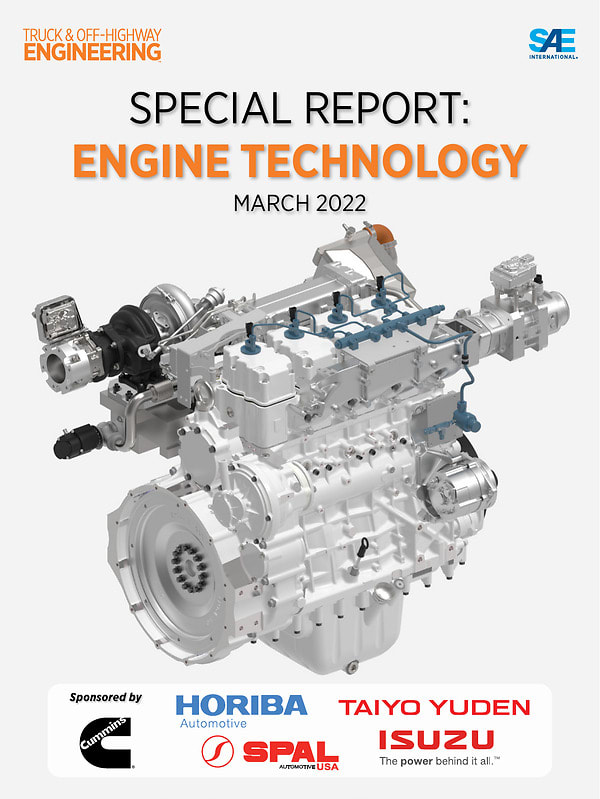
From diesel to electric to hydrogen, SAE's Truck & Off-Highway Engineering magazine reports on the latest advances in commercial vehicle engines. Stay up to date with this compendium of recent articles hand-picked by our editorial team.
Don't have an account?
Overview
The Engine Technology Special Report from March 2022 provides a comprehensive overview of the current landscape and future trends in engine technology, particularly focusing on internal combustion engines (ICE) and their evolution amidst the rise of electric vehicles (EVs) and alternative fuels.
The report emphasizes that despite the growing interest in EVs and fuel cells, diesel engines remain the predominant power source for both on- and off-highway vehicles, a trend expected to continue for at least the next decade. Engineers and research departments are actively working on enhancing the efficiency of ICEs through advancements in engine design and fuel technology. This ongoing development is crucial as industries seek to balance traditional power sources with emerging technologies.
One of the key highlights is the exploration of hydrogen as a potential interim power source. Hydrogen-fueled ICEs are being developed to address the challenges of replacing conventional fuels like diesel and gasoline. Collaborations, such as that between Mahle and Liebherr Machines Bulle SA, are focused on overcoming the technical hurdles associated with hydrogen's unique properties. The report notes that while hydrogen presents promising opportunities, it also poses significant challenges that need to be addressed for widespread adoption.
The report also discusses the role of variable geometry turbochargers (VGT) in improving engine performance. VGTs have been utilized in commercial engines for their ability to provide high boost pressure at low speeds, which enhances combustion efficiency and reduces emissions. Recent regulatory standards, such as those from the U.S. EPA and Euro VI, have driven engineers to optimize turbine efficiency across all operating conditions, leading to innovative design modifications.
Another significant development highlighted is the Detroit DD15 Gen 5 diesel engine, which has achieved remarkable success in the heavy-duty truck segment. The engine has surpassed one billion miles of cumulative field service in less than a year, showcasing its reliability and efficiency. This milestone underscores the ongoing demand for high-performance diesel engines in the Class 8 truck market.
The report also touches on the advancements in fuel cell technology, particularly by companies like Rolls-Royce, which aims to supply emergency power to data centers using CO2-free fuel cells. This initiative reflects a broader trend towards integrating cleaner energy solutions into existing infrastructure.
In summary, the Engine Technology Special Report illustrates a transitional phase in the engine industry, where traditional combustion engines are being refined and adapted to meet modern efficiency and emissions standards. The exploration of hydrogen and the continued innovation in diesel technology signify a dual approach to power generation, balancing the immediate needs of the industry with the long-term goals of sustainability and reduced environmental impact. As the industry evolves, the collaboration between traditional engine manufacturers and new technology developers will be crucial in shaping the future of transportation and power generation.










