

Vehicle Electrification - July 2022
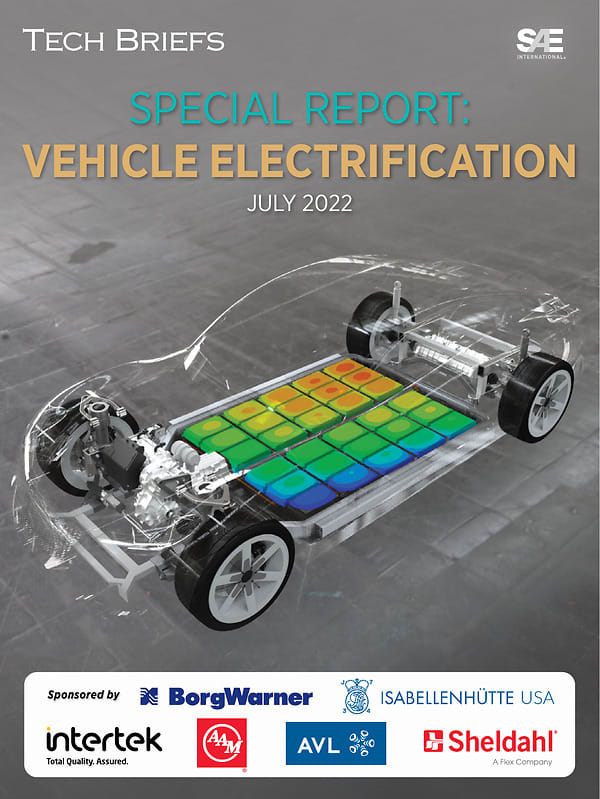
Innovation is happening at a rapid pace in the e-mobility space. Read this compendium of recent articles from the editors of Automotive Engineering and Truck & Off-Highway Engineering to learn about the latest advances in solid-state battery manufacturing, powertrain design, bi-directional charging technology, and much more.
Don't have an account?
Overview
The July 2022 Special Report on Vehicle Electrification highlights significant advancements and trends in the electric vehicle (EV) market, emphasizing the growing importance of battery technology and innovative features that enhance the utility of EVs.
One of the standout features discussed is bi-directional charging, prominently showcased by Ford's F-150 Lightning. This capability allows EVs to not only draw power from the grid but also supply energy back to homes during power outages. Ford's Intelligent Backup Power system is designed to meet the electrical needs of a typical home for up to three days, which could be a game-changer for consumers, particularly in areas prone to power outages.
The report also notes the rapid growth of battery electric vehicle (BEV) sales, which have more than doubled in recent years, reaching over one million units sold in 2021. This surge is attributed to several factors, including improved performance, lower maintenance costs, and increasing regulatory pressures on emissions. As battery prices continue to decline—reportedly by 87%—the adoption of EVs is expected to accelerate further.
In addition to bi-directional charging, the report discusses the potential of solid-state batteries, which promise higher energy density and safety compared to traditional lithium-ion batteries. These advancements are crucial for meeting the high expectations of the automotive market and could lead to new products and services, such as autonomous vehicles and electric delivery trucks.
The report features insights from industry leaders, including Mary Barra, CEO of General Motors, who emphasizes the shift towards sustainability and inclusiveness in the automotive sector. Carlos Tavares, CEO of Stellantis, echoes this sentiment, highlighting the urgency of innovation in the face of changing market dynamics.
Furthermore, the report covers the importance of a connected process in electric vehicle battery development, from design to delivery. This holistic approach is essential for manufacturers to achieve success in the competitive EV landscape.
Overall, the Special Report on Vehicle Electrification provides a comprehensive overview of the current state and future potential of electric vehicles, underscoring the transformative impact of battery technology and innovative features like bi-directional charging. As the industry continues to evolve, these advancements are set to redefine mobility and enhance the value proposition of electric vehicles for consumers.










