

Medical Manufacturing & Outsourcing - August 2022
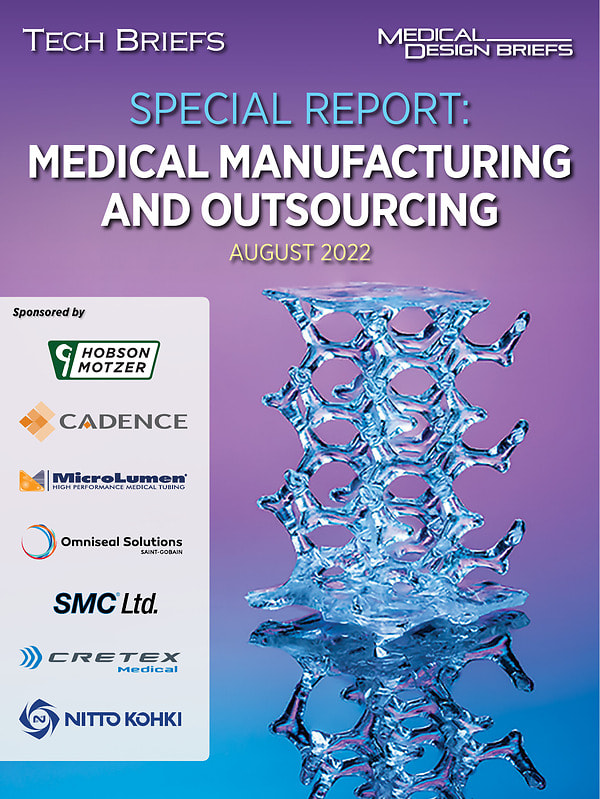
A novel ink that enables 3D printing of bone with living cells...advances in ultrasonic welding of plastics...additive manufacturing of self-powered wearable devices. Read these stories and more in this compendium of recent articles from the editors of Medical Design Briefs magazine.
Don't have an account?
Overview
The August 2022 Special Report on Medical Manufacturing and Outsourcing highlights significant advancements and trends in the field, particularly focusing on additive manufacturing (3D printing) and its implications for medical devices.
One of the key features of the report is the exploration of new frontiers in additive manufacturing, which is revolutionizing production and validation processes. The report discusses how innovative techniques, such as volumetric additive manufacturing, allow for the rapid creation of complex structures, including delicate optics made from silica glass. This method can produce microscopic objects in a matter of seconds or minutes, showcasing the potential for faster and more efficient manufacturing in the medical sector.
Another highlight is the introduction of a hybrid 3D printing method developed by researchers at the University of Notre Dame. This method enables the creation of self-powered wearable devices using piezoelectric materials that generate their own electrical charge from mechanical stress. The report details how these devices, which include stretchable sensors for detecting hand gestures and heartbeats, do not require external power sources, thus enhancing their practicality and usability in real-world applications.
The report also emphasizes the importance of quality control in additive manufacturing. It notes that while challenges exist in ensuring the quality of 3D printed parts, these challenges also present opportunities for new solutions and business ventures. For instance, companies like Taraz Metrology are emerging to provide advanced inspection solutions tailored to the needs of additive manufacturing, leveraging proprietary software for detailed topographical analysis.
Additionally, the report covers various aspects of medical device manufacturing, including the significance of outsourcing and the role of medical plastics. It discusses how ultrasonic welding is becoming a critical technique in the assembly of medical devices, improving the integrity and performance of products.
The report also touches on the advancements in 3D printing capabilities, such as the development of novel inks that can print bone with living cells, which could have profound implications for regenerative medicine and tissue engineering. This innovation represents a significant step forward in creating biocompatible materials that can integrate with human tissue.
Overall, the Special Report underscores the transformative impact of additive manufacturing on the medical industry, highlighting how these technologies can lead to faster production times, improved product quality, and enhanced patient experiences. It serves as a comprehensive overview of the current landscape in medical manufacturing, showcasing the potential for innovation and collaboration in addressing the challenges faced by the industry.
In conclusion, the report illustrates a dynamic and rapidly evolving field where advancements in technology are paving the way for more efficient, effective, and patient-centered medical solutions. As the industry continues to embrace these innovations, the future of medical manufacturing looks promising, with the potential to significantly improve healthcare outcomes.











