

Aerospace & Military Robotics - September 2022
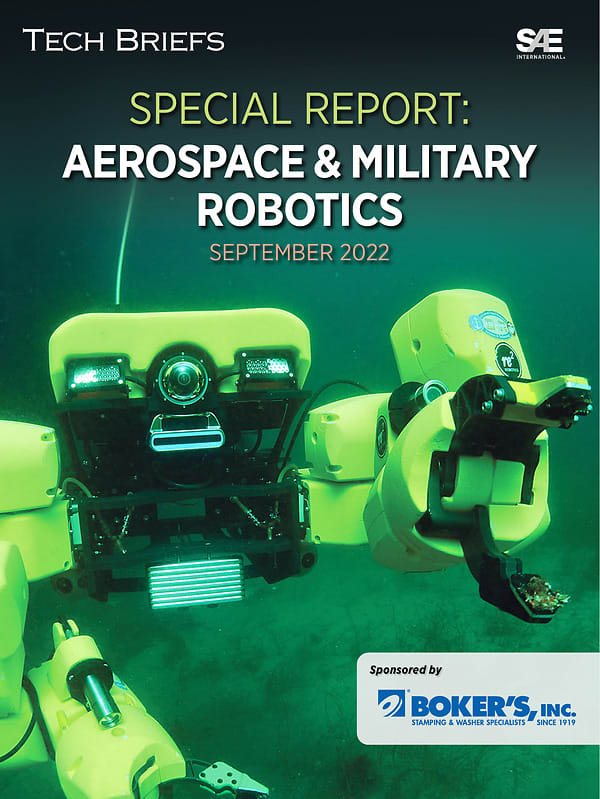
Autonomous robots explore the deep sea...AI-powered machines think for themselves in hazardous places...advanced bipedal robots combine walking with flying. These are just a few of the innovations you'll read about in this special report from the editors of Aerospace & Defense Technology and Tech Briefs magazines.
Don't have an account?
Overview
The September 2022 Special Report on Aerospace & Military Robotics explores the latest advancements and applications of robotic technologies across various sectors, emphasizing their transformative impact on operations in challenging environments. Sponsored by Quality Stampings & Washers, the report covers a range of topics, showcasing how robotics is enhancing safety, efficiency, and capabilities in both military and civilian applications.
One of the key features of the report is the use of underwater robotics for autonomous deep-sea exploration. These advanced systems are designed to navigate and operate in extreme underwater conditions, enabling researchers and engineers to gather data and perform tasks that would be difficult or impossible for human divers. The report highlights the importance of these technologies in expanding our understanding of marine environments and supporting scientific research.
Another significant area covered is the role of autonomous unmanned ground vehicle (UGV) technologies in defense applications. These vehicles are equipped with advanced sensors and AI capabilities, allowing them to perform reconnaissance, surveillance, and logistics tasks in remote or hazardous locations. The report discusses how UGVs enhance operational efficiency and reduce risks to human personnel in military operations.
The report also delves into innovative applications such as the use of laser-equipped robots for removing aircraft paint. This technology not only improves the efficiency of maintenance operations but also minimizes environmental impact by reducing the need for harmful chemicals traditionally used in paint removal processes.
Digital twins, a concept that involves creating virtual replicas of physical systems, are explored in the context of robotic systems. This technology allows for real-time monitoring and simulation, enabling engineers to optimize performance and predict potential issues before they arise. The report emphasizes the growing importance of digital twins in enhancing the reliability and effectiveness of robotic operations.
In addition to these applications, the report features advancements in AI-powered machines designed for hazardous environments. These robots are engineered to operate in conditions that pose risks to human safety, such as nuclear decommissioning sites. The Robotics and AI Collaboration (RAICo) initiative in Cumbria is highlighted, showcasing a joint research program aimed at developing advanced robotic and AI solutions for the nuclear sector.
The report also discusses the development of multi-legged swarm robots capable of navigating challenging terrains and performing cooperative tasks. These robots mimic natural organisms and are designed for applications such as search-and-rescue operations, environmental monitoring, and space exploration. The research focuses on improving their control, sensing, and power capabilities to ensure effective real-world performance.
Overall, the Special Report on Aerospace & Military Robotics provides a comprehensive overview of the current state of robotics technology, highlighting its potential to revolutionize various industries. By showcasing innovative applications and ongoing research, the report underscores the critical role of robotics in enhancing operational capabilities, safety, and efficiency in both military and civilian contexts. As technology continues to evolve, the future of robotics promises to bring even more groundbreaking advancements that will shape the way we interact with our environment and perform complex tasks.







