Vehicle Electrification - January 2023
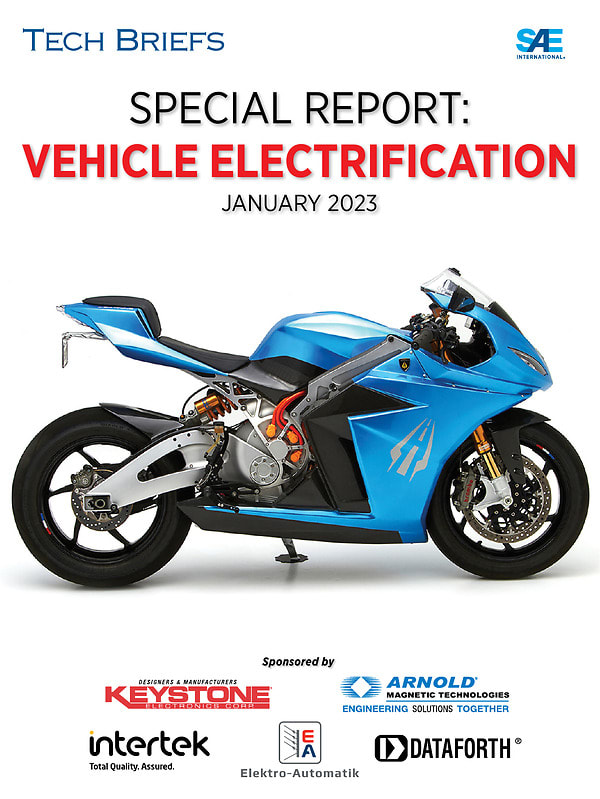
Innovation is happening at a rapid pace in the e-mobility space. Read this compendium of recent articles from the editors of Automotive Engineering and Truck & Off-Highway Engineering to learn about the latest advances in solid-state battery manufacturing, powertrain design, bi-directional charging technology, and much more.
Don't have an account?
Overview
The Vehicle Electrification Special Report from January 2023 provides a comprehensive overview of the latest advancements and trends in the electric vehicle (EV) industry, highlighting key innovations, challenges, and future directions.
One of the standout features of the report is the achievement of Lightning Motorcycles, which set a world speed record for electric two-wheelers at 215.907 mph with their Strike Carbon superbike. This accomplishment was made possible through a partnership with CBMM, utilizing niobium titanium oxide (NTO) battery cells, showcasing the potential of advanced materials in enhancing EV performance.
The report discusses the rapid growth of the EV market, emphasizing the increasing demand for electric vehicles and the corresponding need for efficient testing and development processes. It highlights the importance of charging standards, noting emerging technologies like CHAdeMO 3.0 and the Megawatt Charging System (MCS), which promise to enable faster charging solutions for EVs.
A significant focus is placed on battery technology, particularly the development of silicon-anode batteries. General Motors' joint-research agreement with OneD is noted as a pivotal step towards higher-performance battery anodes, which could lead to improved energy density and faster charging times. Additionally, the report explores the potential of niobium as a key element in battery chemistry, which may enhance cell capacity and performance under extreme thermal conditions.
The report also addresses the challenges of EV battery recycling, emphasizing its critical role in the sustainable future of electric vehicles. It outlines the hurdles that must be overcome to create a viable recycling infrastructure, which is essential for minimizing waste and maximizing resource recovery.
Another innovative development discussed is a new optimization framework from researchers at the University of Michigan, which could accelerate the testing of new electric vehicle battery designs by up to four times. This streamlined approach aims to reduce costs and improve the efficiency of assessing battery longevity and performance.
The report touches on the evolution of the vehicle-to-grid ecosystem, which represents a significant shift in how electric vehicles can interact with the power grid. This system allows EVs to not only draw power for charging but also to return energy to the grid, enhancing energy management and supporting renewable energy integration.
In summary, the Vehicle Electrification Special Report encapsulates the dynamic landscape of the electric vehicle industry, highlighting technological advancements, the importance of sustainable practices, and the ongoing evolution of charging infrastructure. As the market continues to expand, the report underscores the need for innovation in battery technology, recycling methods, and grid integration to support the future of electrification.