

Vehicle Electrification - January 2023
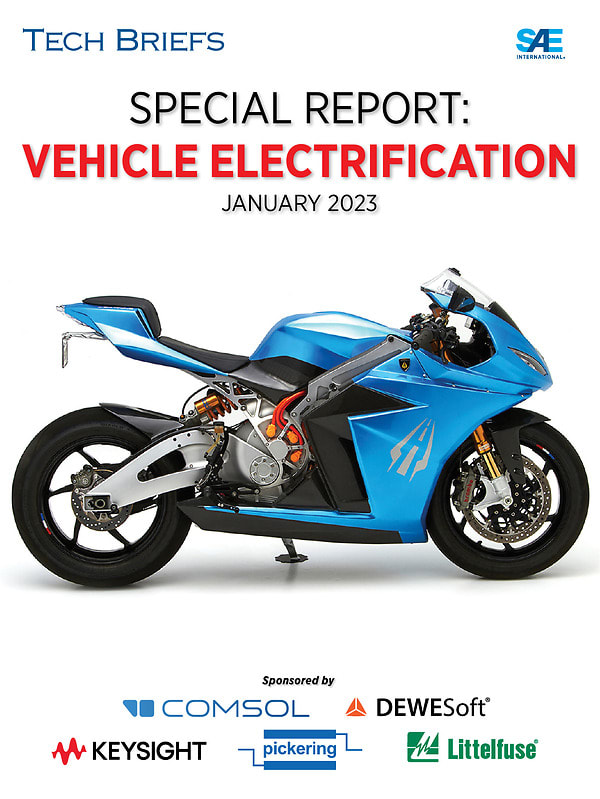
Innovation is happening at a rapid pace in the e-mobility space. Read this compendium of recent articles from the editors of Automotive Engineering and Truck & Off-Highway Engineering to learn about the latest advances in solid-state battery manufacturing, powertrain design, bi-directional charging technology, and much more.
Don't have an account?
Overview
The Vehicle Electrification Special Report from January 2023 provides a comprehensive overview of the latest advancements and trends in electric vehicle (EV) technology. It highlights significant developments in battery technology, electric powertrains, and the broader implications for the automotive industry and sustainability.
One of the key features of the report is the exploration of new battery technologies. Notably, the report discusses the collaboration between General Motors and OneD, focusing on the promise of silicon-anode development. Silicon anodes are expected to enhance battery performance by increasing capacity and efficiency, which is crucial for the growing demand for electric vehicles.
The report also highlights the innovative use of niobium titanium oxide (NTO) battery cells by Lightning Motorcycles, which helped set a world speed record for electric two-wheelers at 215.907 mph. This showcases the potential of advanced materials in pushing the boundaries of electric vehicle performance.
Another significant topic covered is the evolution of electric axles, or eAxles, which integrate electric powertrains into the vehicle's axle system. This development is aimed at improving the efficiency and performance of electric trucks and other vehicles, making them more competitive with traditional combustion-engine vehicles.
The report emphasizes the importance of recycling in the EV ecosystem, addressing the challenges and opportunities associated with recycling battery materials. As the electric vehicle market continues to grow exponentially, finding sustainable solutions for battery disposal and material recovery will be vital for the industry's future.
Additionally, the report discusses a new optimization framework developed by researchers at the University of Michigan, which could significantly reduce the time and cost associated with testing the longevity of new electric vehicle battery designs. This streamlined approach could accelerate the development of more durable and efficient batteries.
The report also touches on the need for advancements in renewable energy production, particularly through solar thermochemical hydrogen, which could complement the electrification of vehicles by providing cleaner energy sources.
Overall, the Vehicle Electrification Special Report serves as a valuable resource for understanding the current landscape of electric vehicle technology, the challenges faced by the industry, and the innovative solutions being developed to address these challenges. It underscores the critical role of research and collaboration in advancing the e-mobility ecosystem and highlights the potential for electric vehicles to contribute to a more sustainable future.










