Aerospace & Defense Sensing - April 2023
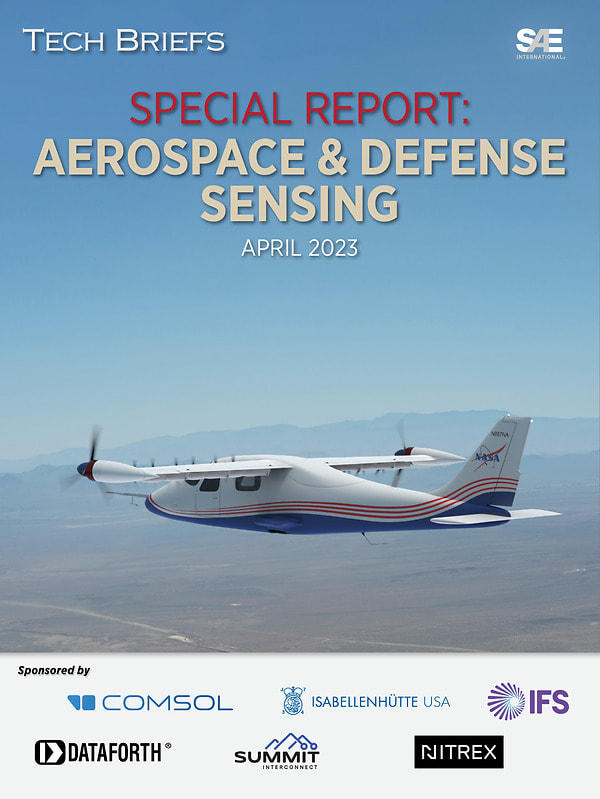
NASA is applying sensor technologies to create a state-of-the-art dexterous humanoid robot, to monitor the structural health of inflatable habitats designed for Mars, and to test the first all-electric X-plane. Read about these and other exciting advances in this new report from the editors of Tech Briefs and Aerospace & Defense Technology.
Don't have an account?
Overview
The April 2023 Special Report on Aerospace & Defense Sensing explores the latest advancements in sensor technology, emphasizing its critical role in the evolving landscape of aerospace and defense. The report highlights the increasing demand for sensors that can deliver accurate data in harsh environments, relying on advanced manufacturing methods that integrate multiple materials into precision assemblies.
A key theme of the report is the transition from traditional mechanical systems to digitally connected devices, driven by the Internet of Things (IoT) revolution. This shift is characterized by the emergence of smart, connected devices that enhance operational efficiency and data analytics. The report discusses how 5G connectivity is pivotal in this transformation, enabling advanced sensor-level edge computing and supporting applications in artificial intelligence, machine learning, and autonomous systems.
The report features various applications of sensor technology, including NASA's X-57 Maxwell Electric Aircraft, which showcases the integration of all-electric motors powered by traction batteries. This aircraft exemplifies the push towards energy-efficient aviation, using significantly less energy than traditional gasoline-powered aircraft.
Another focus is on the miniaturization of sensors, which has become increasingly important in both military and consumer applications. The report notes the development of compact, battery-powered sensors that can fit into small spaces while maintaining high functionality. Examples include postage stamp-sized temperature sensors and nanosensors for medical applications, which are smaller than a grain of rice. This trend towards smaller, smarter sensors is driven by the need for enhanced sensing capabilities and longer battery life.
The report also addresses the importance of sensor reliability and longevity, particularly in challenging operational conditions. Sensors must withstand thermal, chemical, and mechanical stresses while providing consistent performance. The integration of advanced materials and manufacturing techniques is crucial to achieving these goals.
Furthermore, the report discusses the compounded value of smart, connected sensors, which combine digital capabilities with miniaturized components and reliable communication platforms. This holistic approach to sensor design mirrors the interconnected systems of the human body, where various senses work together to create a comprehensive understanding of the environment.
In summary, the April 2023 Special Report on Aerospace & Defense Sensing provides a comprehensive overview of the current state and future direction of sensor technology. It highlights the critical role of connectivity, miniaturization, and advanced manufacturing in developing sensors that meet the demands of a rapidly changing world. As the aerospace and defense sectors continue to innovate, the evolution of sensor technology will play a pivotal role in enhancing operational capabilities and driving advancements across various applications.