

Space Technology - November 2023
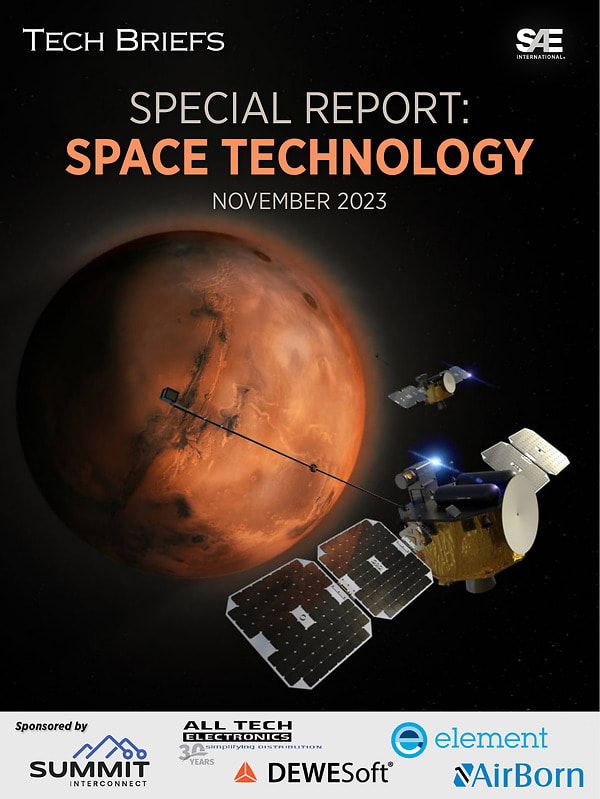
Read about NASA's plans for future Mars exploration, ultrafast laser-based space communications, new strategies for cleaning up orbital debris, and much more in this compendium of recent articles from the editors of Tech Briefs and Aerospace & Defense Technology magazines.
Don't have an account?
Overview
The November 2023 Special Report on Space Technology presents a comprehensive overview of recent advancements and ongoing projects in the field of space exploration and technology. It highlights the evolution of communication technologies, particularly the ongoing debate between traditional radio and emerging laser-based systems. While radio has been a reliable medium for over a century, lasers are increasingly recognized for their superior capabilities in telecommunications, particularly in defense applications.
The report also delves into the challenges and innovations associated with imaging space debris. It describes a model involving a cluster of reflectors that work in unison to detect signals emitted from ground control stations. These signals, which operate in the X-band frequency range (8 to 12 gigahertz), are reflected off space debris, allowing for the collection of data. However, the report notes that higher frequencies can lead to image distortions due to atmospheric fluctuations, complicating the imaging process. To mitigate these effects, the authors emphasize the importance of correlating data from multiple receivers.
Additionally, the report reflects on the historical context of Mars exploration, tracing the journey from NASA's Mariner 4 flyby in 1964 to the Perseverance rover mission in 2020. This timeline underscores humanity's long-standing interest in Mars and the significant technological advancements that have facilitated these missions.
The report also discusses the critical need for robust and reliable technologies in space exploration, especially for human safety during extended missions. It highlights how traditional safety-critical systems have evolved, leveraging advancements in computing power and electronics reliability. This shift towards digital and software controls has enabled significant improvements in performance, size, weight, and power (SWaP) efficiency.
Overall, the Special Report encapsulates the dynamic landscape of space technology, emphasizing the interplay between historical achievements and future innovations. It showcases how advancements in communication, imaging, and system reliability are shaping the future of space exploration, particularly in the context of Mars missions and beyond. The report serves as a testament to the ongoing commitment to exploring humanity's place in the universe and the technological strides being made to ensure safe and effective exploration.







