

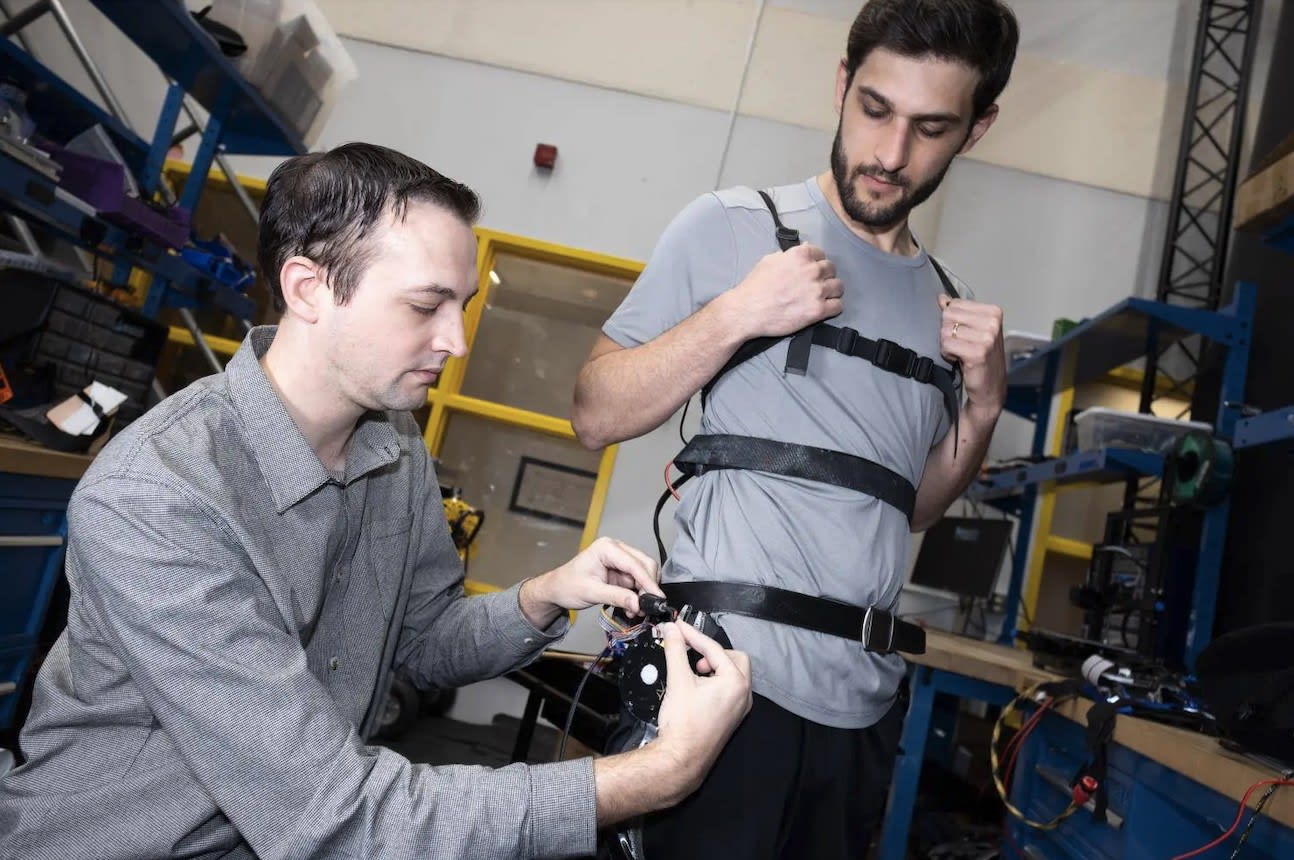
A team of Georgia Tech researchers in Aaron Young’s lab has developed a universal approach to controlling robotic exoskeletons that requires no training, no calibration, and no adjustments to complicated algorithms. Instead, users can don the “exo” and go.
Their system uses a kind of artificial intelligence called deep learning to autonomously adjust how the exoskeleton provides assistance, and they’ve shown it works seamlessly to support walking, standing, and climbing stairs or ramps. They described their “unified control framework” in Science Robotics.
“The goal was not just to provide control across different activities, but to create a single unified system,” said Associate Professor Young. “You don't have to press buttons to switch between modes or have some classifier algorithm that tries to predict that you're climbing stairs or walking.”
Here is an exclusive Tech Briefs interview — edited for length and clarity — with Young.
Tech Briefs: What was the biggest technical challenge you faced while developing this framework?
Young: In general, the biggest technical challenge is engineering (collecting, etc.) the appropriate training data for the deep learning system to function well. It requires tons of hours of human data collection and then a tremendous amount of data cleanup and labeling before ML algorithms can be trained. This engineering of all the appropriate data to have a fully functional system is one of the most challenging aspects of this strategy.
Tech Briefs: Can you explain in simple terms how it works?
Young: In simple terms: The AI is designed to estimate your own internal joint effort. The idea is that as long as the AI can accurately predict (in this case at the hip) the amount of effort that a given joint wants to exert at any time, then it can provide useful assistance regardless of the specific context (e.g. across walking, ramps, and stairs) without necessarily knowing the specifics of the environment. It can do this based on millions of training labels learning the relationship of exoskeleton sensing data to underlying joint dynamics of the human user across numerous individuals and across numerous different task conditions in the data set.
Tech Briefs: What are its pros and cons?
Young: Pros: It provides meaningful assistance in a range of different modes (walking, ramps, stairs). We are also able to track the human dynamics quite accurately with the system. It provides substantial augmentation relative to not wearing any device in both walking and ramps.
Cons: We still have the issue of donning/doffing a 4.5kg exoskeleton. There can be discomfort associated with an exoskeleton interface. While controls are still in very good shape, we still feel like hardware improvements are necessary to deploy such a system commercially.
Tech Briefs: Do you have any updates you can share? What are your next steps?
Young: We are still in the very early stages of this. Similar to this experiment, we are doing tons of ‘training data’ collection and engineering in order to perform this type of estimation in this unique population. Until we have sufficient training data, we won’t be able to make further progress, and this will be many months of work.
Probably the biggest next step is translating to a clinical population.
Tech Briefs: Do you have any advice for engineers/researchers aiming to bring their ideas to fruition?
Young: Patience is key in that the right solution is usually not the fast or expediate one. Our group tends to take a principled approach that may take a long time but (hopefully) the final product is something that is truly valuable and extensively tested. This requires a lot more effort (and money) than perhaps some might like, but it is the key to developing highly technical engineering solutions that will provide value to our customers and communities.
There are always a lot of failures and incorrect hypotheses along the way, and adapting to these while focusing on the end goal and product are critical as often methodological adjustments along the way are critical to ensuring success in my opinion.
Tech Briefs: Anything else you’d like to add?
Young: One thing to perhaps emphasize is that we have made all this data into an open-source dataset for the community. In order for AI algorithms to successfully evolve in the exoskeleton field, we need groups willing to not just publish their algorithm findings and code, but in fact the underlying datasets, so we can create large models like what has been done in the machine vision and language fields to much success.
Our biggest challenge as a field moving forward in using large, deep AI algorithms is a lack of critical training data, as, ideally, we would have access to hundreds if not thousands of individuals’ worth of data from a huge range of activities (with full ground truth labels). We are still a long way from this goal and our group is trying to stimulate this by open-sourcing and sharing this large dataset, which adds to a few of our previously published datasets.
Transcript
00:00:00 so we primarily work in varable robotics uh the research that we have spans a lot of different application areas but we are very focused generally on mobility and Community ambulation and specifically using kind of assistive devices to help people be able to ambulate and get around more easily in their lives so for a lot of us mobility
00:00:29 is something we're able ble to take for granted um but when you think about how humans go about their day Mobility is really a key feature right of course one of the hopes is that this work can obviously translate to people with Mobility impairments um to to hopefully lift their quality of life one of the basic types of devices like what you see in front of you is is called an
00:00:51 exoskeleton so these are wearable devices that go around your existing Limbs and will help you walk and so these can be at any joint or at multiple joints we also work in a different class of devices that is for limb replacement so these are usually called robotic prostheses and will replace joints missing on an ampute and so what's so neat about this space is essentially we
00:01:16 tried to develop uh an environment that's very similar to what you might experience in daily life with stair Heights of varying uh varying Heights or or ramps of varying inclines but we put it in a space where we can collect all of the data we need to compute the ground truth labels of what the actual human biological joints are doing my prosthetic device that I wear it it
00:01:39 changes the gate changes as I walk so when I go from a slow speed to a fast speed but I'm doing all the work this assists you so you don't have to work as hard and you don't have to expend as much energy just to reserve that that energy for your day-to-day activities will allow other amputees to be more active during the day and do more the impact is really focused on function can
00:02:08 we increase people's function in their daily lives and then we we also think about impact from two other things energy so can we make it easier for someone to get around doing the same thing the other is in stability and the idea is that these devices should help provide more safety and stabilization when they become unstable so for example if you trip on something hopefully your
00:02:31 device is helping you get back to a a nominally safe and stable game











