

Aerospace & Defense Sensing - April 2024
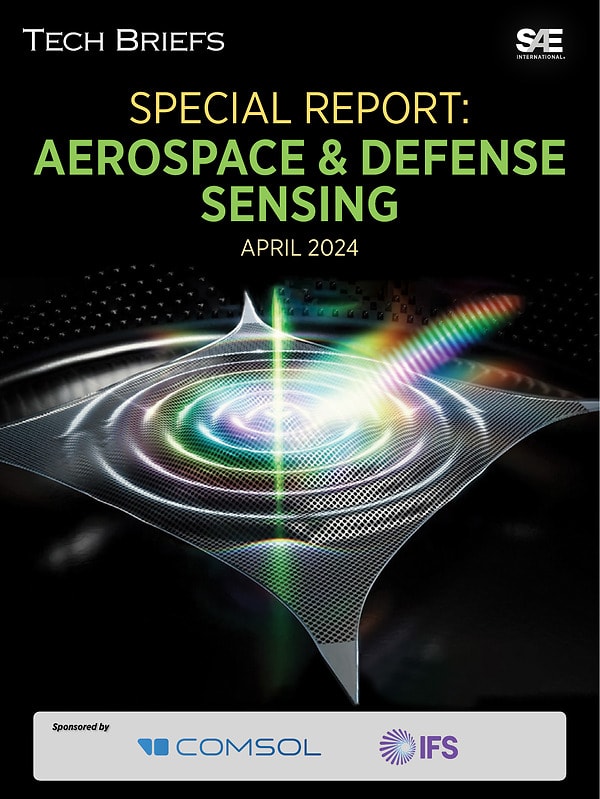
The world's first long‐range radio communications with an atomic quantum sensor…a sensor material 10x stronger than Kevlar…a microchip combining two Nobel Prize‐winning techniques to monitor the Earth's climate and human health with high precision. Read about these and other sensor innovations in this report just released by the editors of Tech Briefs and Aerospace & Defense Technology.
Don't have an account?
Overview
The April 2024 Special Report on Aerospace & Defense Sensing presents a comprehensive overview of the latest advancements and technologies in the field. This edition highlights several key features and innovations that are shaping the future of aerospace and defense sensing applications.
One of the standout features is the evolution of airborne inspection sensors, which are now enhanced with LiDAR, mid-infrared technology, and artificial intelligence. These advancements enable more precise and efficient inspections, crucial for maintaining safety and operational integrity in aerospace applications.
Another significant development discussed is the work by Rydberg Technologies, which showcases the potential of long-range radio frequency (RF) sensing using quantum sensors. This technology promises to revolutionize how data is collected and transmitted over long distances, enhancing communication and monitoring capabilities in defense scenarios.
The report also delves into optimizing torque measurement in robotics applications. It emphasizes the importance of sensor resolution and update rates, noting that for certain applications, the interrogation power and sensor read range can be minimal, allowing for rapid torque updates. This optimization is vital for improving the performance and reliability of robotic systems in various operational contexts.
Additionally, the report introduces wearable RFID sensor tags designed for extended operational times. These tags are particularly beneficial in scenarios where battery charging or replacement is impractical, thus enhancing the functionality and longevity of wearable sensors in the field.
The report features several tech briefs that highlight emerging technologies, including a new ultra-strong material for microchip sensors, an optical concentration sensor for liquid solutions, and a flow-through transducer for wind tunnel analysis. These innovations are critical for advancing sensor technology and improving measurement accuracy in various applications.
Moreover, the report discusses the development of a new microchip capable of monitoring Earth's climate and human health. This technology represents a significant step forward in environmental monitoring and public health initiatives, showcasing the potential for sensors to contribute to global challenges.
The cover story features a team from Delft University of Technology, which has successfully combined two Nobel Prize-winning techniques on a microchip for the first time. This groundbreaking achievement could lead to new applications and improvements in sensor technology, further pushing the boundaries of what is possible in aerospace and defense sensing.
Overall, the April 2024 Special Report on Aerospace & Defense Sensing encapsulates a range of innovative technologies and applications that are set to transform the industry. From advanced inspection sensors to wearable technologies and groundbreaking microchip developments, the report underscores the importance of continuous innovation in enhancing safety, efficiency, and performance in aerospace and defense operations.







