Automotive Test & Simulation - May 2024
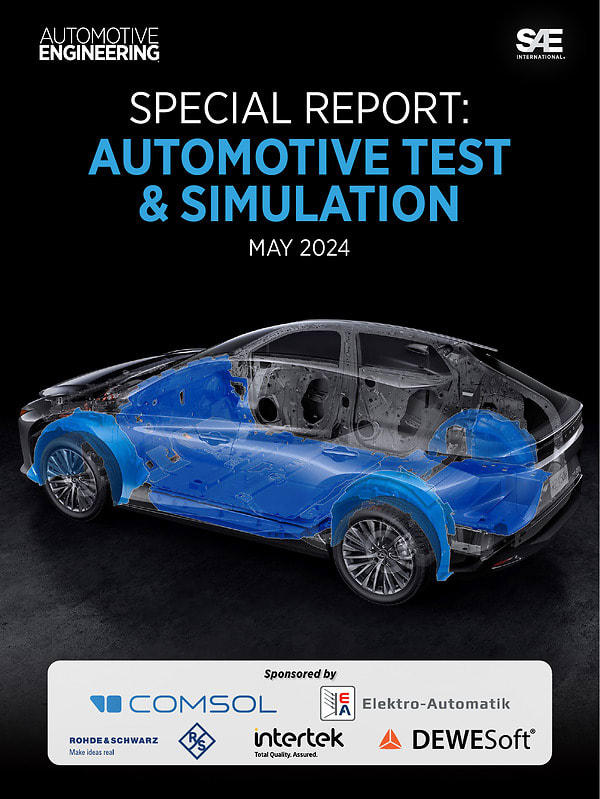
In this compendium of articles from the editors of Automotive Engineering and Truck & Off‐Highway Engineering, learn about the latest simulation and test technologies for ADAS, autonomous vehicles, EV batteries, NVH abatement, and other critical applications.
Don't have an account?
Overview
The Automotive Test & Simulation Special Report for May 2024 highlights key advancements and trends in the automotive industry, particularly focusing on testing and simulation technologies that are essential for the development of modern vehicles.
One of the central themes of the report is the growing importance of sensor fusion in enhancing vehicle sophistication. As the demand for automated driving and efficiency-enhancing features increases, innovations in sensor fusion are becoming critical. This technology integrates data from multiple sensors to improve decision-making capabilities, enabling functionalities that would not be possible with isolated sensor data. The report discusses how the adoption of various sensor technologies will be evaluated based on their cost-effectiveness relative to performance, particularly in applications where secondary systems, like backup eMotors, may have lower performance requirements.
The report also features an article on upcycling commercial fleets into circular electric vehicles (EVs). California-based Evolectric is highlighted for its use of digital twin technology, which allows older vehicles to be transformed into cleaner, smarter, and more affordable options. This approach not only extends the life of existing vehicles but also contributes to sustainability efforts within the automotive sector.
Another significant topic covered is the integration of battery test systems. The report emphasizes the importance of designing test systems that can recover energy locally and utilize the inherent benefits of electric vehicles, such as energy sharing on testbeds. This is crucial for optimizing battery performance and ensuring the reliability of EVs.
The report also delves into emerging plasma-focused ion beam scanning electron microscopy (PFIB-SEM) techniques that are advancing battery innovation. Traditional gallium FIB-SEM tools are effective for lithium-ion battery research, but PFIB-SEM offers enhanced analytical capabilities for evaluating advanced battery systems, which is vital for the ongoing development of more efficient and powerful batteries.
Additionally, the report addresses the challenges posed by noise, vibration, and harshness (NVH) in electrified vehicles. As electrification becomes more prevalent, new benchmarks and tools are required to tackle these challenges effectively. The report discusses the engineering advancements that are being made to improve NVH performance in electric vehicles, ensuring a more comfortable driving experience.
Overall, the Automotive Test & Simulation Special Report provides a comprehensive overview of the current landscape in automotive testing and simulation, emphasizing the role of technology in driving innovation. It highlights the need for cost-effective solutions, the importance of sustainability through upcycling, and the ongoing advancements in battery technology and NVH management. As the automotive industry continues to evolve, these insights will be crucial for stakeholders looking to navigate the complexities of modern vehicle development and ensure the successful integration of new technologies.