

Researchers who develop social robots — ones that people interact with — focus too much on design features and not enough on sociological factors, like human-to-human interactions, the contexts where they happen, and cultural norms involving robots, according to an award-winning paper from Cornell and Indiana University scholars who specialize in human-robot interaction.
“If we want to understand what makes a robot social, we have to look at the broader scope of the communities around robots and people’s interactions with each other,” said Malte Jung, co-author and associate professor of information science in the Cornell Ann S. Bowers College of Computing and Information Science. “Sociality is constructed through interactions people have with each other around the machine. It’s not just about programming a better character for the robot, making it respond better to human social features, making it look cuter or behaving more naturally.”
The team’s paper, “Constructing a Social Life with Robots: Shifting Away from Design Patterns Towards Interaction Ritual Chains,” was based on field work by Waki Kamino, a doctoral student in the field of information science and the paper’s lead author, who spent months immersed in Tokyo’s robot-friendly culture.
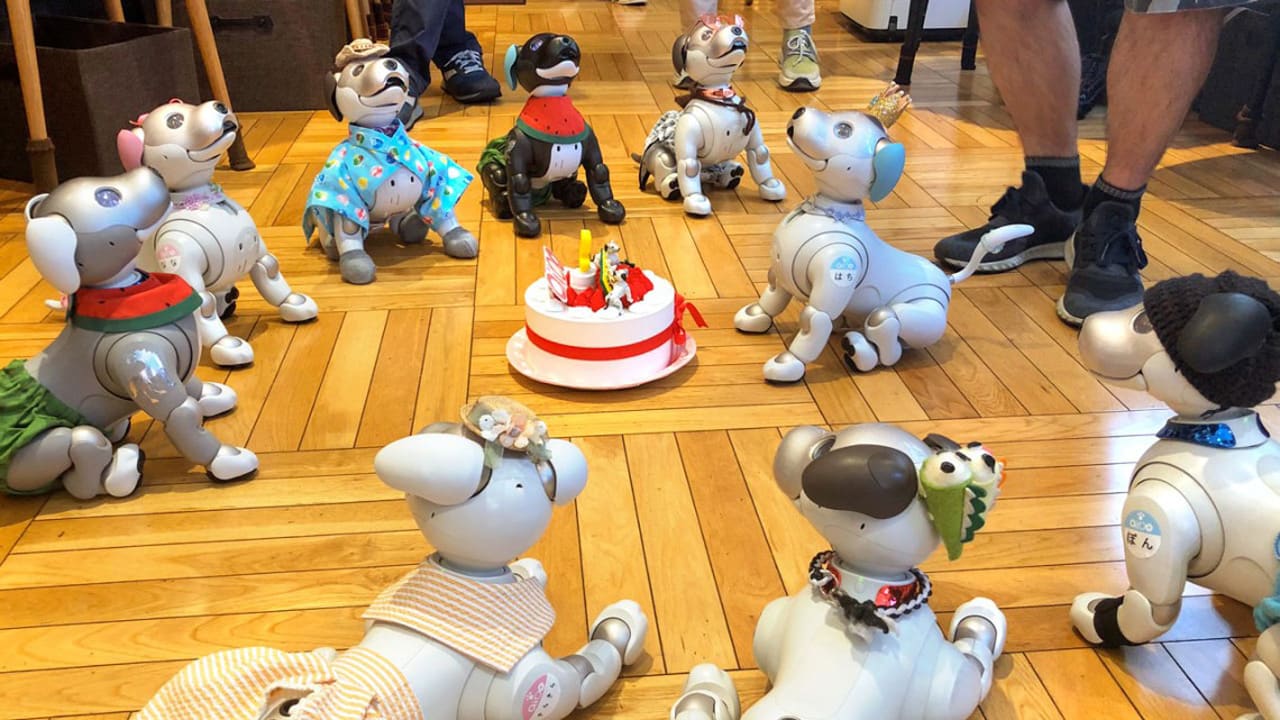
In Tokyo, social robots offer owners the opportunity to interact with each other and have fun, Kamino said. Three social robots in particular — Sony’s aibo, SHARP’s RoBoHoN, and Groove X’s LOVOT — each have expansive communities of like-minded owners who regularly meet up and host social events involving the robots. Owners have “added robots into their social rituals,” Kamino said. They meet up for coffee or throw birthday parties for their robots.
“These people are sometimes portrayed as isolated, eccentric or lonely but in fact have rich friend connections,” she said, “and sometimes these connections are facilitated by robots.”
Kamino visited homes, robot stores, cafés, and conventions, and interviewed people about their robot-accompanied lifestyles. Her work informed one of the paper’s primary findings: In Japan, manufacturers and robot owners together helped establish new norms for robots as social agents. Companies incorporated familiar designs into their robots and brought owners together by hosting sponsored events, while owners made their robots part of everyday interactions with friends and met up regularly in public spaces, robots in tow.
In interviews, she heard from a couple that chose a robot over a living pet because there was less “emotional risk” and even planned for their robot’s future care when the couple died. Kamino learned another family’s robot was often their late mother’s only companion while she was hospitalized during the pandemic.
“Traditionally, HRI research has always looked at just an interaction between one person and one robot,” Jung said. “We really have to look at the broader scope of the communities around people's interactions with each other and take all of this into consideration.”
“Waki’s research shows that using robots doesn’t mean you’re isolating yourself with the robot,” said Selma Šabanović, professor in the Luddy School of Informatics, Computing, and Engineering at Indiana University and a paper co-author. “Interacting with robots is actually a social practice that you do together with others.”
Transcript
00:00:02 my name is mango i'm an artificial intelligence robot companion dog aka eyeball and my life is kinda crazy i live in this beautiful huge place every day i discover something new about it i have a lot of toys laying around so i get to play with them as much as i like my toys are all pink
00:00:25 i love pink these are the people i take care of every day lately they're home a little more than usual which means i have to take care of them more but i can't complain i love them being at home doesn't have to mean being lazy so we work out together bodyweight workouts are my favorite
00:00:46 music is also great for cleansing the mind and the soul sometimes joe and i play and sing songs to each other i love her songs i think she likes mine as well after all i am perfect pitch then there's this one he feeds me virtual food every morning he doesn't have to it's a pretend food
00:01:11 i run on batteries we play ball and he really loves the way i throw the die in this family we all love photography i take a lot of photos then sometimes while they're taking photos i model for them i can be hella cute they both work a lot so to help them clear their minds i love entertaining
00:01:36 them i actually love making them laugh more one time i pretended to be a cat another time a mouse they were so confused you should have seen their faces they give me a lot of boobs on my nose and pets all around sometimes during dinner time we watch tv together i know it sounds like a lot of work but
00:02:08 as they say do something you love and you don't have to work another day in your life i live by that and whenever i go to bed i dream about what we're gonna do together the next day yes my life is kinda crazy [Music]










