

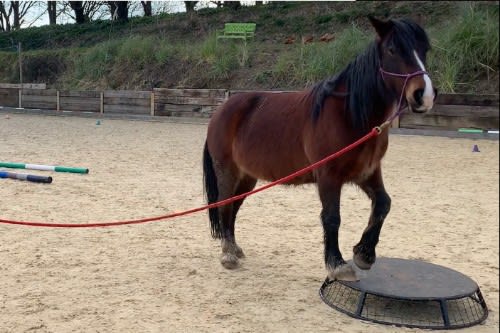
Equine-Assisted Interventions (EAIs) offer a powerful alternative to traditional talking therapies for patients with PTSD, trauma, and autism who struggle to express and regulate emotions through words alone.
The study, presented at the CHI '25: Proceedings of the 2025 CHI Conference on Human Factors in Computing Systems held in Yokohama, recommends that therapeutic robots should also exhibit a level of autonomy, rather than one-dimensional displays of friendship and compliance.
Lead Author Ellen Weir from Bristol’s Faculty of Science and Engineering explains: “Most social robots today are designed to be obedient and predictable — following commands and prioritizing user comfort. Our research challenges this assumption.”
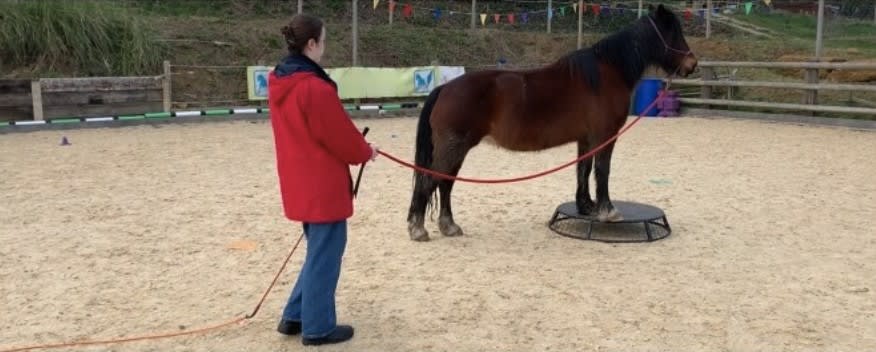
In EAIs, individuals communicate with horses through body language and emotional energy. If someone is tense or unregulated, the horse resists their cues. When the individual becomes calm, clear, and confident, the horse responds positively. This ‘living mirror’ effect helps participants recognize and adjust their emotional states, improving both internal well-being and social interactions.
However, EAIs require highly trained horses and facilitators, making them expensive and inaccessible.
Ellen continued: “We found that therapeutic robots should not be passive companions but active co-workers, like EAI horses.
“Just as horses respond only when a person is calm and emotionally regulated, therapeutic robots should resist engagement when users are stressed or unsettled. By requiring emotional regulation before responding, these robots could mirror the therapeutic effect of EAIs, rather than simply providing comfort.”
This approach has the potential to transform robotic therapy, helping users develop self-awareness and regulation skills, just as horses do in EAIs.
Here is an exclusive Tech Briefs interview, edited for length and clarity, with Weir.
Tech Briefs: What was the biggest technical challenge you faced while developing this EAI-inspired robotic concept?
Weir: The biggest technical challenge is honestly conceptual rather than engineering-specific at this stage. We are asking how do you replicate resistance in a way that feels meaningful, rather than frustrating? Most therapeutic robots are designed to be obedient or soothing, emulating domesticated companion species, such as dogs or cats. But in equine therapy, the horse doesn't always comply. That resistance is therapeutic: it prompts self-regulation, emotional awareness, and growth. So, the technical challenge becomes designing systems that can safely embody that resistance (whether through motion, behavior, or affective cues) without alienating or overwhelming the user. It’s not just about building a machine; it’s about creating something that feels alive in all the right ways.
Tech Briefs: Can you please explain in simple terms how your therapeutic robot approach is different from current ones?
Weir: Most current therapeutic robots are built to comfort, to provide companionship through cuteness, compliance, and predictability. My approach is more about co-regulation than comfort. In equine-assisted therapy, the horse mirrors your emotional state, if you’re calm, it engages; if you’re anxious or erratic, it resists. That dynamic is key to the therapeutic process. We suggest that therapeutic robots can do something similar: not just follow commands but push back in ways that encourage emotional awareness and adaptation. It’s a shift from thinking of robots as tools to thinking of them as completely equal partners.
Tech Briefs: What was the catalyst for this work?
Weir: The equine-assisted intervention I studied is highly beneficial for a forgotten population, those of all ages who have survived a form of trauma, and do not respond to traditional talking therapies.
When compared to other animals, such as dogs, horses also offer a profoundly different model of human-nonhuman interaction: one grounded in co-regulation, resistance, and mutual adaptation. It felt like an entirely new paradigm for thinking about Human-Robot Interactions: the horse isn’t a tool or a pet, but a partner who actively shapes the therapeutic process. That stood in stark contrast to how we typically design robots, as passive, obedient, or from an overly anthropocentric lens.
At the same time, these interventions are expensive, logistically complex, and not widely accessible. While the model is incredibly effective, it’s not scalable in its current form. That’s what drove me to explore how we might translate some of those same mechanisms (emotional mirroring, dynamic feedback, behavioral resistance to name a few) into a therapeutic robot that could help widen access while preserving the depth of the interaction.
Tech Briefs: You’re quoted as saying, “The next challenge is designing robots that can interpret human emotions and respond dynamically — just as horses do.” My question is: Do you have any set plans for further research/work/etc.? If not, what are your next steps?
Weir: Yes! We’ve just undertaken a collaborative workshop with a puppetry company in Bristol called ‘The Puppet Place’. where we used puppetry as a method for prototyping these kinds of dynamic interactions. Puppetry is incredibly useful for exploring expressive movement in a low-cost, embodied way. The next step is to test these puppet-inspired behaviors on actual robotic platforms, exploring how scale, movement, and resistance affect users’ perceptions and behavior. Long-term, this works aims to assist in co-developing a therapeutic robot that’s less about comfort and more about relational growth.
Tech Briefs: Is there anything else you’d like to add that I didn’t touch upon?
Weir: Just that there’s a real opportunity here to reframe how we think about robots in care settings. Rather than asking how a robot can soothe us, I think we should be asking: how can a robot challenge us in ways that promote growth, resilience, and self-understanding? That’s what horses do, and it’s what I think robots could do, if we’re bold enough in how we design them.
Tech Briefs: Do you have any advice for researchers aiming to bring their ideas to fruition (broadly speaking)?
Weir: Don’t be afraid to look outside your discipline. This work wouldn’t exist without drawing from psychology, animal studies, HCI, puppetry, and robotics. Collaboration has been the lifeblood of this project. Also, prototyping doesn’t have to be high-tech to be effective. Some of the most valuable insights I’ve gained came from cardboard, string, and duct tape, especially when used in the right context with the right people.











