

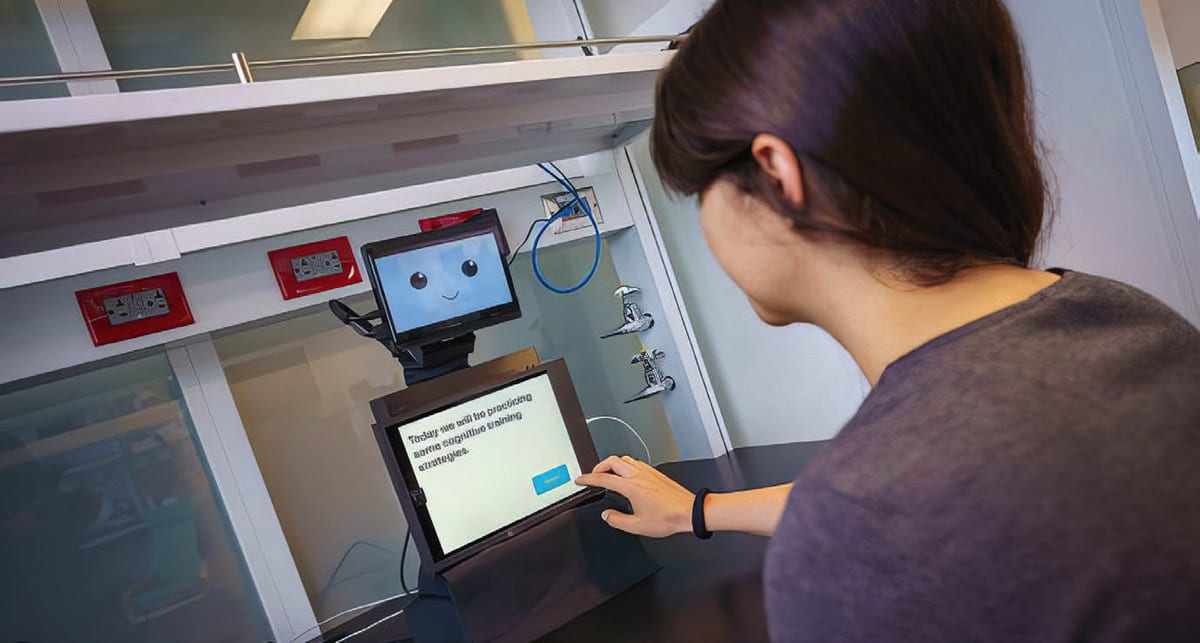
Engineers at the University of California San Diego in collaboration with clinicians, people with MCI, and their care partners have developed CARMEN, short for Cognitively Assistive Robot for Motivation and Neurorehabilitation — a small, tabletop robot designed to help people with mild cognitive impairment (MCI) learn skills to improve memory, attention, and executive functioning at home.
To the best of the researchers’ knowledge, CARMEN is also the only robot that teaches compensatory cognitive strategies to help improve memory and executive function. “We wanted to make sure we were providing meaningful and practical inventions,” said Laurel Riek, Professor of Computer Science and Emergency Medicine at UC San Diego and the work’s senior author.
MCI is an in-between stage between typical aging and dementia. It affects various areas of cognitive functioning, including memory, attention, and executive functioning. About 20 percent of individuals over 65 have the condition, with up to 15 percent transitioning to dementia each year. Existing pharmacological treatments have not been able to slow or prevent this evolution, but behavioral treatments can help.
Researchers programmed CARMEN to deliver a series of simple cognitive training exercises. For example, the robot can teach participants to create routine places to leave important objects, such as keys; or learn note taking strategies to remember important things. CARMEN does this through interactive games and activities.
The research team designed CARMEN with a clear set of criteria in mind. It is important that people can use the robot independently, without clinician or researcher supervision. For this reason, CARMEN had to be plug and play, without many moving parts that require maintenance. The robot also has to be able to function with limited access to the internet, as many people do not have access to reliable connectivity. CARMEN needs to be able to function over a long period of time. The robot also has to be able to communicate clearly with users; express compassion and empathy for a person’s situation; and provide breaks after challenging tasks to help sustain engagement.
Researchers deployed CARMEN for a week in the homes of several people with MCI, who then engaged in multiple tasks with the robot, such as identifying routine places to leave household items so they don’t get lost, and placing tasks on a calendar so they won’t be forgotten. Researchers also deployed the robot in the homes of several clinicians with experience working with people with MCI. Both groups of participants completed questionnaires and interviews before and after the week-long deployments.
“We found that CARMEN gave participants confidence to use cognitive strategies in their everyday life, and participants saw opportunities for CARMEN to exhibit greater levels of autonomy or be used for other applications,” according to the researchers.
Next steps include deploying the robot in a larger number of homes. Researchers are also exploring how CARMEN could assist users with other conditions, such as ADHD.
For more information, contact Ioana Patringenaru at











