

For many patients waiting for a donor heart, the only way to live a decent life is with the help of a pump attached directly to their heart. This pump requires about as much power as a TV, which it draws from an external battery via a seven-millimeter-thick cable. The system is handy and reliable, but it has one big flaw: despite medical treatment, the point at which the cable exits the abdomen can be breached by bacteria.
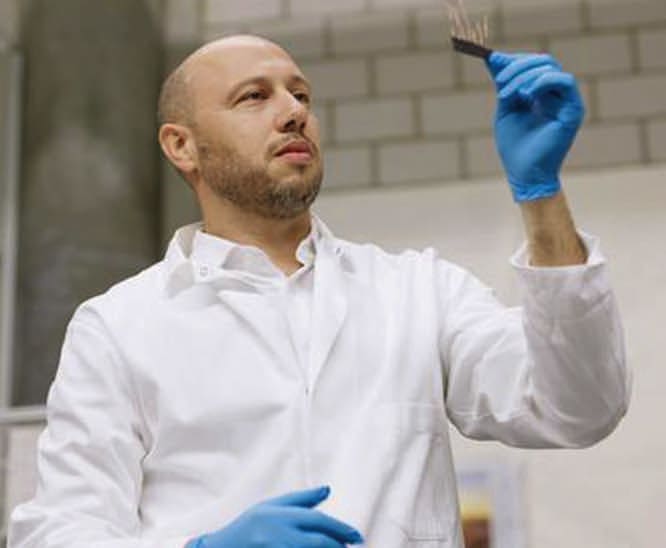
Andreas Kourouklis, ETH Zurich researcher and engineer, is working to soon make this problem a thing of the past. With the support of ETH Zurich Professor Edoardo Mazza and physicians from the German Heart Centre in Berlin, Kourouklis has developed a new cable system for heart pumps that doesn’t cause infections. This is particularly important given that wireless methods of transmitting power remain unavailable to patients in the foreseeable future.
Scar tissue with a limited blood supply forms around the exit point. This not only impairs the skin’s ability to heal itself but also increases the risk of infection. Since the outer layers of the skin are wounded and loosely attached to the flat surface of the thick cable, they grow in downwards. As a result, bacteria can travel from the surface of the skin into deeper tissue layers, often leading to patients having to struggle with infections and rehospitalization.
Instead of powering the heart pump via a thick cable that is much stiffer than human skin, they use several thin and flexible wires with a rough, irregular surface. Kourouklis and his team compare their approach with the way in which human hair breaks through the skin without causing infections: “More flexible wires whose surface is full of microscopic craters help the skin heal,” Kourouklis said.
To create craters on the cables’ surface, a team of engineers led by Kourouklis and Mazza have developed a new process that allows the creation of very small, irregular patterns on surfaces that are not flat — something that had not been possible before.
This method, which is currently patented at ETH Zurich, entails coating the flexible cables with a thin silicone layer and cooling them to minus 20 °C. The surface of the cables thus becomes malleable. They are then put into a condensation chamber, where small droplets of water are pressed into the liquid layer of silicone, creating microscopic craters. “We can control the position of the craters on the cables by adjusting the humidity and temperature in the condensation chamber,” Kourouklis said.
The challenge here is that the craters can’t be too large or too small: if they’re too large, bacteria may settle in them and the risk of infection increases; if they’re too small, the skin does not adhere to them and grows inward — in which case the risk of infection also increases. A classic optimization problem overcome by means of computational and experimental methods in tissue biomechanics and biomaterials.
Kourouklis and his colleagues carried out initial tests on skin cell cultures before implanting both the old and thick cables and their new cable system in a sheep. The results make the ETH Zurich researcher optimistic: while the thick cables with a flat surface caused severe inflammation, the thin, flexible cables only showed mild inflammatory reactions. No sheep suffered permanent injuries during the tests.
For more information, contact Peter Rueegg at











