

Unmanned Aerial Vehicles & Systems - August 2024
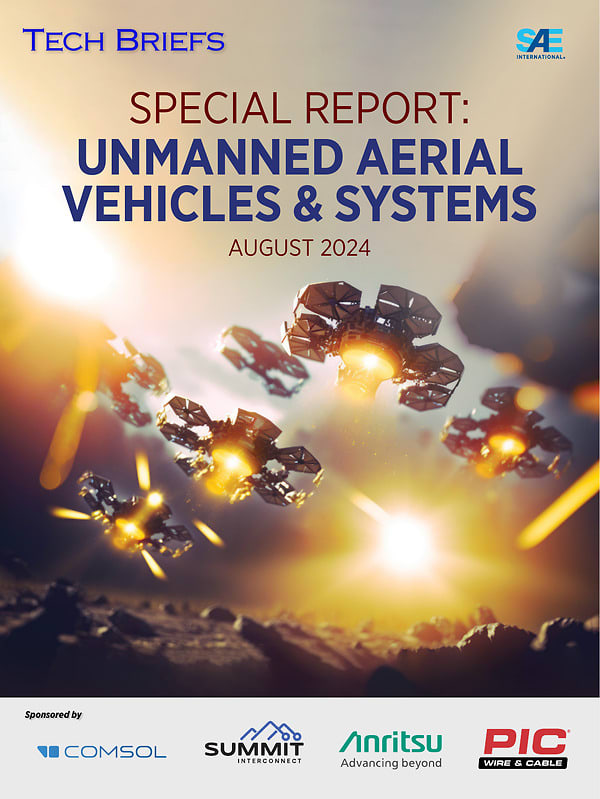
U.S. Department of Defense to release thousands of low‐cost autonomous UAVs…manned‐unmanned aircraft swarming and synchronized flying demonstrated for the first time…new counter‐drone strategies for military and civil missions. Read about these and other developments in this compendium of articles from the editors of Tech Briefs and Aerospace & Defense Technology magazines.
Don't have an account?
Overview
The August 2024 Special Report on Unmanned Aerial Vehicles & Systems provides a comprehensive overview of the latest advancements and applications in drone technology, particularly in military and civil contexts. The report is structured into several key features and tech briefs that highlight the evolving landscape of unmanned aerial systems (UAS).
One of the primary features discusses the increasing importance of Counter Unmanned Aircraft Systems (CUAS) in modern warfare. As geopolitical conflicts escalate, such as the ongoing war between Ukraine and Russia, the demand for effective CUAS technology has surged. These systems are designed to detect, disrupt, disarm, and defeat airborne threats, reflecting the critical role drones play in contemporary military operations.
Another significant highlight is the U.S. Department of Defense's new "Replicator" program, which aims to deploy thousands of low-cost autonomous systems. This initiative is part of a broader strategy to enhance military capabilities through the use of swarms of drones, which can operate in coordinated formations to achieve various mission objectives. The report emphasizes the potential of these low-cost systems to transform military operations by providing scalable and flexible solutions.
The report also delves into advances in multi-UAV operations, including manned-unmanned teaming, swarming, and synchronized flying. These technologies enable a single operator to manage a large number of drones simultaneously, significantly increasing operational efficiency. Research from Oregon State University indicates that one person can supervise a swarm of over 100 autonomous vehicles without experiencing excessive workload, showcasing the potential for streamlined operations in complex environments.
In the tech briefs section, several innovative developments are highlighted. For instance, a new algorithm has been created to prevent midair collisions between drones, enhancing safety during operations. Additionally, advancements in AI are enabling drones to navigate unseen environments using liquid neural networks, which improve their ability to operate in challenging conditions.
The report also addresses the application of drones in search and rescue operations following natural disasters. While drones are commonly used to assess damage from above, their current designs often limit their ability to navigate through collapsed structures. Researchers are exploring ways to enhance the resilience of drone designs to withstand collisions, thereby improving their effectiveness in disaster response scenarios.
Furthermore, the report discusses an innovative AI approach that utilizes natural-language models to reconstruct data from sparse sensor inputs. This method has broad applications across various fields, including industry, science, and medicine, demonstrating the versatility of AI in enhancing drone capabilities.
Overall, the Special Report on Unmanned Aerial Vehicles & Systems provides valuable insights into the current state and future potential of drone technology. It highlights the critical role of UAVs in military operations, the advancements in autonomous systems, and the innovative research that continues to push the boundaries of what drones can achieve. As the technology evolves, it is clear that unmanned aerial systems will play an increasingly vital role in both military and civilian applications.







